the 10th arrondissement

Paris Neighborhood Guide: the 10th Arrondissement

Ah, le dixième. One of my favorite Parisian neighborhoods (after my beloved Montmartre, of course), you’ll often find me there on a given weekend. It’s one of the least “touristy” areas in the city — I lived in Paris for a full six months as a student back in 2012 and never even knew it existed — and I love spending time in these small pockets of unspoiled places in Paris. Well, maybe not completely unspoiled but you get the idea.

And while I’d love to keep the 10th arrondissement all to myself, I’m no gatekeeper. For those of you coming to Paris to visit, or maybe Paris residents who, like me in 2012, never ventured up to the tenth, here are some spots to add to your to-see lists.

Les Gares

The Gare du Nord and Gare de l’Est aren’t necessarily “sights to see,” but they are in the 10th arrondissement and you’ll likely need to access them at some point if you plan on doing some traveling. 

Both are known as being on the “sketchy” side but I have never personally had any issues there. Pay attention and keep your belongings close and you shouldn’t have a problem. Gare du Nord will get you to places in northern Europe (as well as merry old England) and Gare de L’Est will get you to places in eastern Europe (and beyond), respectfully. 

Le Canal Saint Martin

If you have spent time in the 10th arrondissement, I’m willing to bet it was along the Canal Saint Martin. This little waterway that flows from Bastille all the way up to La Villette in the 19th arrondissement has often been a sanctuary for me, particularly on those sweltering August nights, as the leaves begin to fall in autumn, and even during a drizzle in the colder months. 

When the weather cooperates, there are plenty of places to sit down next to the canal with a good book. If you don’t feel the need to be directly on the canal, there’s a lovely park called the Jardin Villemin with lots of grass to sit on. 

My yoga studio is along the canal (Jivamukti Yoga Paris if you’re interested), and I will often make the 40-minute walk from my place in the 18th arrondissement to get there. 

The bar Le Comptoir Général is a vibe and is my go-to when I want to impress friends in town visiting. Chez Prune is a bit more on the casual side (and more authentically French, in my opinion), and I’ve shared many a glass of wine/charcuterie board there over the years. Ten Belles for coffee, always, and Maria Belza for tapas. Trust me.

For those who love a good story, the Canal was also where Earful Tower host Oliver Gee heard the story that led to his first children’s book, Kylie the Crocodile in Paris. It makes a fun gift for kids who might be interested in the City of Light.

Le Marché Saint-Quentin

There are a myriad of marchés (markets) to be found in Paris — some are static, like the rue Mouffetard or le marché des Enfants-Rouges, while others set up shop just a few times a week.

Like le marché des Enfants-Rouges, le marché Saint-Quentin is a covered market. It’s one of the largest and oldest markets of its kind in the city (first built in 1835, destroyed in 1852, and rebuilt in 1866), and is home to produce sellers, butchers, florists, fishmongers, cheesemongers…there are even places to buy beer and wine. 

While this isn’t my favorite marché in the city (I have a penchant for rue Mouffetard myself), it’s worth a visit if you get there early enough to beat the crowds. Doors open at 8am every day.

Cour des Petites Écuries

The 10th arrondissement is not short on nightlife. I like places that are cool and cozy with a big enough terrasse to fit me and all of my friends. I first started hanging out on the cour des Petites Écuries because a friend of mine worked at a small bar there. That was about five years ago and I often find myself returning on a Thursday or Friday evening.

The street is tiny, only about 850 feet long. Nestled along the cobblestones are about a dozen cafés, bars, and restaurants to discover. And, if you venture off the street you’ll find dozens more. It’s a good option if you like to bar-hop and wander. Most places are very affordable if you’re on a budget. 

Like most Parisian neighborhoods, the 10th arrondissement is also a wonderful place for a stroll. Use the places I mentioned above as a jumping-off point and then explore on your own. You just may get lost for a few hours, but that’s never a bad thing in Paris.

Photo by Florencia Potter on Pexels

Did you enjoy this article? TAIP is 100% reader-supported through tipping. If you want to leave us a tip of any amount it would be highly appreciated. These tips help support our efforts to keep TAIP an ad-free environment. Just as at a cafe, the tips are split evenly among the team.

montmartre

Why I Love Living in Montmartre

I’ve lived in several different places in the Greater Paris Area since I began my French séjour. After close to eight years abroad, I’ve moved five times. Before that, when I was still living in the US I moved six times in just four years — blame it on student housing and summer rentals in a small village by the sea.

When I was an au pair I lived in the chic suburb of Les Vesinet. Then I finally broke the pérephérique (the pseudo freeway-cum-border that surrounds Paris) and moved to the 16th arrondissement. From there, I headed back out to the suburbs to Nogent-sur-Marne where my in-laws live. Next, Montreuil, the up-and-coming suburb that also has access to the métro.

Suffice it to say, I’m tired of moving and I hope to never do it again (kidding, but not really). Luckily, I now live in what I consider to be the best neighborhood in Paris: Montmartre in the 18th arrondissement.

The Architecture

I walk out of my door and take a quick left to climb the hill to head to the Sacré-Cœur Basilica, which just happens to be a few minutes’ walk from my place. On my way, I decide to take the Rue Caulaincourt to get there. It’s springtime so the wide avenue is shaded by lush trees that I take a moment to look up at as I pass by. Something so simple as watching the leaves blow in the trees instantly becomes special when you’re walking through Paris, doesn’t it?

The buildings in the area are a mixture — the 18th 19th, 20th, and 21st centuries come together to form the hodgepodge that is Montmartre. My building was built in 1881. The Lapin Agile, a bar where Picasso used to hang, is just around the corner and was built in 1795. The Sacré-Cœur? Construction finished in 1891. 

There are cafés on every corner (obviously, it’s Paris) and each one is just as unique on the outside as it is on the inside. Okay, I’m exaggerating a bit but I’ve personally never met a Parisian café I didn’t like. Even if it did look the same as the one next door.

The Food

Speaking of cafés, there is no shortage of restaurants to try in the 18th. My local hangout is Georgia Love on Rue Caulaincourt. You’ll catch me and my husband on their terrasse 1-2 times per week.

A little further down the hill is the Boulangerie du Square, where I pick up my daily baguette fix — if there isn’t an insane line at Maison Landemaine, I’ll pick up a sandwich there. For my fresh fruits and veg, Rue du Poteau has several outdoor markets to explore, as well as a cheese shop aptly called La Fromagerie de Montmartre. There are also several butchers, and a Monoprix in case I need other essentials.

If you climb back up the hill to the Sacré-Cœur, there are even more eateries to try. For an authentic French experience, head to Le Miroir on Rue des Martyrs. If you’re craving good Italian (yes, it’s possible in Paris), visit Constantia Martyrs, also on Rue des Martyrs. For the best Mexican I’ve ever tasted in France, ACÀ on Boulevard de Clichy is always a good idea.

The Vibe

The mood, the atmosphere, the vibe. Different words for the same thing: The feeling that I get when I’m wandering the streets of Montmartre is unlike anything I’ve ever felt elsewhere. From the first moment I visited the area, something just seemed right. I was home. 

Considering my background, it makes sense. Montmartre was once (and some argue, still is) the artists’ quarter of Paris. Along with Montparnasse, the best and the brightest once lived here. Picasso, van Gogh, Verlaine, Renoir, Modigliani…I could go on and on. 

It makes sense. I’m a writer at heart and that heart seeks out places where those who came before me once lived. The reason why I feel so at home here is because it’s the perfect place to sit with myself and create. The architecture and food help, but the vibe is what makes it so unique. That ephemeral, impossible-to-articulate sensation that I feel as I climb the winding streets up to one of the highest points in the city is so difficult to communicate that I can only say this: You have to experience it yourself to understand. 

And I sincerely hope that each and every one of you does, one day.

Photo by Bastien Nvs on Unsplash

Did you enjoy this article? TAIP is 100% reader-supported through tipping. If you want to leave us a tip of any amount it would be highly appreciated. These tips help support our efforts to keep TAIP an ad-free environment. Just as at a cafe, the tips are split evenly among the team.

We Wrote a Book, Part II: Publishing

When Stephen first asked me to come on board as a guest writer for The American in Paris I was thrilled — I had long wished for a space where I could speak about my experiences as an expat in France. 

I wrote my first few articles and the feedback we received helped us realize there was a need for more information on getting the student visa, au pair visa, and APS visa, all of which I’ve successfully applied for and received. 

The more we worked together the more we realized the need for a manual — or a guide, really — for Americans who were interested in moving to France from the United States. We did it ourselves (as did our other co-author Gracie Bialecki) and we wanted to help others with the process. Stephen mentioned it before and I’ll say it again: it’s the book that we wish we had at the start of our journeys

What started with an idea to create a 29-day email autoresponder morphed into something much larger: we decided to create an actual paperback book and ebook version to go along with it. We knew that it could potentially help a lot of people and were prepared for the amount of work it would take to get it published. 

Famous last words. At the beginning of our publishing journey, I did a quick Google search: how to self-publish. A slew of articles came up and I skimmed a few. All of them said how easy it would be. I quickly let Stephen and Gracie know that I would be happy to take care of the publishing process myself — I had just opened my native English creative boutique Plume and I was eager to get some publishing experience under my belt. I tend to be optimistic when starting a new project. My motto: How hard could it be?

Well, it turns out a lot harder than you would think! I want to preface this by saying that I am so grateful for the opportunity to be an actual published-in-print writer and I am thrilled with how everything came out. That said, something that I figured would take me ten hours tops ended up taking double, even triple the amount of time.

Figuring out margins, bleed, what quality printing we wanted to go with, page numbers, and crafting areas to take notes inside the book was a long and arduous process. I tried and tried and tried again, uploading manuscript after manuscript into the self-publishing platform we used. After over a dozen attempts, success! Our manuscript was accepted and under review.

With the paperback version taken care of, it was time to figure out the ebook. Because the paperback manuscript was done and dusted this part of the publishing undertaking was a lot easier. That’s not to say that I didn’t spend at least an hour lining up the bullet points. Again, I want to express my gratitude for this project but, phew, who knew publishing could be so complicated? (Anyone in publishing who is reading this article is likely chuckling to themselves).

At this point, the email autoresponder was a piece of cake. Unsurprisingly, it was the easiest part of the project. That’s not to say that I didn’t have to test it out with several different services before finally settling on one that I liked. But, en fin, our project was ready to launch!

And here we are today. Stay tuned for more updates on our book and if you purchase it, please do let us know what you think. We’re so happy and honored to be able to help so many others make their I-want-to-move-to-France dreams come true, as we did.

Molli offers private consultation services which range from help with visas and adjusting to life abroad to Paris travel itineraries. Fill out the contact form to learn more.

Photo taken outside San Francisco Book Company near the Luxembourg Gardens, after we (finally) got our approved proofs back!

Did you enjoy this article? TAIP is 100% reader-supported through tipping. If you want to leave us a tip of any amount it would be highly appreciated. These tips help support our efforts to keep TAIP an ad-free environment. Just as at a cafe, the tips are split evenly among the team.

Marriage in France, Part II — Religious Ceremony and Reception

If you’ve been following along as I share more about the life I have created for myself in France, you know that I got married (civilly) last March. It was a major step in my personal life as well as my administrative life here in Paris. In the most literal sense, the French government has been very much involved in my relationship. If you’re not in an intercultural relationship like I am this may sound odd to you. For my fellow cross-continental couples, I’m sure you get it.

My now-husband and I had to make a lot of serious decisions somewhat early on in our relationship. When my student visa was about to expire, we had to decide whether we were “for real” or not. We always knew that we didn’t want to do long distance for a variety of reasons. In order for us to be able to legally live in the same place, I needed to figure out my visa situation. 

We decided to get married: we loved each other and knew we wanted to stay together forever. It would also enable me to get the vie privée et familiale (VPF) visa, which would allow me to live and work in France. Eventually, I do plan on getting French nationality, but it’s a long process that I’m not quite ready to embark on just yet. 

You can read all about how to get married civilly in France in the article linked above, so I’ll give you the TL;DR version: you have to gather a lot of paperwork, head to your local town or city hall (la mairie), make your case, and then attend the actual ceremony. It lasts around 20 minutes and it’s legally required in France. Anyone and everyone can also have a religious ceremony if they like, but the marriage won’t be recognized by the state unless you also do the civil ceremony. In fact, you need that marriage certificate to start the religious marriage process (more on that later). 

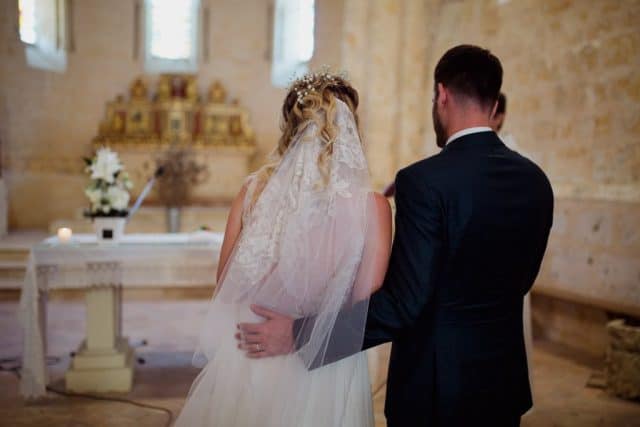
We always knew that we wanted to have a religious ceremony to celebrate our marriage, but with the last few years of lockdowns and border restrictions, it wasn’t possible for my American friends and family to come to France. After two long years of waiting, I got married in the Catholic Church and had a reception with loved ones on June 4, 2022. I wanted to share the process, and what it was like to bring my two (very separate) lives together at the reception. 

As a note, the information I’ll be providing is for a Catholic wedding between an American and French person. Other religions or nationalities may require different documents and processes.

Documents You’ll Need

So, you thought the document-gathering process was over after the civil ceremony? I hate to burst your bubble, but nope. Luckily, most of the documents required are the same so you shouldn’t have to do much hunting. That said, you will need to provide a few more specific pieces of information before you get started:

For the American:

  • Passport
  • Birth certificate — it needs to be no less than three months old and you need an official apostille as well. Then, you’ll have to get it translated into French by a certified translator. 
  • Baptism certificate — again, officially translated.

For the French person:

  • Passport
  • Birth certificate — remember that it needs to be no less than three months old.
  • Baptism certificate 

You also need to provide your marriage certificate. This is why it’s essential to get married at the town hall before the church. Most people don’t wait over a year to do it as I did, but many do at least a few months before. My in-laws actually did the civil ceremony the same day as the religious one. I suggest that you give yourself at least a few weeks between the two as otherwise, you’ll be setting yourself up for a very long and stressful day. The marriage certificate is the last piece of the puzzle that you’ll need on the actual day of the religious ceremony, and so most parishes are used to receiving this part of your dossier last.

One hiccup that I hit when gathering my paperwork was that I was under the impression that only one of us needed to provide a baptism certificate in order to get married in the Catholic Church. Although I am baptized, I figured it would be one less thing to get translated so I was happy about that. The church where we got married insisted that BOTH my husband and I show proof of baptism for reasons that are still unclear to me. Maybe they just wanted to see what an American baptism certificate looked like? Who knows, but I complied. 

Going Through Pre-Cana

Pre-Cana is the preparation process required by the Catholic Church in order to get married. In French, they simply refer to it as the préparation du mariage. It is a long and at times arduous procedure but overall we both really enjoyed it. We were also sponsored by a couple in the church, who happened to be my sister-in-law’s in-laws which made me feel really comfortable. 

We were required to attend four meetings:

  1. First meeting — a few hours long presentation on the four pillars of marriage. This was by far the largest and the longest meeting we attended. Between 15-20 other couples were there with us.
  2. Second meeting — a more intimate meeting between our sponsors and three other couples. We had to do it over Zoom for health concern reasons, unfortunately.
  3. Third meeting — another intimate meeting with our sponsors and our fellow couples. Again, it was done via Zoom but normally these rendez-vous are conducted in person.
  4. Fourth meeting — we were back with the large group for the last meeting. A priest was present and he spoke more about the four pillars of marriage.

We also had to meet with the priest who was going to marry us. My husband is quite close with the priest that he grew up going to Mass with and it was really important to him that he marry us. He happily obliged (I really appreciate this priest so I was thrilled as well) and it was decided, he would be there to consecrate our union.

This part was really fun: we traveled down to Lyon where Father lives and stayed with him in the rectory for the weekend. We got our own private room and we shared our meals with the other priests that live there. We also got to explore a new city, one that is lovingly referred to as the Gastronomy Capital of France. Needless to say, it was a great weekend.

Father also worked with us on our lettre d’intention (letter of intention), another essential part of Pre-Cana. I wrote one addressed to my husband and he did the same for me. Inside, we shared our expectations of our union: our hopes and dreams, how we want to raise our children, and what the four pillars of marriage mean to us. It’s private and to be shared only with the couple and the priest. It’s actually legally required for a religious ceremony, but it also holds a lot of sentimental value. We would have written them even if it wasn’t mandatory.

Once you’ve gone through Pre-Cana, the priest marrying you will take care of the rest. He will need to send off your completed dossier to the diocese where you live as well as to the parish where you plan to get married so that it can be verified. You’ll sign another (religious) marriage certificate on the day of your wedding, in front of your friends and family.

Bringing My Two Worlds Together

As I mentioned, we were forced to wait a year and a half after our civil ceremony to get married in the church. I say “forced,” but it was really because my American loved ones weren’t legally allowed to enter France for many years due to border restrictions. As soon as the borders opened back up we jumped back into planning mode: the wedding was on!

Logistically, bringing 30 Americans (who are scattered across the US) over to France was easier said than done. I didn’t get married in Paris, but rather ​​in Mouthiers-sur-Boëme in the Charente department. If you’re familiar with the area, the closest “big city” is Angoulême. It’s a beautiful area (my husband grew up there), but it also meant having to guide folks from the CDG airport, down to Montparnasse station, and then on to Angoulême. Yeah. Easier said than done.

No matter how difficult and stressful the whole thing was, being able to share this day with everyone who mattered to us was one of the most special moments I’ve ever experienced. It was a rollercoaster of emotions: stress (so real I have to say it twice), joy, surprise, grief (for those who weren’t there), relief, comfort, and of course, love. 

I never thought I would see everyone I love gathered in the same place; they traveled across continents and oceans and time zones just to be there for me and my husband. It was a lot of work to make it happen, but I don’t regret a single second of it. 

Now, I’m starting a new phase of my life in France and to that I say, bring it on.

Molli offers private consultation services which range from help with visas and adjusting to life abroad to Paris travel itineraries. Fill out the contact form to learn more.

Photo from Molli’s wedding taken by the talented Pauline Maroussia P.

Did you enjoy this article? TAIP is 100% reader-supported through tipping. If you want to leave us a tip of any amount it would be highly appreciated. These tips help support our efforts to keep TAIP an ad-free environment. Just as at a cafe, the tips are split evenly among the team.
Marriage in France, Part I — Civil Ceremony

In March of last year, I officially became Madame. When I first came back to France to live, I never thought that just 7 years later I would be a married woman. Being in an intercultural relationship meant that my now-husband and I had to have a lot of serious conversations early on in our relationship. About three years in, I was coming to the end of my student visa, which meant I had to either leave France or figure out another way to legally stay here.  

After a lot of late-night talks, we decided to get married. It may not sound very romantic, but it was! If you want I can get super corny and say that it was love at first sight (it was) but I’ll refrain. 

Like any administrative task in France, getting married involves a lot of paperwork, and slightly more if you’re not French like me. And, yes, getting married can be considered an administrative task here. If you find yourself in the same situation as I did — an American marrying a French person — then you may find this article helpful.

Documents You’ll Need

The first step is to determine where you want to get married. Most people choose their local town hall (Mairie in French), however, it is possible to get married elsewhere — for example, my husband and I had our ceremony in the suburb where his parents live. 

The town hall that you choose is important as in order to get married you’ll be required to show proof of address. While there is no hard and fast rule that states that you must be married where you live, you may raise suspicions of a “mariage blanc” (the French version of a “green card marriage”) if you choose an obscure town that neither you nor your future spouse has ties to. 

In true French fashion, now you need to start gathering paperwork. But, before you do that, you’ll have to go to the town hall of your choice to make an appointment to drop off your file. Simply tell the person at the front desk that you want to get married there and that you’re ready to make an appointment to drop off your dossier, which is the French term for the pile of paperwork you’ll need to produce. They will give you a list of everything that you need. Be sure to include:

For the American:

  • Passport
  • Birth certificate — issued no more than three months before you drop off your paperwork. Remember to ask your town or city hall to include the apostille (here’s where I made a huge mistake — I forgot to ask for the apostille and it set me back at least a month!). You’ll also need to have your birth certificate and apostille officially translated into French.
  • Proof of address
  • Proof that you are not currently married — this document technically doesn’t exist in the United States, but you can find the equivalent on the US Embassy website here. I was not required to have my signature notarized, but you may be depending on the town hall. Follow the instructions on the page above if that is the case.

For the French person:

  • French ID card or passport
  • Birth certificate — issued no more than three months before you drop off your paperwork. This can be found in the town hall where your Frenchie was born.
  • Proof of address

You’ll also need to bring information about your witnesses. I personally had one witness and my husband had two. On a piece of paper, simply write down their names, birth dates, where they were born, current address, and profession. You’ll also need a copy of their IDs.

The Waiting Game

When you go to the town hall to drop off your paperwork, the person working there will sit down with you and your future spouse to make sure that you have everything you need. If everything checks out, you’ll be able to pick your tentative wedding date then and there! 

Once you’ve picked your date, you’ll have to wait at least a week for the town hall to double-check that you have all of the correct paperwork. I mentioned above that you’re allowed to choose a tentative wedding date as it can’t be confirmed until the mayor, or assistant mayor has gone over your file him or herself and signs off on it. 

Don’t be afraid to call the town hall if you haven’t heard back from them within a week’s time. We hadn’t heard anything ten days after we dropped our file off and so my husband called them to see what was going on. Again, in true French fashion, they had simply forgotten to call and tell us that we were all set. The longer you live in France, the more you’ll realize that a lot of administrative tasks involve patience and a little bit of pushiness. 

On the Day of the Wedding

The big day. Congratulations, your relationship is about to be officially recognized by France. On the day of the ceremony, you won’t have to worry about bringing any paperwork as all of that is already taken care of. You just need to show up with your future spouse, witnesses, friends, and family. 

The ceremony itself isn’t usually longer than 20 minutes. The assistant mayor (or mayor, if you’re lucky) will make a speech. Then, he or she will ask you and your future spouse if you consent to marry each other. After a few ouis, the newlyweds and the witnesses sign the marriage certificate. Then the fun can begin.

A Note on the “Wedding Contract”

As you do your research on what you need to get married in France, you’ll likely come across the words contrat de mariage or a certificat de notaire. If you don’t plan on drawing up a prenuptial agreement (or, at least, the French equivalent), then don’t worry about any of that. You are not required to have a wedding contract, but if you’re interested in one, you’ll have to talk to a certified notary. 

Molli offers private consultation services which range from help with visas and adjusting to life abroad to Paris travel itineraries. Fill out the contact form to learn more.

Photo by Yan Berthemy on Unsplash

Did you enjoy this article? TAIP is 100% reader-supported through tipping. If you want to leave us a tip of any amount it would be highly appreciated. These tips help support our efforts to keep TAIP an ad-free environment. Just as at a cafe, the tips are split evenly among the team.

​​How to Get the APS (Autorisation Provisioire de Séjour) Visa in France

When I first came to live in France in 2014, I originally planned on staying for one year as an au pair. One year quickly turned into 2.5 years with the same family, which turned into three more years at a French university. The first was an intensive 20-hour per week program to learn French, and the last two years were to complete my master’s degree

At that point, I knew that I wanted to stay in France for the long haul, but I was at a loss as to how to do so legally. I didn’t want to be a student anymore, but I also didn’t have any major job opportunities lined up yet, at least, not with a company willing to sponsor a work visa for me.

Enter: the Autorisation Provisioire de Séjour (APS) visa. This type of visa is basically an extension of a student visa after obtaining a higher education diploma. In other words, the perfect visa for someone like me! 

Requirements to obtain an APS visa

The APS visa allows foreign students in France to stay in the country for one year after they graduate for a variety of different reasons. If you’re granted the visa, you have all of the rights that you had as a student, which means you can keep that student job of yours in the meantime as well!

Here are the requirements to obtain an APS visa:

  • Graduated with a licence professionelle (an undergraduate degree)
  • Graduated with a master’s degree, or equivalent. This can include an engineering, political science, or accounting degree
  • Graduated with an undergraduate or master’s degree with the desire to open your own company in France

How to apply for an APS visa

There are two situations in which you can apply for an APS visa:

  • You need an extension on your student visa to finish your final exams
  • You need an extension on your student visa after you have already passed your final exams

You can apply for an APS visa with your local prefecture. As usual, you’ll have to come prepared with a pile of paperwork. 

If you need an extension to finish your final exams, get in touch with the prefecture at least 15 days before your visa expires. This type of extension is free. You’ll need to physically go to the prefecture with the following documents (don’t forget to make copies, too):

  • Official letter from your university stating the date of your final exams
  • Your passport
  • Your residence permit (carte de séjour — étudiant)
  • Proof of address less than three months old

If all goes well you’ll receive a récépissé de prolongation de droit au séjour en qualité d’étudiant, which will give you the right to stay in France until you’ve finished your exams. As a note, if you want to stay even longer once you’ve obtained your degree, you’ll have to follow the procedure below.

If you need an extension to look for a job after you’ve obtained your degree OR you want to open your own company in France, you also need to physically go to the prefecture before your visa expires. This type of extension costs 75 € in “timbres fiscaux.” You know what that is if you already have a visa to be in France. Bring the following documents (and those copies!):

  • Your passport 
  • Your residence permit (carte de séjour — étudiant)
  • Proof of address less than three months old
  • 3 photos
  • Your diploma
  • Proof of health insurance
  • If you hope to open a company in France, a business plan

If you have all of the correct documents, you’ll receive a récépissé while the prefecture goes over your application. If you’re approved, you’ll be called back to the prefecture to pick up your new APS visa!

What to do when your APS visa expires

When your APS visa expires and you’ve either obtained a job or created a French company, you’ll have to change your status and ask for a new residence permit. Here is what you’ll need to have accomplished in order to change your status and stay in France for even longer:

  • If you’ve landed a CDD (a contract for a set amount of time, for example, six months or one year) or CDI (a contract for an indefinite amount of time, also known as the Holy Grail in France), it must be validated by the DIRECCTE (Direction régionale des Entreprises, de la Concurrence, de la Consommation, du Travail et de l’Emploi Regional Department of Competition, Consumption, Work, and Employment). You also must earn 1.5 times the minimum wage per month. If you meet these requirements you can apply for a “temporary employee” resident permit.
  • If you’ve created your company and can prove its viability, you can apply for a “temporary freelance entrepreneur” residence permit or a multi-year “freelance entrepreneur talent passport” resident permit.
  • If you are a researcher and have landed a research gig, you can apply for a multi-year “researcher talent passport” resident permit.

It’s important to note that if you do land a job or your company takes off that you change your status as soon as possible. Don’t wait until your APS visa expires! And, of course, if you haven’t obtained a job or opened your would-be company, you must leave France. 

As for me, I was lucky in that I met my now-husband by the time my APS visa ran out and I was able to change my status thanks to my relationship with a French person. I didn’t find a job with the requirements above, but I did open my own small business in France and officially became an auto-entrepreneur. I’m not sure what I would have done if I hadn’t met my husband in the meantime, but believe me, I’m glad I did. The moral of the story is that if you have a desire to stay in France legally do some serious digging well before your current visa expires. There is usually a way to do so if you go through the correct processes and have a passion for paperwork.

Molli offers private consultation services which range from help with visas and adjusting to life abroad to Paris travel itineraries. Fill out the contact form to learn more.

Photo by Seyi Ariyo on Unsplash

Did you enjoy this article?  TAIP is 100% reader-supported through tipping.  If you want to leave us a tip of any amount it would be highly appreciated.  These tips help support our efforts to keep TAIP an ad-free environment.  Just as at a cafe, the tips are split evenly among the team.

An Expat Discussion of CSS vs Mutuelle

A note from the authors: In these articles, we (Molli — MS and Gracie — GB) have a conversation about a topic that’s familiar to both of us. In addition to providing information, our aim is to explore it from two different angles and give you a more in-depth view of the complexities of French life and the expat experience.  To get the most benefit, make sure you read our previous articles explaining CSS and mutuelles.

GB: Since moving to France, I’ve been both impressed and mystified by the French healthcare system. For a long time, I assumed everyone’s carte vitale was a magical debit card that paid all their medical expenses. Eventually, I learned that this isn’t the case and that many French people also have a mutuelle which acts as additional health insurance. My American perspective is to assume health care plans are linked to employers, so I figured a mutuelle had to come from a full-time job at a French company, and since I arrived in France on a specifically non-working visa, none of these options felt accessible to me. What were your first impressions of the French healthcare system, Molli? Did you have someone to help you avoid my misconceptions?

MS: I had a similar perspective as you! I think that in the U.S. there’s this big narrative around the fact that yes, health care is free in most other countries, but that it means low-quality care, long wait times, and old-fashioned hospitals and healthcare centers. I was also shocked to find out that the “free” health care so bragged about here isn’t actually free.

The first time I had to go to the doctor or hospital was when I was still an au pair. I cut my thumb on some broken glass and when the cut got infected my host dad took me to the hospital. I was pleasantly surprised at the normal wait times, friendly doctor, and standard hospital equipment that I was used to seeing in the US Yet another stereotype bit the dust that day. 

That said, one stereotype did come true that day, and it was the fact that health care here is extremely affordable albeit not free. You definitely don’t have to worry about going bankrupt if you end up in the emergency room and you don’t have a carte vitale, which I didn’t at the time. I was on some special au pair insurance that my host family had set me up with. If you’re wondering what a carte vitale is, think of it as a healthcare card similar to the insurance cards in the US. You use it at the doctor’s office, pharmacy when you pick up prescription drugs, and at the hospital. It also has your French social security number on it, as well as your name and picture.

I actually didn’t get my first carte vitale until I opened my auto-entreprise three years after I had been living in France. Interestingly enough, I should have been given one automatically when I began the intensive French language program I began after I decided to stop nannying, as all students are part of France’s social security system (which includes the carte vitale). But, in true French bureaucratic fashion, halfway into the school year I still wasn’t issued one. Luckily, I decided to start my auto-entreprise while I was still a student. 

I also had never heard of the concept of a mutuelle, and naively thought that I could go to any sort of doctor or specialist for free. I have since learned that if you have to go to the dentist, eye doctor, or physical therapist and you don’t have this extra coverage, things can get really expensive. Gracie, do you have extra coverage now that you understand the system better? And, speaking of which, when and how did you start to wrap your head around how everything works?

GB: Yes, I have extra coverage through complementaire sante sociale (CSS) in addition to a carte vitale. Having both of those together means the French government pays for most of my healthcare which makes me feel amazing and lucky. That said, it did take about a year and a half of filing paperwork and waiting to get the whole thing in place. And to qualify for a CSS, you have to be making very little money so I’m not sure if it will be a permanent solution, especially since you have to reapply each year. As with all French bureaucracy, they don’t make it easy. 

I started to wrap my head around how everything works after being in France for about two years.  I’d always assumed that I had to be a French citizen or have a more permanent visa (at the time all I had was a long-term visitor visa), but that wasn’t correct. France is actually fairly lenient about including immigrants in its healthcare system, and all you have to do is prove that you’re living in France in a “stable and regular manner.” This means you do not have to be born in France, married in France, or even working in France to register. It does mean you do have to have spent at least three months in the country and have a valid titre de séjour

This was one of those classic –– why didn’t anyone tell me this –– revelations. From there, I learned more from the assurance maladie office which told me I could apply for a permanent number and a carte vitale after I was PACSed and had a VPF visa. My primary care physician was also extremely helpful and advised me to apply for the CSS in the first place.

What about you — were there any specific moments or people who illuminated this process for you? And once you were in the French system, what made you decide to get additional coverage?

MS: It seems like I’ve had to just figure out everything as I go ever since I arrived in France. In all seriousness, when I was an au pair, my host family was very helpful, but almost too helpful because my host parents took care of almost everything for me, including a lot of paperwork. Once I became a student and was no longer living under their wing, a lot of things came as a shock and there was a massive learning curve!

I was really hesitant to get a mutuelle because up until very recently I had the mentality of “I’m healthy, I’m young, I’ll never have to go to the hospital, and I don’t want to spend the money on something I’ll never use.” And, until I was 26 and still under my parent’s insurance back in the States, I saved my yearly dentist and eye doctor appointments for when I went home to visit. 

My French mother-in-law actually pushed me to finally get a mutuelle. Since I’m turning 30 this year, it was about time, and ultimately I’m happy I took the plunge into the world of paying for my own healthcare. I pay around 30 € per month, and most of my prescription drugs are covered as well as the dentist and the ophthalmologist (I wear glasses and contacts). I have to admit, there’s something so sweet about going to the pharmacy and picking up medicine for free!

My last question for you about the CSS is, do you have the same coverage as someone like me who has a mutuelle? Or, are there things that I have access to and you don’t? 

GB: I’m pretty sure my CSS has the same coverage as a mutuelle, if not more. Although I haven’t taken it to every possible doctor, the documentation says it reimburses most glasses, prosthetics, and hearing aids, as well as all visits to the doctor, dentist, and hospital. I wear insoles and have been meaning to see my podiatrist about those, and I’m assuming that’s covered as well. I also have lofty ambitions to work with a kinesiologist and would love it if that was reimbursed since I know it’s only partially covered by the normal medical system. 

My admittedly American approach is to show up to any doctor, assume it will cost hundreds of euros, and be pleasantly surprised that it’s significantly cheaper than in the US. That said, the medical system here is much more transparent about costs –– all doctors post their fees on their website and in their offices, and they will explicitly tell you how much a procedure is and if you’ll be covered when discussing it with you. My dentist wanted to x-ray my teeth and told me it would only be partially reimbursed –– the x-rays cost 50 € and I’d get back 60%. The total cost was laughably small, especially since I used to pay $300 to have my teeth cleaned. That said, I’m grateful she had the conversation with me and wish the American medical system had the same transparency.

We hope this has been a helpful discussion of our experience with the French medical system. Feel free to comment with any questions or health insurance adventures of your own.

Photo by Marcelo Leal on Unsplash

Did you enjoy this article? TAIP is 100% reader-supported through tipping. If you want to leave us a tip of any amount it would be highly appreciated. These tips help support our efforts to keep TAIP an ad-free environment. Just as at a cafe, the tips are split evenly among the team.

How to Get a Mutuelle in France

When I first decided to start my life in France after years of being an au pair and a student, I started to hear talk of something called a mutuelle. I had already been enjoying the benefits of seriously discounted health care for years at this point, and I often relished the fact that my monthly prescriptions were only a few euros instead of upwards of $40 per month back in the states.

You may be thinking, “Huh? But I thought going to the doctor was free in France and so was all medicine.” Health care is much, much less expensive here than in the United States, but as they say, nothing in life is free. 

Why You Should Get a Mutuelle in France

If you’re a permanent resident of France, you’re eligible to receive government-provided health insurance within the first three months of being here. It works like a co-payment system, and much of your medical costs are reimbursed up front by the standard, public health insurance. For example, if you go to the doctor and you’re uninsured, you’ll pay around 25 € (still a steal, if you ask me). If you sign up for public health insurance, you’ll pay around seven euros. If you get a mutuelle (some call it “top-up” coverage in English) in France, you’ll pay nothing.

Having that extra coverage ensures that you don’t pay anything at the doctor’s office and most prescriptions are covered too. If you have to stay overnight at the hospital, depending on the plan that you choose, you won’t have to pay for that either. 

If you wear glasses or contacts or enjoy having clean teeth, you’ll want to sign up for one as well. I wear both glasses and contacts (and like keeping my pearly whites, well, white) and so my mutuelle is a lifesaver. I went from paying hundreds of dollars every year for my eyes to paying nothing.

I haven’t even begun to mention all of the other perks you could be enjoying if you sign up for your own mutuelle. Specialists such as dermatologists, chiropractors, and osteopaths are also covered (again, depending on your plan). Furthermore, you can sign up no matter your medical history and without fear that a preexisting condition will make the monthly free skyrocket. Oh, and if you’re pregnant or plan to be, a mutuelle is also really helpful.

Shout out to my French mother-in-law for pushing me to finally sign up. I think for me, seven euros to go to the doctor just seemed so sweet that I couldn’t imagine paying even less. My American mentality prevented me from signing up for a mutuelle for several years when in reality I could have started benefitting from one all the way back in 2012.

How to Know Which Plan to Choose

Not all mutuelles are created equal, but neither are everyone’s health care needs.  Stephen, for example, almost never goes to the doctor, so a mutuelle for him would be a waste of money. Furthermore, if you don’t have terrible eyesight as I do, you don’t need a plan that will help you save on glasses and contacts. 

When you begin shopping around for a plan, you’ll notice that coverage is determined in percentages. I recommend opting for coverage that is over 100%. Start with at least 150%. And if you have problems with your teeth or need to visit the eye doctor, consider going up to 175-200% coverage. I know that asking for over 100% coverage may sound a bit much, but some doctors charge more than the standard fee set out by the government. You’re going to want that extra coverage just in case you find yourself at a specialist (like the dentist, ophthalmologist, or chiropractor) that naturally charges more than your primary care physician. 

You’ll be charged a monthly fee in order to benefit from your mutuelle. The cost is nominal, especially when compared to the ever-climbing costs of private health insurance in the US. For example, my mutuelle is one step above the “basic” plan, and I pay around 30 € per month. There are several different providers to choose from:

Once you sign up, you’ll receive your mutuelle card. It’s not a plasticized card like your carte vitale (the card you use to benefit from the standard public health care), but rather a small piece of paper you’ll have to be careful not to lose.

My advice? Take your time when comparing plans, ask your French friends for advice, and don’t get too hung up on finding “expat” specific plans. If you are a resident of France, you have all of the rights of a French person. These so-called expat-specific plans tend to be much more expensive for no real reason that I can see. And, if you don’t earn a lot of money, you could be eligible for a state-run mutuelle program called the CSS, so, if you can, don’t forget to look into that option, either.

There are plenty of mutuelle comparison sites that can help you decide as well. This one by Le Comparateur Assurance (The Insurance Comparer — a great resource for comparing any type of insurance in France) is my favorite. However, I will say this again, your French friends will be your best asset here. They’ve had this type of insurance their whole lives and are the best place to start for some advice!

Photo by National Cancer Institute on Unsplash

Molli offers private consultation services which range from help with visas and adjusting to life abroad to Paris travel itineraries. Fill out the contact form to learn more.

Did you enjoy this article?  TAIP is 100% reader-supported through tipping.  If you want to leave us a tip of any amount it would be highly appreciated.  These tips help support our efforts to keep TAIP an ad-free environment.  Just as at a cafe, the tips are split evenly among the team.

How to Get a Long-Stay Visa for France Through French Lessons

While it would be nice if Americans were able to live in Europe visa-free, it’s not the case (one can dream that it will be someday, right?). If you’re from the US and want to live in a country like France for more than 90 days, you’ll need to apply for a long-stay visa (known as the VLS-TS) first.

If you don’t have family or a French spouse, there are (to really simplify things) two ways you can live in France legally as a non-European: through work or school. 

I’ve already touched on how to obtain a student visa for France, but this “hack” is for those of you who are more interested in improving your French skills rather than going to a university.

What Kind of French Classes Get You a Long-Stay Visa for France?

If you’re like me, you cringe at the thought of going back to school. Maybe you finished your undergraduate degree and thought to yourself “Never again!” Or, maybe you’ve gotten as far as your master’s or doctorate and there isn’t much university-level schooling out there for you. Or, hey, maybe after high school you decided to go straight to work.

As someone who never thought she would ever go back to school after my undergrad, I eventually did get my master’s degree here in France. But, that’s another story for another day. In between being an au pair and enrolling in my master’s program, I did one year of intensive French classes. And, those classes enabled me to get a long-stay visa for France.

For a bit of background, once I did ultimately decide to go for my master’s degree, I knew I needed to improve my French for a few different reasons. First of all, I wanted to be able to intelligently engage in a conversation with a French person. I also knew that in whatever master’s program I enrolled in, I would be required to understand, speak, and write at least basic French (a level I had not yet reached after living here as a nanny). Plus, if you want to go to a public French university as a foreigner, you need to prove that you have at least “B2” level French. 

B2 refers to a level in the “Common European Framework of Reference” (CEFR) scale for languages. It is used to assess people’s language levels and ranges from A1-C2. Here is a breakdown of the different levels for French:

  • A1: Beginner
  • A2: Elementary 
  • B1: Intermediate
  • B2: Fluent
  • C1: Advanced
  • C2: Bilingual

To be honest, whether or not you want to continue on to a master’s or doctorate program if you plan on living in France for an extended period of time, you should try to obtain at least a B2 level. 

The good news is, an intensive French language program will get you that student visa you’re after whatever level you’re at! Here is what is required:

Once you’ve found your dream program, you’ll have to go through the steps of applying for a student visa for French. I’ve mapped out everything you need to know here.

If you’re in Paris, I did the FETE program at Université Nanterre (yup, that Nanterre. Any other 20th-century history buffs out there?). It’s located just outside of the city to the west. I recommend it to anyone who is interested in improving their French. The classes are a mix of speaking and writing as well as cultural classes. Fieldtrips include visits to Parisian museums and landmarks, how cool is that? There is also a similar option at La Sorbonne

If you’re not in Paris, simply take a look at the list of FLE-accredited schools I linked above!

Some Things to Remember if You Want to Renew

If you plan on spending just one year in France and know that you won’t need to renew your visa, you can skip the next section.

If you already know that you’ll want to extend your time in France after one year, there are a few things to keep in mind:

  • You need to pass the school year in order to renew. That means you’ll have to take school seriously. Attend all of your classes and study for your tests. Stay on good terms with your professors as well.
  • Make sure you have a plan for what you want to do next. Do you want to continue with intensive French courses until you’ve achieved C2? Do you want to enroll in university? Remember, for the latter, you’ll need at least a B2 level.
  • Start gathering the paperwork you need to renew 4-5 months before the end of the school year. You’ll need to schedule your renewal appointment at least 3 months before your visa expires.
  • As a general note concerning all French visas: keep everything. That means bank statements, cell phone bills, copies of your lease, or a letter from the person who is housing you saying that they are housing you. You’ll need all of this plus proof that you passed the school year. 

Disclaimer: I’m not giving you permission to slack off or stop going to school if you don’t plan to renew your visa. My advice? Take advantage of the fact that you’re in France learning French. It’s the best way to learn a new language, and you’ll have the opportunity to speak French with actual French people. Don’t throw away an opportunity like that.

Molli offers private consultation services which range from help with visas and adjusting to life abroad to Paris travel itineraries. Fill out the contact form to learn more.

Photo by Faisal Waheed on Unsplash

Did you enjoy this article? TAIP is 100% reader-supported through tipping. If you want to leave us a tip of any amount it would be highly appreciated. These tips help support our efforts to keep TAIP an ad-free environment. Just as at a cafe, the tips are split evenly among the team.
How to Become an Auto-Entrepreneur in France

Many people dream of living and working in France, and while I was right there with you when I first got here, I know that I had a tendency to put the logistical side of everything on the back burner. Thinking about taxes and the like just didn’t fit into my Midnight in Paris vision of what I wanted my life to be like here. 

I was soon brought back down to reality when I finally got settled into my new post-master’s-degree life. I had already been in France for some time at that point, but I worked as an au pair (the family I worked for paid taxes on me), and after I was a full-time student (I traded English lessons for my apartment and took other odd jobs to make a little cash on the side). I knew I wanted to pursue freelance writing as a career, but I was unsure how to do so legally (plus how to get the benefits that I knew came from paying taxes here). 

I was soon introduced to the concept of the auto-entrepreneur. There is no literal translation for the term, but it should be understood as a one-person business. If you’ve also seen the term micro-entrepreneur floating around, it’s because in 2016 the French government officially changed the term from “auto” to micro-entrepreneur. However, although it’s been officially changed for five years now, most people continue to call it the latter and even the website you’ll use to open your business and pay your social charges features the word auto-entrepreneur. That’s France for you!

Similar to the 1040 freelancer tax status in the United States, opening your own one-person business is a great way to freelance legally in France. If you have a valid residence permit that permits you to work in France (sorry Visitor visa holders!), you’re eligible. When I got started myself, I found the process confusing and so I created this guide to help anyone else who may be in the same position.

Registering as an Auto-entrepreneur

I want to clarify one more time that the terms auto-entreprise and micro-entreprise are one and the same, and both signify a one-person business in France. Once you open your business, you become an auto, or micro, entrepreneur. There are a few different ways to open your business:

  • In-person, at the Centre de Formalités des Entreprises (CFE) closest to your residence (a quick Google search will help you determine which one).
  • By mail, but filling out the form on this website (click on accéder au formulaire) and sending it to the correct CFE.
  • Online, by visiting this website.

I recommend you do the online option unless you’re eager to practice your French or use your printer and pay for postage. Once you visit the website, follow these instructions:

  1. The first question is asking if you are already an “independent worker,” which is yet another term for auto-entrepreneur. You are allowed to have up to two small businesses, but if you’re reading this how-to article I’m assuming you don’t have one already! Check the box that says “non.” Then, click the button that says “déclarer mon auto-entreprise.” 
  2. You’ll be asked to create an account, which you’ll need to pay your social charges, and to have access to any sort of information related to your new small business. Fill in your personal information and then click on “créer mon compte.” You’ll have to confirm your email address and then sign in to your new account before you can move on to the next step.
  3. Once you’ve signed in, you’ll see a message at the top of the page asking you to complete the process to create your small business (Pour effectuer votre formalité…). Click on it.
  4. You can now finally get down to business. Fill in the necessary information, including what you plan on doing, when you want to start, and some other questions. The nice thing about the process (which didn’t exist when I opened my small business) is the small question marks next to each step that you can click on if you’re confused. 
  5. Below is a screenshot for reference, of what I would put if I were to sign up for a small business for freelance writing:
  6. Click on “Suivant.” Here, you’ll be required to fill in your personal information like your address, date of birth, and the like. You’ll also need to put your nationality, and here you’ll be prompted to put in your residency permit number.
  7. Click on “Suivant.” This next section has to do with your marital status and your monthly social charges. If you already have a social security number you can put it here, otherwise, click on the box that says “Ce numéro ne m’a jamais été attribué.” You’ll be able to choose the frequency of your social charge payments. I personally prefer monthly payments, but you can also opt to pay each trimester. There is also the option to pay your yearly taxes at the same time as your monthly social charges. Again, this is all preference! If you’d like to separate yourself legally from your business (similar to an LLC in the US), check “oui” next to the option to become an EIRL. 
  8. Click on “Suivant.” You’ll want to check “non” for the first question as you’re creating the business for yourself. Check “oui” for the second question, you’ll need the SIRENE for your future business dealings!
  9. Click on “Suivant.” You’ll be brought to a summary of all of the information that you’ve filled in so far. Review it and edit if necessary. 
  10. Click on “Suivant.” Here you’ll be required to upload a copy of your ID and your valid residency permit. This next part is a bit tedious, but you’ll have to scan and print out your documents and sign with the words, “J’atteste sur l’honneur que cette pièce d’identité est conforme à l’original,” Plus, “Fait à … le …” with your location as well as the date. Then, re-scan this document and upload it onto the site. Make sure you click on “Joindre le fichier” after you’ve selected the document from your computer. You should then see it below like this:
  11. Click on “Suivant.” You’ll be taken to a confirmation page with the option of downloading your application and I recommend that you do so for your own records! If you followed the steps above, you should receive a confirmation letter from INSEE, the institute responsible for managing all small businesses in France. In the letter is your SIRET, which is the ID number assigned to your business. You’ll be required to put that number on any invoices you send to your future clients!

Paying Your Social Charges as an Auto-entrepreneur

Now that you’ve set up your new small business in France the next step is to start working! I wanted to include a note on paying your charges. Whether you opt for monthly payments or each trimester, you need to stay on top of them to avoid paying late fees. You can use the same website that you used to create your business to tell the French government how much money you made and to pay the social charges based on how much you earned. 

  1. Sign in to your account. You’ll be brought to the homepage:
  2. Under “Déclarer et payer” click on “mes échéances en cours.” You’ll see a red “1” if you haven’t filled yours out yet (like me, as of writing this article!). Click on the month that you need to pay. Here you’ll fill out your earnings. There are different categories depending on what your small business does. If you offer a service, such as writing, put your income in the first box. If you make things, like pastries, for example, put how much you took in as a salary in the second box, and in the third box how much money you made from actually selling the pastries. 
  3. Click on “Suivant.” You’ll see here how much you owe the government. As a small business owner in France, you’re required to pay about 23% of your income to social charges. This is the price of advantages like low-cost health care and other such benefits. Click on “Valider” to confirm that you agree with the amount.
  4. Here you can enter your bank information if you haven’t already. I usually click on “Payer via ce mandat” right away so that it’s taken care of. You won’t see it deducted from your account until the beginning of the next month.

Congratulations, you’re officially a small business owner in France!

Molli offers private consultation services which range from help with visas and adjusting to life abroad to Paris travel itineraries. Fill out the contact form to learn more.

Did you enjoy this article? TAIP is 100% reader-supported through tipping. If you want to leave us a tip of any amount it would be highly appreciated. These tips help support our efforts to keep TAIP an ad-free environment. Just as at a cafe, the tips are split evenly among the team.