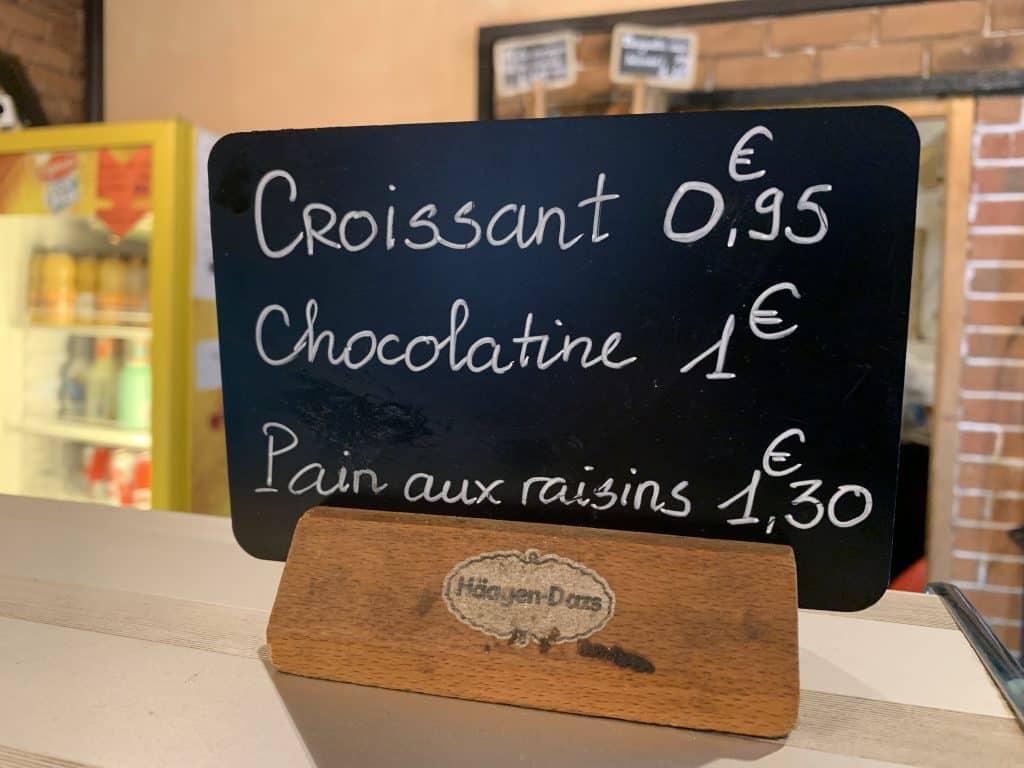
chocolatine

Boulangerie Basics

I can’t speak for every foreigner, but I can describe the feeling that most Americans have the first time we enter a French boulangerie of any size or reputation.

Wow.

Followed closely by that feeling of awe is the complete ignorance you feel about what to order.  Everyone in line with you seems to be on a mission.  The staff are patient, but not so patient for you to simply stare open-jawed indefinitely.  Where will I learn what to do and what to say?

Turns out, imitation works as a start.

It was maybe my second day in France as I stood in line and tentatively ordered, “une baguette, SVP.”  “Ça sera tout?” is the reply that is repeated, verbatim, by every person who works in any boulangerie in France.  I used to automatically answer “oui” but came to realize as years wore on that the French are giving you permission to change your mind.

Perhaps you only came in here to get a baguette or a pastry, but now confronted with the reality of the situation, you might add on another pastry, or another loaf, or perhaps another treat for later, for a friend of course.  Sometimes after this second or third choice there will be silence as they watch your eyes, which are in turn looking at choices.  Then an internal timer dings in their head and they repeat their default saying, “ça sera tout?”  If there are other staff they will already be helping the people behind you in line.

The imitation game picks up tricks rapidly.  You hear someone ask for a “demi-baguette” and watch one of the staff deftly slice one of the baguettes in half to what is a perfect size for a single person’s dinner accompaniment.  “une demi-baguette, SVP,” I say as if I’ve said that countless times in my life, and hand over exactly half the cost of the regular-priced baguette.  Baguettes were even price-controlled until 1986.  Much like rice in Asia, baguettes in France are still seen as a basic “right” of sorts and if prices rise they will usually be on other types of bread before hitting the rates for the baguette.

More imitation: I hear a gentleman ask for a baguette “bien cuite” and ask myself “a well-done baguette?”  I watch the lady shuffle through the baguettes on the shelf and pick one, holding it for inspection.  The gentleman wants a different one.  She finds one in the back and there it is: a well-done baguette means a bit more cooked, hence a bit darker on the outside and crunchier to the mouth.  You can go the opposite way too, by asking for a “blanche” baguette, though I’d never heard this ordered before I ordered one for a friend who I knew preferred them that way.

More imitation: Someone asks for a “tradition” and the lady reaches for something that looks like a baguette but has a slightly different shape and size.  I then order one and inspect and taste for differences.  They have pointier ends and are hand-formed and baked on premises.  By a 1993 law, a “baguette tradition” can only contain flour, leavening, water, and salt.  The “levain” is something like a sourdough starter but that sourdough taste doesn’t come through as strongly as Americans would expect from anything that has “sourdough” attached to it.

How many different ways can the French deliver such a great product, I thought as my imitation game became a knowledge game and I started to share with friends my fascination about how bakeries worked and how I was having to learn as an adult all the things French children know by the age of six.

There’s also the pain au chocolat/chocolatine “controversy,” if it can even be called that.  Anglophiles might be familiar with the differences between how Devon and Cornwall take their cream tea.  In Cornwall, you put jam on your scone first and follow with a spoonful of cream.  In Devon, on the other hand, cream goes on first, then a bit of jam on top.  It’s always amusing to watch English people argue about this difference as if there’s something genuinely at stake.  So too I’ve been amused to watch “chocolatine/pain au chocolat” square-offs.  The last time I witnessed one was near Montparnasse with a fiercely traditional Breton acquaintance, who rolled her eyes at the chocolatine “advocates” and even more so at the peacemaker who proposed “pain au chocolatine” as the compromise.  The divide can be seen down south at large chains like Paul which use “pain au chocolat” in areas where around them all the independent shops use “chocolatine.”  “It does sound a bit more ‘French,'” I noted to the opinionated Bretonne.  “What do you know?” she said in a (mostly friendly) huff.

What is more wonderful is to see the centuries-old tradition of baking and running a bakery at work in the present day.  Nothing is wasted.  The pastries that weren’t sold yesterday are sold at half price in groups of usually half a dozen.  Look for the plastic bags with pastries inside or ask if they are any “viennoiseries à l’ancienne.”  Any bread that is not sold and is on the way to going stale is then sliced up and put back into the oven to shrink into “biscotte” which are sold for (at the most) 75 centimes a bag and are a great accompaniment to soup or can be broken up to serve as croutons for soup or salad.  I’m certain there’s also a fair amount of trade in breadcrumbs to nearby restaurants that might need them.  There is waste that used to go to the poor or to the pigs in the old days, and some of that still goes to them, but with computers and spreadsheets showing historical demand, I think today’s boulangers have the opportunity to make less waste (and more profit) than their ancestors.  Whether they do or not can also depend on how seriously they take their craft.

When you’ve had hundreds of baguettes you finally start to know instinctively what the French know from their early childhood: the difference between real bakery bread and what is warmed up from frozen prep.  The shocking thing is in Paris quite a lot of baguettes are made from frozen, but that’s because the French people know it’s the lowest denominator of bread and in part are okay with that.  Unlike the “tradition” which is regulated by law as to ingredients and prep, baguettes are not and as such are just there at the very base of the bread pyramid, in a way.

This also means you can taste French supermarket bread for what it is: sad, tasteless, industrial lumps of sadness that would have blown your mind had it been served to you when you still lived in America and didn’t know what real bread could be like (that said, I know a lot of places in America are becoming real havens of true baking skills, but the reality in the heartland is still mostly inedible).

Does that mean you should always order a “tradition“?  It totally depends on you.  When you fall into the rhythms of your neighborhood and your own shopping routine, you will notice that people may skip the bakery next to their house and walk 200-300m to another bakery.  Why?  Perhaps they have a good relationship with the owner.  Perhaps that bakery makes the type of crust they really go for.  Or, in my case, they also make kouign-amanns on a regular basis (worth another article in itself!).

There’s even an importance to what time of the day you go to the bakery.  While Americans might balk at standing in line just to buy bread (even though they’ll happily sit in a drive-thru line for junk food), a line is indicative of usually the best time to get it before all you are left with is slim pickings.  The earlier you go, the better, though there’s a window around 16h00, known as “goûter,” when French kids might get a snack on the way home and fresh bread and pastries come out.  When you come late, you might have the “agony” of what happened to me the other night when the gentleman in front of me ordered the last “pavé,” (country white bread that is so called because it’s shaped like a paving stone) which is my personal favorite for my daily bread, and I had to pretend not to be disappointed as I ordered the sole remaining charpentier, but that’s the joke: a “disappointment” in a French bakery means instead of getting my preferred type of bread, I get another amazing type of loaf.  A charpentier has a beautiful color with a wonderful crust and is just as enjoyable as my usual pavé.

So, those are the basics.  First, start with the imitation game.  Listen to those ahead of you in line and order what they order.  When you get to the front of the queue everyone is going to be patient with you: don’t feel like you need to be in a rush.  Just make it clear that you are studying items rather than just staring off into space with no idea.  During this stage you’ve got nothing to lose since you know nothing and tasting is the best way to teach your palette.  Then as your imitation game becomes a knowledge game, actively try different items and different bakeries to expose yourself to everything your neighborhood has on offer.  Finally, resist routine.  All French people fall into this, but should you wish to be a lifelong learner of the absolute gift to civilization that French bread is, you need to keep trying different things and different bakeries.  You are going to turn into a bread snob, but what did you expect when you moved to France?

I took the photo in Toulouse in late 2020 when I excitedly ordered a “chocolatine” for the first time in my life. 🙂

Did you enjoy this article?  TAIP is 100% reader-supported through tipping.  If you want to leave us a tip of any amount it would be highly appreciated.  These tips help support our efforts to keep TAIP an ad-free environment.  Just like at a cafe, the tips are split evenly among the team.
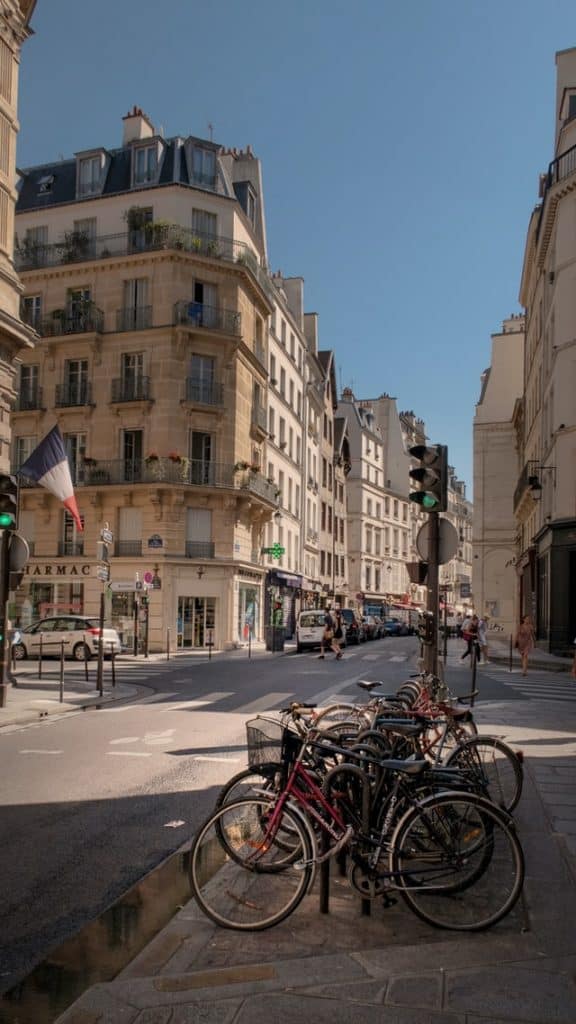
bikes in Paris

How Paris Quietly Became a Bike City

When I moved to Paris in 2013 one of the first things I did was obtain a Navigo card and after a couple of months of buying monthly passes manually via machines I switched to an annual pass and have not had to think about topping up again.  The métro was the way I moved about Paris.

But after getting to know the Métro fairly well you realize that it’s often just as easy to walk to a certain location and you start making choices about what form of transportation makes the most sense given the weather, your mood, what you’re carrying, and what else you still need to accomplish.  Vélib was already around when I arrived in 2013 and the shared bike boom followed by the rise in trottinette usage meant that options for transport have only multiplied since then.  The one form of transport that has received an explosive infusion of support from local government is bicycles.

Infrastructure

Now that bike lanes are so well-established in Paris, I wonder how so many of us were brave enough to ride with vehicle traffic for many years prior.  Cars and their drivers, convinced that everyone but them were simply “intruding” on their entitled space, didn’t make life easy for those of us on bicycles, but we figured that was simply the way it would be.  I mean, this wasn’t Amsterdam after all.  But little did most of us know that the Dutch model was exactly what Mayor Anne Hidalgo had in mind to transform Paris from the ground up.

Plan Vélo

Back in 2015, a year after Hidalgo’s first term began, the city started a project called Plan Vélo.  This was a big play to make it significantly easier for bicyclists to navigate the city by creating north-south and east-west réseaux express vélos (REVes), or “bike express lanes.”  Similar to what you are going to see on almost every street in the Netherlands, this is a protected bike lane that not only provides bidirectional traffic but also allows bikes to continue moving when their right-of-way is not impeded by traffic.  If you haven’t ridden in one of these before, you can’t possibly know how transformative it is.  It changes the experience of bicycling in the city from one analogous to driving a car, i.e. having to always pay attention while being subject to a lot of traffic and stoplights, to one of breezy insouciance: these north-south and east-west corridors make point-to-point travel significantly faster, safer, and more pleasant.

Plan Vélo has paid off in numerous ways, not least of which was featuring as the centerpiece of Hidalgo’s successful re-election bid as Mayor.  Paris jumped up into the top ten of bicycle-friendly cities in the world during her first term.  The infrastructure in place during the late 2019 transportation strike also allowed for an overnight 54% jump in bicycle use among Parisians, many of whom did not go back to the Metro even after the strike ceased.

Hidalgo also seized on Danton’s (in)famous notion of audacité during the early days of Covid-19 and took back Rue de Rivoli, the longest street in Paris, and limited it to one lane for buses and taxis.  She also created a number of “coronapistes” which created new protected bike lanes via removable plastic cones.  The reasoning given was that fewer cars were on the road because of lockdown and some people weren’t comfortable traveling in the confined spaces of the Métro.  But, just as with the accompanying “extended terrasse” permissions given to the restaurants, rights ceded were not going to simply be given back, and now Plan Velo 2 has arrived.

Plan Vélo, Acte 2

Part of the infrastructure changes needed to pérennisée both the so-called coronapistes and the extended restaurant outdoor terraces was the removal of the largest enemy of vibrant life in any city: cars.  Cars need a “home” in the form of parking places and 70% of the existing on-street parking spots designated for cars are being removed.

Hidalgo is running for President on the slimmest of chances and Plan Vélo Acte 2, released last month (two days before her announcement to run for President), has to be seen as part of her case for progressive measures to form economic and social life at a granular level.  The benefit is enormous for those of us who live in the city (Paris as 100% cyclable by 2026, it promises), but it’s doubtful that people outside of Paris really care, as life in the French countryside, like life almost everywhere in America, is unimaginable without cars.  Indeed, such denizens would snort at her proposed 2030 gas-powered car ban, which seems quite reasonable to those of us who live in the capital, but might seem very odd to those who don’t.

That said, this plan involves investing 250M euros to make the entire city bikeable by adding another 180km of dedicated two-way cycling paths in addition to making permanent the 52km Hidalgo and her team snuck in via the coronapistes last year (to put that in perspective, at the moment we already have more than 1,000 km of bike paths, quite a few snaking into the suburbs).  There’s also a budget for more passenger and cargo bike parking spots and cleaning and trash removal for cycling paths.

In addition there will be programs to teach children to ride bikes in schools, repair workshops in each arrondissement, and a cycling tourism push.

Mindset Shift

But having the infrastructure in place is only one part of the problem.  The second is getting Parisians to realize they are now living in a bike city and to make the changes in their behavior necessary.

In my early years of living in Europe I often said that the Netherlands was the only place in the world in which I was terrified of bikes.  The “ding ding” I heard struck fear into my heart as I wondered if I was standing in the wrong place, completely oblivious to my pending death at the hands of some kind person mounted on one of the country’s 23M bikes who would mutter “wat jammer” before moving my body to the side of the road and making a call to the relevant authorities to take care of my remains.

Often I was standing “in the wrong place” and quickly moved to avoid being mowed down.  Sometimes I wasn’t and it was someone else who was needing to be “dinged.”  The reason I was “terrified of bikes” in the Netherlands was because I didn’t have the right mindset.  After my first visit to what the French call the “low country” I flicked on a mental orange switch every time I came to the country (more than half a dozen times since 2014) that I was in a place where bikes, not cars, ruled.  I even, like a new car driver, ventured into the bike lanes on a borrowed bicycle and realized just how different the bicycling experience was when it was treated as a legitimate source of transportation.

Now that 95% of my trips in the city are on a bicycle (which Anne Hidalgo and her team helped pay for) I’m very aware that there are many Parisians who continue to remain as I was on my first trip to the Netherlands and thus have failed to install that mental switch.  This leads to near-misses with pedestrians including one time that I braked hard enough to simply gently bump into an instantly apologetic female pedestrian.

The lack of mindset shift is the same for Parisian bicyclists.  Many of them, like me, are new and don’t even use the proper hand signals for turning, thinking that a left turn means just putting your left hand out the way you do with your right hand to indicate a right-hand turn, or never thinking to signal for an unexpected stop.

This all leads to a sometimes dangerous mix of cars, pedestrians, and cyclists who are getting used to a new way of living with each other which leads to situations like the one well-captured in the tweet below at Bastille.

One of the reasons that bicycling is so safe in the Netherlands is that every single car driver is a bicyclist as well.  That leads to an awareness that is now normative in the entire country.

While I don’t expect the unbelievable growth in bicycles here in the capital to lead to changes everywhere in France, it’s clear to me that cities that protect bicycles necessarily change the mindsets of the pedestrians and the car drivers.  It only takes one near miss by a careless pedestrian in the bike lane to suddenly render visible to that pedestrian what was previously an “invisible” bike lane.

It’s also clear that whatever will happen to her presidential ambitions, Hidalgo’s mayoral legacy is assured, if only for the transformation she has achieved for bicycles in the City of Light, a transformation that she persevered in against the noisy protests of car owners and their lobbyists, who seem to have forgotten that Paris and the rest of the world managed to exist, and exist quite well, thank you very much, without personal cars, for centuries.  For her work on this issue, Hidalgo deserves every Parisian’s gratitude.

This change to our city will take time.  In the meantime I’m enjoying all the benefits that come with riding a bicycle in Paris: a different perspective, speed of transportation (I regularly beat friends who take the Métro and leave at the same time I do for a shared destination), and thanks to the aforementioned Plans Vélos, more protected infrastructure.

Ding ding.

Photo by Svetlana Gumerova on Unsplash

Did you enjoy this article?  TAIP is 100% reader-supported through tipping.  If you want to leave us a tip of any amount it would be highly appreciated.  These tips help support our efforts to keep TAIP an ad-free environment.  Just like at a cafe, the tips are split evenly among the team.
This article also appeared on Medium.

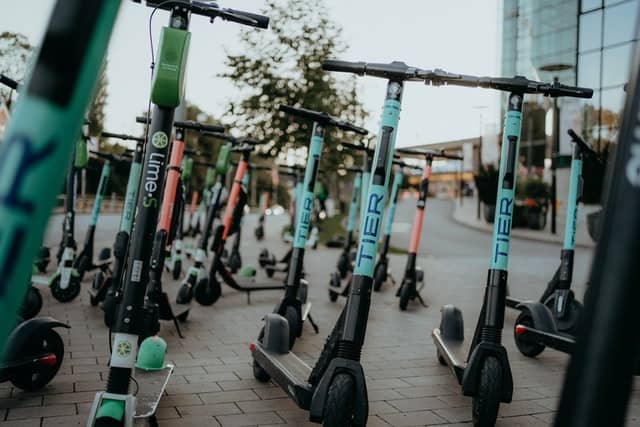
scooters in Paris

The Trottinette Life in Paris

I first looked into a trottinette (what the French call the platform-with-wheels-and-a-stick electric scooters) in January 2020, in the throes of yet another transportation strike (oh, for those good old days when strikes were our big problems!).  I wasn’t alone.  Many people were tired of the CGT and the disruptions and as such a first big move in Paris towards using bicycles and trottinettes began.  With many people choosing these new options, the shared biking system (Vélib) and the various shared scooters (Lime, Dott, etc.) were strained.  They simply couldn’t keep up with the new demand and those who were trying to get away from the frustrations of the transportation strike didn’t want to leap into another frustrating situation (no bikes or scooters available) and so they opted to buy their own bikes and scooters.

It was sometime in Spring 2020 when I bought what is the most popular model of trottinette in Paris, the Xiaomi Pro.  While this model is inexpensive (new for about 400 €, used for around half that) the key feature that has made many go for it is its foldability.  This means that users can take them on the metro with them, an option not available to most on bikes, as the majority of Parisian bicyclists do not have the folding Brompton ones.

This form of “multimodal” transport, in which someone walks, takes a métro/bus, then finishes the “last mile” of the journey on a trottinette, is a dream of transportation experts.  However, some studies point out (rightfully) that those riding trottinettes are not people who would otherwise have driven cars.  They are usually pedestrians who don’t want to walk anymore or just want to get somewhere faster.  There’s nothing wrong with that, and it is good to pull some pedestrians out and put them into the ever-expanding bike lane system in Paris.  But it cannot be argued that trottinettes do anything to ease vehicle congestion in the city.

Not Such a Deal

The thing is, the cobbled streets of Paris are tough on the small-wheeled trottinettes.  And the Xiaomi Pro, as I found out, is not the most stable and strong scooter platform you can buy.  So I’ve had numerous repairs to pay for in the last 18 months.

The first was a new tire tube after some stray glass had flattened the existing one.  Broken glass is an issue that you have to deal with even as a pedestrian, but the consequences are more significant for those who are rolling along on rubber tires.  When I got a second flat, the repairman suggested a tubeless tire.  “What, a tire that can’t deflate?  What’s the catch?”  The smoothness of the ride.  By having a very hard, reinforced tire that doesn’t inflate (or deflate) and can take as many nails or pieces of glass you throw at it, you necessarily have a ride that now treats you to every bump and curve of the road.  This isn’t a problem when you’re on a flat, well-paved, perfect road.  Those are not the majority of the roads in Paris, particularly in the center, though the bike lanes which I alluded to above very often are and that network seems to get bigger every single day.

I had only gotten a tubeless tire on the back tire and the ride still felt pretty smooth in general, but after my third flat, I had enough and made the front tire tubeless as well.  The cost of two tubeless tires and the original flat + installation = 225 €, which is more than I had paid for my used trottinette (150 €), but no matter, I thought.  No more flats (just intolerably bumpy rides when you hit cobbles).

But there were other costs.  A small part in the front broke (59 €) as did another piece (59 €) and at one point I had to get the battery replaced (200 €).

This is when I decided to get my electric bike: I was motivated by the subsidies on offer, but I also liked the idea of being outside in Paris without a mask (this was permitted to anyone on a bike during the old days of an external mask mandate).  My trottinette, which had accompanied me in all sorts of weather and traffic situations, and up and down countless metro stations, is soon to go on Le Bon Coin (the French Craigslist) and hopefully give someone else some good use, as I’m done with the money pit the Xiaomi platform became.  Once you’ve gotten used to riding your bike in Paris, you can go as fast as these scooters and get the exercise your body needs too.

Alternatives

You could choose to get an unlock pass for one of the floating shared trottinettes.  I periodically get a pass for the Dott platform which is around 5 € and that gives you unlimited free “unlocks” for 90 days.  The cost of a ride is usually a 1 € unlock fee and then 20 cents for each minute you are on the trottinette.  I am now very rarely out in Paris without my bicycle but if I do need to use one of these Dott scooters I’m usually on for under ten minutes, which means 2 € for the ride, and even three times a week, every week, that would be 24 €/month or 288 €/year.  That’s definitely the route I would recommend for the more casual user.  While the theory of “having your own” trottinette in Paris is plausible, much depends on the quality of the platform you choose, and by delaying an immediate purchase you can give yourself time to shop around and figure out what you like, using a shared system in the meantime.

If you are committed to buying your own, knowing what I know now, I would recommend a brand new Wegoboard trottinette.  I’ve been to their store in the 11th a couple of times and the scooters are made in France, are much sturdier and stabler than the Xiaomi, and come with a two-year guarantee.  If you’re stuck with a Xiaomi, the fastest/best repairs are going to be up in the 18th at Smartinette.

Photo by Jonas Jacobsson on Unsplash

Did you enjoy this article?  TAIP is 100% reader-supported through tipping.  If you want to leave us a tip of any amount it would be highly appreciated.  These tips help support our efforts to keep TAIP an ad-free environment.  Just like at a cafe, the tips are split evenly among the team.

outlook on Paris

To Know the Place Again for the First Time: TAIP’s Soft Reboot

Eight years and one week ago, I penned my first ever blog post on a website I called The American in Paris.  It talked about my plans to leave the US and some of my thinking that led me to leave the country I had called home for 25 years at that point.  At the time I alluded to what I envisioned as the goal of the blog: telling people about my adventure moving to and living in France.  At the time I was telling everyone that I was going to stay a year and see what happened next, in part because I didn’t know what would be next or even how to renew a visa.

How it Started

As time went on, I shared the experience of getting my first visitor visa, how I changed to a profession libérale visa, and all about the French agencies that were now part of my life.  These were important parts of my immigration journey.  But I also wrote about getting robbed (the first time), the critical summer that changed my immigration path, and the thoughts on my mind the night we “lost” Notre Dame.  Turns out moving to a new culture and country offers endless points of reflection and the blog gave me a platform to share those reflections.

At first people told me they printed out my articles, followed them step by step, got their visas, and offered to buy me coffee when they arrived in France.  Before long I was doing private consultations to help others get the visas they wanted.  Eventually the outlines for those consultations got turned into video courses for visitor and prof lib.  I even decided to create an official logo with the help of the team at Circle Sideways who have been at my side for design for projects since 2011.

As 2020 gave all of us more time to reflect on our lives (like lockdown in Paris and flying during a pandemic) and the various projects and endeavors we were involved in, I conceived the beginnings of pivoting TAIP away from solely my particular and personal journey to more of a platform for fellow Americans to share aspects of their journey that overlapped with mine but also covered areas that I had no experience in whatsoever.  Knowing that I no longer had to shoulder writing all the articles meant that not only could there be more articles on more subjects, but those articles could come more frequently.

How It’s Going

Hence over the summer, during the transition to this planned day in October, the tagline for the website changed from “My Adventures in the City of Light” to “Helping You Adapt to Life in France” and two of the writers, Gracie and Molli, penned their first articles for the site which started to fill in some gaps in the information the website was offering.  After those successful articles (some of which were also syndicated by Dispatches Europe) and many coffee and tea-driven meetings talking through our shared values and vision for TAIP, they agreed to come on board as part-time writers.  If you’d like to learn more about them and the values that undergird our writing, click here.

On a practical level, preparing for this soft reboot meant going through every single one of my nearly 150 existing entries since 2013 and editing them to make sure there was a unified style which the entire team (and any guest writers) could use.  It was a very long (but useful!) trip down memory lane.  By the way, if you are interested in writing for us, we do pay for every article and you will retain publishing rights for other platforms of your choice.  You can click here to learn more.  While we do unashamedly write from an American perspective, with all that implies, you don’t have to be an American to write a guest article for us, and writing one article doesn’t commit you to an ongoing engagement.

So it’s a new chapter for TAIP and you’ll be hearing a lot from the newer members of the team in coming weeks.  To commemorate eight years of the blog you are going to see eight articles between the two of them in the next two weeks.  Expect to see a regular publishing schedule with articles coming at least once a week, if not more frequently!  We’ve also stood up Facebook and LinkedIn pages for the site (please consider liking/following).  Share the site with friends who you think could benefit not just from help immigrating to France, but on how different Americans see long-term life in France.  Between the three of us we’ve been here twenty years and counting.

Thanks for all your support reading hundreds of articles, leaving thousands of comments, and sharing our advice and articles all over the place.  This would never have become the fun passion project that it is without you.  Here’s to many more years helping people from all over the world adapt to life in France. 🙂

Photo by Thibault Penin on Unsplash

Did you enjoy this article?  TAIP is 100% reader-supported through tipping.  If you want to leave us a tip of any amount it would be highly appreciated.  These tips help support our efforts to keep TAIP an ad-free environment.  Just like at a cafe, the tips are split evenly among the team. 
euros

How to Get Free Money for Your New Electric Bike in France

One of the aspects of life in French that is perhaps underappreciated by its citizens is the number of benefits on offer at any given time.  Sure, the French will brag to you about all that’s available, but often, they are conquered by the paperwork before they ever begin.  I alluded to that in my article about free money for French classes some time ago.  The hundreds of euros I recently got rebated from various agencies to cover the purchase of my new electric bike only underlined the lesson: if you are willing to do the paperwork correctly, you’re usually going to get what you want in France.

Start with Your City

So I know that there are other municipalities that offer money towards your electric bike purchase, and even though I’m writing this as a Paris resident, the same principles I’ve outlined here are applicable to other areas of France.  That first principle is that all other reimbursement programs for an electric bike purchase look to how your municipality of residence dealt with your purchase.

Parisians start here.  You’re going to create an account.  Before you start excitedly filling out the application, make sure you have digital copies of the following:

  • a receipt with your name and address on it (I bought my bike at Decathlon and they are familiar with this process; once you finish checking out you can go with your receipt to the customer service window and have them print a formal receipt for you which has your name and address remember to bring something that proves that address)
  • a certificate from the place that you bought the bike certifying that this model meets the EU standards for electric bikes (you can see the one I used for my bike model here)
  • your electricity bill or attestation de hébergement (this proves your residency)
  • your ID (either passport or carte de séjour; no preference)
  • your RIB (reimbursements are, presumably, only to French bank accounts: one more reason you should get one)

It took me half an hour to fill out the paperwork for the City of Paris.  You have to keep in mind that this isn’t entirely “free money.”  Paris wants a lot of data from the people they are giving money to, specifically, data about your mobility habits.  They are wondering how often you take public transportation and how getting this bike is going to affect that, and whether you will be riding the bike in all types of weather or just on the weekends, etc.  They also ask whether you would have bought a new bike if this subsidy program did not exist.  I checked “no,” as I would have bought a used electric bike at half the price rather than a brand new one.

They also ask for a full itemization of your purchase.  I knew that the program offered reimbursements up to 500 € in total so I decided to max that out by also buying a helmet, basket, and lock, all of which are included in the programs.

The bike itself had cost 799 €, so when you add 56 € for the lock (one of the most expensive I could find), 35 € for the helmet, and 52 € for the saddlebags and basket, the total was 942 €.

I submitted on March 17th and got a response on April 23rd: 219.72 €.  They didn’t give any reasoning for the calculus.  While the email told me the money would hit my account within a maximum of two months, it ended up hitting within two weeks.

Also, I didn’t idly wait for the City to rule on my dossier.  I waited a month before sending a follow-up via the electronic system and Twitter.  Whoever is running the City’s social media account is paying attention and made sure that my request got answered more quickly and that’s why I think I got my response in five weeks instead of the six to eight you might read about online.  Use social media to your advantage!

Then Try Your Public Transportation Provider

After I submitted my dossier to the City of Paris, I started a simultaneous dossier with IDF Mobilités, which is the agency that is in charge of all the public transportation in the Île de France region (start here).  While you cannot get a final decision from them until you include the decision from your municipality, you can do every other step of the process in the meantime and submit an incomplete dossier.  Your dossier will then get flagged up for missing this documentation, but hopefully by that time you will have the decision from your municipality and can respond to the flag with the documentation.

While I had correctly done everything else, I had incorrectly submitted my RIB.  I had typed in my personal bank account information but had inexplicably submitted the electronic RIB for my business bank account.  Instead of letting me resubmit, they just trashed my dossier because the numbers didn’t match and made me start over.

So I started the process over with IDF Mobilités on May 10th.  The process and dossier are almost identical to the one for the City of Paris.  The second time I applied I was able to submit proof of the aid I had already received from the City of Paris, which was simply an email informing me of the decision.  While that didn’t strike me as “official” enough, I submitted it anyway.  I didn’t get immediate pushback.

Since I had already submitted before, I knew the time to a decision, once they had a complete dossier, was 17 calendar days.  Judging by the file number from my original application in comparison to my second one I calculated that they are getting 300+ applications per day.  That sounds like a lot, until you realize there are 12M people in the region, and not all those dossiers are complete or acceptable.  I submitted on May 18th and hadn’t heard by June 4th and so I sent a gently-worded tweet to their official account.  Three days later I got a decision: 251.28 €.  The notifying email gives an even longer lag time for the funds to hit your account: four months.  But again, that was just to give them a wide margin of error.  The money hit within 12 business days.  471 € towards my purchase meant that thanks to these two agencies, exactly half of my bike had been paid for.

When some people (who don’t pay taxes here) expressed dismay at these programs, I noted that not only am I an annual Navigo holder at IDF Mobilités, paying north of 700 € each year for my pass, I also pay various types of taxes to the City of Paris.  I saw these funds as customer/tax rebates for myself which, all told, only took a couple of hours of my time, including the actual purchase of the bike in the first place.

But Wait, There’s More!

There’s also a program called Bonus Vélo that operates at a national level (but you apply within your specific region: Paris is “Grand Est”) and, unlike the previous two programs I mentioned, is means-tested.  If your French income was below 13,489 € in the previous year, you can qualify.  You must also apply for the program within six months of the original purchase.  I happen to know someone who had applied for this program and asked him for the scoop.

Unlike the other programs, which are entirely online, this one operated in the old-fashioned way: a printed dossier sent by registered mail.  You will need all the same information that you did for the other two dossiers, along with a copy of your previous year’s tax return, but note that the email that you receive from the City of Paris informing you of a favorable decision isn’t considered sufficient “proof” by this agency.  That’s fine.  If you email the City and let them know you need proof for the Bonus Velo program they will send you a more “official” document than an email that conforms to what the Bonus Vélo program demands.  You will then have to print that up and include it with your dossier.

This process seems to be faster because if you have a completed dossier you will get a decision within one month of mailing it in.  The person who applied for this program also went through a similar process with the other two agencies (for the same model bike!) and got 200 €.  The money arrived within two weeks.

That meant he got 671 € of an original 942 € reimbursed, bringing his effective total for his brand new electric bike, helmet, lock, saddlebags, and basket to 271 €.  Not bad!  This is a perfect example of taking advantage of programs that many French people don’t even know about, much less apply for.  The processes just take a bit of time, but immigrants are so used to having to do paperwork just to legally stay in France, that doing paperwork to get money is almost fun, especially when you’ve come to understand how French bureaucracy works at every level.

There are several reasons why I got an electric bike in the first place (although, as I noted, the incentive to get a new one was the free money) even though I’ve been almost exclusively a métro rider and walker in the City for years now.  But I’ll talk about that more in another article.

Photo by Christian Dubovan on Unsplash

This article also appeared on Dispatches Europe.

TAIP is 100% reader-supported through tipping. If you want to leave us a tip of any amount it would be highly appreciated. These tips help support our efforts to keep TAIP an ad-free environment. Just as at a cafe, the tips are split evenly among the team.
french taxes

French Tax Season Concludes

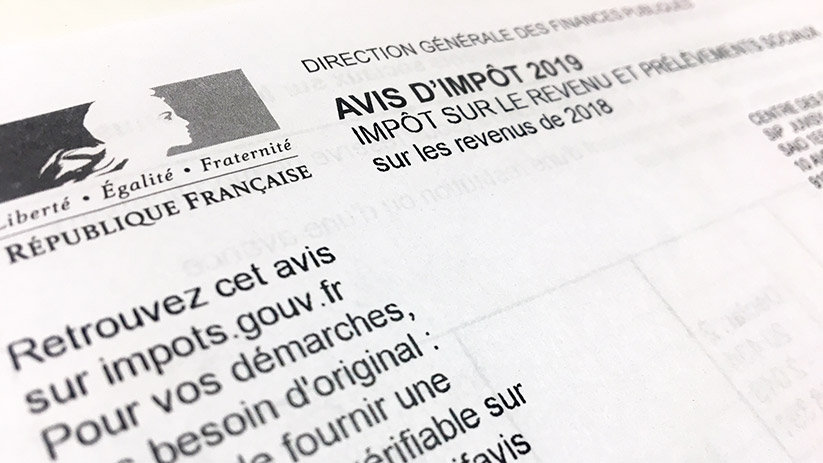
It’s that time of year when French accountants have closed their offices, put do-not-disturb autoresponders in their email inboxes, and have fled town to relax.  Tax season is over.  I never expected to write so much about taxes on this site, but enough people ask me about them that I have to pretty consistently write about the topic, as I did in 2015, 2016, 2018, 2020 (twice) and this article adds 2021 to the list.

Yesterday was the last day this year that personal income taxes could be filed in France.  The Fifth Republic gives paper filers the least amount of time.  This year that date was May 20th.  After that only online filing was possible.  May 26th was the deadline for departments 01-19 and non-residents of France (if you have real estate or a business that earns income in France you have to file even if you don’t live here).  June 1st was the date for departments 20-54, and yesterday, June 8th, was the deadline for all the rest of the departments, from 55 to 976 (Mayotte), including those of us here in Paris (75).

I’ve not filed my own taxes in any country since my early 20s, before I started to own businesses and learned how favorable the US tax code was to them.  Even then, I always took cues from paid accountants who spent their entire working lives learning about the tax code and were always up on the latest regulations.  I carried that same attitude over when I moved to France.  I hired my French personal accountant in 2014 and she’s taken care of me every year since and works in concert with my US firm that handles my business and personal US returns and specializes in location-independent businesses.  My French accountant sends her engagement letters out to her existing clients early each year and that guarantees you a spot for the year’s filings.  If you’re not a pre-existing client, you’re going to pay much more to file a return if you reach out to her or her colleagues even in mid-season.  You’ll pay progressively more each week closer to filing time, and double or triple what I pay if you contacted her last week, if she was even willing to pick up the phone then.

Hence, when I get panicked emails from Americans in April and May asking if I know anyone who can help them, I often say, “I don’t know.”  There are a very limited number of firms that work with Americans filing taxes here in France and because of that, the rates are significantly higher.  Then the immediate retort to the price I quote, which is usually from someone on visitor status is, “But I don’t even PAY taxes here.”  But the problem with that statement is its lack of anchorage in reality: you don’t pay your accountant based on how much tax you pay.  The accountants don’t work for the French government.  You pay based on how complicated your return is.  While Americans who are tax residents in France don’t have to file particularly complicated returns, no one would classify those returns as simple.  They get additionally complex when you add in French income from rentals and/or businesses (as I have had to over the years).

Americans forget that there isn’t some equivalent of H&R Block here offering tax returns at cut-price rates done by people who went to a clinic for eight weeks.  Hence they have unreasonable expectations.

One way to adjust your expectations appropriately is to educate yourself.  I recently came across a book written by someone I met in Bangkok at the end of 2019.  He runs an international accounting firm and the book is called US Taxes for Americans Abroad.  It’s not an exciting page-turner (no financial book is) but it’s very helpful for understanding just how complicated life for a US citizen abroad is.  I suspect the estimated nine million of us who live outside the US have no idea how complicated it is, even if, like me, they have been filing in their country of residence for years.

Just a few helpful concepts Vincenzo (himself a non-resident American) includes in his book:

  • how renting a home abroad can lower your US tax burden
  • the ins and outs of the Foreign Earned Income Exclusion (FEIE)
  • how to avoid paying state taxes if you are no longer resident stateside
  • the tax implications of marrying a non-US citizen
  • retirement and investment challenges

And the topic du jour among Americans abroad in recent years: renouncing US citizenship, and all the costs that come with it.

The moral of the story, as always: living outside the United States comes with some amazing opportunities and benefits.  It also comes with at least double the paperwork of a regular life in the US.  Stop your complaining and get to work.  At least one benefit for those of us filing in France this year?  No need to report any of the aid we received for our businesses due to Covid.  One more thing to be grateful for as the weather turns warmer, ever so slightly, day by day.

TAIP is 100% reader-supported through tipping. If you want to leave us a tip of any amount it would be highly appreciated. These tips help support our efforts to keep TAIP an ad-free environment. Just as at a cafe, the tips are split evenly among the team.

free mobile

Firing SFR Mobile

This is the unwitting third in a series of “firing” articles.  Once you realize that it’s definitely more difficult and hence, more satisfying, to fire service providers in France, you are far more willing to do so.  Some time ago I shared the experience of firing Société Générale, my very first bank in Paris, but a luxury afforded me because I already had a business account at BNP Paribas.  A telemarketing experience late last year gave me the opportunity to much more easily fire EDF in favor of Engie.  When I saw that cost savings in banking and electricity, I wondered where else I might trim the fat.

SFR

I walked into SFR within 24 hours of arriving in France in 2013.  My French was impossibly lacking in confidence and vocabulary.  Thankfully, two of the staff there spoke English fairly well and gave me a list of the documents I would need to get a mobile phone line.  One of those was the banking details (what is known here as a RIB relevé identité bancaire) of my not-yet-in-existence French bank account.  Thankfully, I was able to get a bank account set up the following day, and bank details in hand, I made my way to the SFR store once again.

I knew that I would be calling the United States and I didn’t want to have to switch to Skype all the time to make those calls.  But, unlike cell phone plans in America, cell phone plans in Europe are not only fairly inexpensive with large data packages, but those plans include international calling.

The plan I originally signed up for offered hours and hours of free calls to the US as well as dozens of gigabytes of data.  I was also allowed to roam around the EU on that data.  Total cost?  60 €/month.

Over the years the plan continued to upgrade and/or I would upgrade when I saw new features available.  The plan I ended up abandoning recently had unlimited data and calling to the US and Canada and the EU.  It also meant that whether I was physically in the United States or here in Europe, I really had no worry about getting additional charges, as that roaming was included.  I would only get charged if I made calls to countries not designated in my plan, or traveled to places outside of my plan and wanted data.

Unfortunately, SFR’s data packages in Asia, South America, Africa, Australia, and New Zealand were always prohibitively high, so I ended up getting a local SIM when I traveled to those places and put that SIM inside an unlocked mini wifi device, which then allowed me to tether multiple devices, including my French phone.

Free

Xavier Niel, who has an estimated net worth of $9.3B USD, is the founder of many businesses, including the ISP and mobile phone provider Free.  A year before I arrived in France, in 2012, he created Free Mobile, which was offering unlimited text, voice, and data for 19,99 €/month.  Over the years this plan continued to upgrade until it essentially matched my SFR plan.  The highest tier plan didn’t offer unlimited data, but 150 gigs of domestic data and 25 gigs of foreign data per month was going to be more than I would use.  When I discovered this plan I checked with a friend who had Free to ask about the service.  She said that in the city and in the United States it had been fine.  The only times it had been iffy was in some parts of rural France, but that made sense, given that the company wasn’t even ten years old and was still building out its infrastructure.

Still, it seemed to be too good to be true!  In addition to use in France and the EU, the Free plan gave me use of my phone and data plan in Australia and New Zealand, places where I normally spend at least $100-$200/month on data.  But who was I to argue with what would be a 600 € savings a year from what was at that point a 70 €/month charge (the price had risen slightly over the years) from SFR?  I checked with SFR to make sure that I didn’t have a contract in place, then picked a day to go to Free.

I brought all the items I needed to open an account at SFR: passport, electricity bill, RIB.  The woman who helped me smiled and said that I wouldn’t need any of that: just my debit card.  The way number portability works in France is simple.  You call 3179 from your phone.  You will hear a recording that reads a number to you.  That is the RIO (relevé d’identité operateur).  The recording also states whether your number is free of a contract (and if not, what you will have to pay if you choose to port your number anyway).  You receive a corresponding text message with all that information.

The person helping me at Free typed in my mobile number and then this RIO.  She then asked whether I preferred to be billed on the 1st or the 15th (I chose the latter).  Then she scanned a card that held a nano-SIM and handed it to me.  She told me that I would get a text from SFR sometime in the coming days telling me precisely when my number would be ported.

The Switch

Sure enough, about a week later, SFR notified me that my number would be ported on the 26th of the month between 11h-15h00.  I thought that I would see the coverage drop at some point during that window and when it did I swapped SIMs, changed my voicemail recording, and went on with my day.  A couple weeks later, SFR refunded me for the portion of the month that was unused due to my cancellation.

I’ve now had Free for almost two months and heartily endorse it.  I’ve not noticed a change in my service quality but have certainly noticed the change in charges to my bank account each month!  That’s to say nothing of the growing confidence that comes with choosing your service providers based on price and quality, not by default and laziness, which is something that is instinctive in America, but not-so-normal here in France.

TAIP is 100% reader-supported through tipping. If you want to leave us a tip of any amount it would be highly appreciated. These tips help support our efforts to keep TAIP an ad-free environment. Just as at a cafe, the tips are split evenly among the team.

My Change of Heart on Picard

In December 2015 I authored a (perhaps too indignant) piece slamming the frozen food chain Picard (and even questioning its raison d’etre).  It’s Spring 2021 and I have to take back at least some of my words due to a series of events that led to my first (and second, third, and fourth) visit to the chain.

Mailers

Picard regularly drops mailers into just about every mailbox in France.  I have had a habit over the years of using any sale flyers, be they from grocery stores or sports shops like Decathlon or Go Sport, as free language learning supplementation.  I will leaf through them, looking for words or phrases I don’t know.  If I see anything interesting, I’ll tear that sheet out and add it to my “look at later” pile.  Then I’ll message my French friends and clarify things (an example from the past: “You guys call any sports shoe baskets, even if they are for tennis?”)  In early March of this year a mailer landed with the title Hello America featuring a number of “limited-time” special items.

Hmm, what do the French consider quintessentially American,” I thought to myself, and started leafing through the mailer with a smile on my face.  The cover had a “Big Fried Chicken Burger” for 4€50 as well as a banana bread cupcake for 2 €.  The next page featured something called “American box” which gave you 11 pieces each of mac and cheese bites, mozzarella sticks, and pulled pork bites: 33 in total.  That was 8€95 and thousands of calories.

There were also the 3€50 “Tex-mex burrito” and 2€95 “Hot-dog à la New-Yorkaise.”  They even had bottles of Sam Adams beer for 2€50 each.  But the one that caught my eye was on page 3 of this version: 400g of “American chicken wings” for 5€40.

Chicken

Those who know me well know that I am a great lover of chicken in general and even more so of chicken wings.  It’s traditionally classified in the “American food” category for me (even though people all over the world enjoy chicken wings in their own style and cuisine) which I generally stay away from while here in France to make the visits to my family that much more enjoyable: combining people I miss with food I don’t often eat.  But when this mailer landed in my mailbox it was the middle of Lent and I had been fasting from meat for some weeks.  I also considered that I wasn’t heading back to the States anytime soon and that given that these were frozen wings, they could be broken out on Sundays or after Lent was finished.  “Well, for scientific purposes,” I reasoned, “I should really check out these Picard chicken wings and make sure they are good.”

I can’t say I eat frozen chicken wings regularly (or ever, that I can remember) but these were really good!  Could Picard have other frozen food that is good?  Again, in the name of science, I decided to find out.

Subsequent Visits

The Paris stores aren’t very large.  You just have large freezers everywhere and some cardboard boxes in the front you can help yourself to if you don’t have one of your own “keep cold” bags.  The other limitation Parisians often deal with is freezer space.  Most of us in the city have smaller fridges with limited freezer space.  I could pick maybe 3-5 items to bring home, assuming that I had an empty freezer at home.

I pretended that I knew what I was doing, but having never really been inside one of these before, I slowly went by every single freezer, making mental notes on what they had.  I even picked up a few things on those subsequent visits, including:

  • a 20-pack of breaded Alaskan pollock filets (really good)
  • some snack-size ham and cheese calzones (decent)
  • the aforementioned “American box” (honestly, not bad but only meant to be consumed in one sitting if you want a food coma: I’ve been away from the States too long to take down so many calories at once so I took it in parts)

In my eighth year in France, I still love to cook multiple times each day (more than ever, actually) and I still find it unacceptable that many people choose to make Picard a regular part of their lives rather than just an occasional one.  But, almost six years after I penned my last article on Picard, I’m happy to admit that I understand a bit better why the French might choose it: there are some quality flash-frozen fruits and vegetables in addition to the pre-made food I treated myself to, all at reasonable prices.  There’s even the bakery section where someone can grab frozen pain au chocolats that they can warm up in their own oven and make-believe they put the effort in to make them.

While it’s not very French of me to admit that I was wrong, perhaps that’s why the Hello America campaign so brilliantly ensnared me.  Bonjour, Picard.  You got me. 🙂

Photo from the Facebook page of Picard.

TAIP is 100% reader-supported through tipping. If you want to leave us a tip of any amount it would be highly appreciated. These tips help support our efforts to keep TAIP an ad-free environment. Just as at a cafe, the tips are split evenly among the team.
usps delays

USPS to France? Be Prepared to Wait

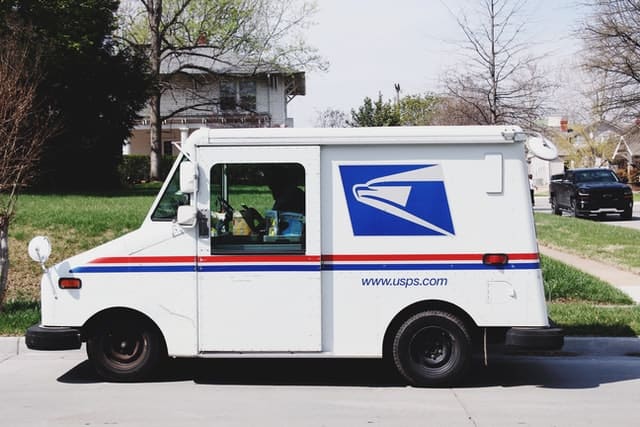
Covid-19 has shaped many parts of our lives in the last 12 months.  One way that wasn’t entirely expected (at least not by me) was the performance of the United States Postal Service.

While the USPS has never been a world-beater, throughout my years abroad I’ve come to expect a fairly reasonable level of service.  If a package was sent to me from the US I could sometimes get it as early as a week, but more often than not it took two weeks.  Not anymore.

I still maintain a US address for various administrative reasons and every now and then I have some of that mail forwarded.  Sometimes it’s routine stuff like a new credit card to replace one that has hit its expiry date.  Other times there are some important bits of paperwork I need to deal with.  In 2020, I also got “free” money from the US government in the mail.

In late October 2020 I had a package put together with some of these important items as well as a couple Christmas gifts I wanted to give to friends in Paris.  Not only did the package never arrive, but it was returned to sender in late January of this year.

The USPS does provide tracking, but there was no update for that number beyond its first original scans.  According to the website, it didn’t appear to have ever left the state of origin.

I wondered if it had been delivered and my local post office had simply forgotten to give me a delivery notice, as the box would not have fit in my mailbox.  I showed the tracking number to a clerk at La Poste.  A few taps later he told me in French, “It’s in customs in Chicago.”  Of course the French knew where my package was, but the USPS seemingly didn’t.

It was late December by that time, so I was able to file a claim for the package, but I had given it up as lost.  I pictured it somewhere in the warehouse you see at the end of Raiders of the Lost Ark.  But just when I had given up hope, I found out it had been returned to sender.  On cue, the USPS called me to follow up on my claim three days later.

The woman on the phone sounded so kindly I had no heart to turn on my customer-service indignation of the US variety.  Indeed, I was so relieved to not have lost the contents of that package (which included a ring I had resized) that I just thanked her for following up and verified that I would get a refund given that I never actually got the package.  “Yes, no problem,” she said.

When a friend went to get the refund the clerk blamed the French.  “It was delivered,” he insisted.  True enough, the package did look like it got stamped/stickered through customs.  But somehow or another it never got to my post office.  It came to France, hung out, then was returned.

I didn’t want to take any chances on the next package so I stripped out everything that wasn’t critical (I’ll get those things some other time, I figured) and focused on only sending something business envelope-sized.  That envelope was sent on February 9th and I’m happy to say it arrived just before the end of February.  “It’s a Christmas miracle,” I typed to my friend as I sent a photo of the envelope in my hands.

Three months for a non-delivery.  Almost three weeks for something the size of an envelope.  Thanks to the tracking I was also able to see that of the 17 days it spent in transit, 12 of them were in the United States, and 11 of those days were spent getting from the origin, in the middle of the country, to New York.

What is going on?” I asked a friend of mine who I suspected might occasionally mail herself things from the US.  She didn’t have a ready answer, but did tell me that her mother had attempted to send her Halloween candy both in 2020 and 2019.  Both times the package never arrived: once it was returned to sender and the other time it disappeared.

The USPS has been underfunded for a long time and unlike what I’ve experienced in Europe and Asia, routinely undercharges for both domestic and international packages (while managing to charge a FORTUNE to ship to Canada, which is closer to 48 of our states than Hawaii or Alaska).  It seems to have caught its own strain of Covid-19 and is, for the moment, not to be relied on for timely package deliveries.

For comparison: a book I ordered from the UK on Tuesday arrived on Thursday of the same week, which is even faster than I’m used to receiving packages from across the Channel.  Clearly not everyone has the same Covid problems.

Over the years I’ve often sent small packages to friends who were flying into Paris.  This allowed, in some years, for nearly half a dozen “courier” deliveries that I paid off with bottles of champagne.  That means is currently not as available.

So, if you’re in France and awaiting packages from the US, adjust your expectations, file claims, and be prepared to wait.  It is, after all, a First World problem.

Photo by Pope Moysuh on Unsplash

TAIP is 100% reader-supported through tipping. If you want to leave us a tip of any amount it would be highly appreciated. These tips help support our efforts to keep TAIP an ad-free environment. Just as at a cafe, the tips are split evenly among the team.

electricity in France

A French Telemarketing Experience

During my time in France I’ve gotten a few telemarketing calls.  Once, my internet company SFR called offering a slightly better version of the home internet plan I already had.  The call lasted maybe 15 minutes in total and I saved a few euros per month with no real additional work on my part.

Earlier this year, fresh off a score of 94/100 on a DELF exam, I confidently decided to say, “Okay,” when a friendly voice asked in French if I was willing to explore saving some money on my electricity bill.

I’ve written an article before explaining that in France electricity is deregulated and as such there are lots of different providers for electricity and gas.  I didn’t really hunt for the cheapest providers when I moved into my current apartment because I had a lot of other things to attend to.  But now that I had had EDF as my electricity provider since 2018 and knew exactly what I paid each month, I felt in control of the technical aspect of the conversation in addition to feeling there was no way he was going to ask me anything in French I would not understand.

My interlocutor was calm, with the perfect soothing voice all of us want to hear from someone trying to sell us something.  I happen to have smart meters for both electricity and gas so he asked me to read the meter numbers to him, which I did.

In France it’s typical to read sequences of numbers in twos, so you would read the number 273629 as vingt-sept, trente-six, vingt-neuf (I’ve always been grateful that my telephone number has no combinations over 60, as I would have struggled in my earliest days here with the funny way of counting the French use between 70 and 99).  Americans in general just tend to read the numbers in sequence, which the French will still understand, but such an action will immediately spotlight you as a foreigner.

I heard a keyboard pattering away along with the hum of his colleagues.  He gently asked for my patience while he looked some things up.  No doubt, due to deregulation, all of the providers have access to common information.  “How much do you pay now?” he asked.  I told him around 100 euros a month for gas and electricity together.  He asked a bit more about my usage of gas vs. electricity and about the square meterage of the apartment.  A few minutes later he came back with a quote for 25 euros less a month, with that rate guaranteed for at least two years.  300 euros saved in about 30 minutes?  Sure!

The rest was fairly simple.  He sent a set of disclosures as well as a contract for me to sign by email.  He waited on the line while I checked my email and digitally signed off on the documents.  He cheerfully told me everything was taken care of and that they would disconnect with EDF for me.  I wouldn’t have to do anything on that end (this is a key feature for the French: their attitude towards bureaucracy is to stay with bad service because it’s “too hard” to change)  In the meantime, if I wanted to sign on to my account on Engie (my new provider) I could set up autopay and paperless billing, etc.

I don’t think I’ve ever hung up happier from a telephone solicitation call.  Of course I had saved some money, but I had managed to conduct the entire call in French and managed to be understood and to understand, even using some technical language that I had picked up over the years.  And, some weeks later, all happened as promised: my old electricity provider, EDF, was kicked to the curb, and I made my first new payment to Engie via the autopay I had set up right after the original call.

In general in France you have to “opt-in” in order to get calls like this, but despite the fact that I studiously avoid opting in whenever I give my personal information, I still get at least 5-6 calls a year.  Most of the time they will be pretty friendly if you tell them you are not interested.  The worst will be if you tell them you will hear them out, but just at another time.  Then they will just call you forever.  That’s just another reminder that in France, as in life, a firm “no” can save you a lot of time and trouble. 🙂

TAIP is 100% reader-supported through tipping. If you want to leave us a tip of any amount it would be highly appreciated. These tips help support our efforts to keep TAIP an ad-free environment. Just as at a cafe, the tips are split evenly among the team.