Why I Left Paris

It’s coming up on a year since I moved out of my favorite city and enough time has passed to share my perspective on the move publicly.

If you had told me in March 2020 that I would ever, ever leave Paris, I would have laughed.  I was one step away from buying a burial plot.  But the world, and Paris changed.

Lockdowns

Most especially, I truly failed to realize what an integrated and essential part of our lives restaurants and cafés are, not just in France generally, but in Paris especially.  Our restaurants were closed for six months and so much happened as a result.

Social routines were interrupted.

Books that had been waiting to be read got read (and even more the following year).

Cash normally spent was saved.

Patterns of thought were broken.

Those of us who live in “world cities” like Paris, London, NYC, Singapore, etc. know and accept that we pay significantly more to live in those cities for the culinary and cultural access they offer, to say nothing of the fact that so many interesting people in those places.  It’s worth paying more to live there.

Until it isn’t.

I thought I was unique in making the decision to leave Paris after multiple lockdowns, but as I caught up with friends late last year, I had several, “oh you moved too?” conversations.  We shared a similar line of thinking: if we are ever going to be locked down in our apartments again, we would prefer to do it closer to nature.

It’s estimated that a third of Paris left for second homes during the lockdowns and some decided to make those second homes the now-primary ones, especially with the never-could-have-predicted dawn of teletravailler, remote working, in France.  What was once the domain of the French tech startup scene has become normative, even for workers in the we-haven’t-changed-procedures-since-the-days-of-the-monarchy French administration.

Remote work + lockdowns = life changes.

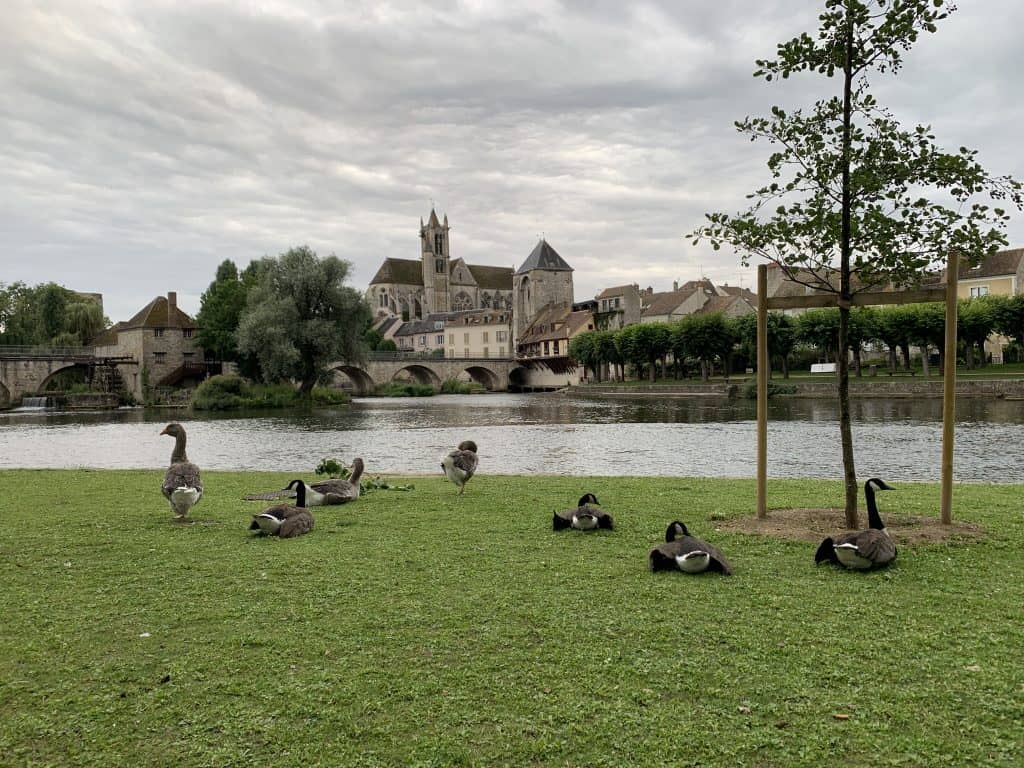
Moret-sur-Loing

In 2016 I was taking day trips with friends to various spots in Île-de-France that the guidebooks said were worth seeing, like Provins, Senlis, Fontainebleau, etc.  One of those spots was the medieval town of Moret-sur-Loing.  It borders both the Loing River and the forest of Fontainebleau and is connected to Paris by a high-speed 45-minute TER with connections every 30 minutes from 5 something in the morning to just after midnight most days.  If you have a monthly/annual Navigo, your travel there is covered.

I and my other Paris friends said the same thing on that (and subsequent visits): “What a charming little town!

We all thought, but didn’t verbalize, “But I could never live out in the countryside!

We lived in Paris for a reason.

In early 2021 I considered the previously unthinkable, moving out of Paris, for the reasons listed above.  My mind went to the memories of Moret, and I thought, if I was going to leave Paris, it wouldn’t be for a large roomy apartment in the suburbs, but it would be for an entirely different experience.

Getting an apartment in Moret (and moving in the middle of an official lockdown) was a new experience which I’ll share in a future article, but for now I’ll say I managed to be very fortunate in both my apartment and landlord.  And everything is significantly cheaper, from the rent to the bread to the meat to the eggs.  I absolutely love living in Moret, which has a twice-a-week farmer’s market about 100m from my apartment.

Routines are a bit different for me now.  Thanks to the ever-expanding bike infrastructure in the capital, now when my train pulls into Gare de Lyon, I unhook my electric bike and stay on the roads instead of using the Métro that I know and love.  It does mean that when it rains, I have to don my Aigle wellies and raincoat, but it also means that I get places faster, and see more of the city at street level than I used to.

As for TAIP, not to worry, I am still very much an American in Paris 2-3 times a week, seeing friends, chatting about books, running errands, attending Mass, and yeah, catching up in cafés with friends.  There is also a growing team of writers here who are resident in Paris who will continue to share their experiences which will blend in with those of us who now, like me, are now on a different road of their French experience, one that doesn’t include living in the City of Light.

I still consider my time in Paris as the greatest period of my life to date, particularly my three years in the 2nd arrondissement, in the beating center of the city.  But perhaps an even greater period is beckoning.  Time will tell.

The photo gives one perspective of the medieval town of 4,000 I live in now.  My apartment is across the street from Notre Dame de la Nativité, which you can see in the center.

Did you enjoy this article? TAIP is 100% reader-supported through tipping. If you want to leave us a tip of any amount it would be highly appreciated. These tips help support our efforts to keep TAIP an ad-free environment. Just as at a cafe, the tips are split evenly among the team.

OFII Visit for Long Stay Visitor Visa (2022 Update)

Note from the editor: In light of new guidance on remote working in France as shared by the official French tax office in June 2025, we have also officially changed our stance on remote working for a US company while living in France under the visitor visa. Read more here, and contact us with any questions or concerns. We’re here to help! — MS

So you have made it through the France-Visas & VFS Global maze, obtained your long-stay visiteur visa (in the form of a sticker pasted into your passport), and moved yourself to France. Congrats! But we are not quite finished with the intake process just yet, there remain a few steps to be completed in France to make ourselves official residents. Thankfully they are not at all difficult.

Stephen already wrote about his experiences and the two basic assignments remain the same now as when he went through them almost a decade ago we need to register our visa with OFII, and we need to complete a medical exam. The biggest change since Stephen’s time is that the registration portion is now done entirely online, and if that wasn’t great enough news, the process also involves fewer steps and requirements. It is completely painless (except for the 200 € fee) and can be completed in a few minutes.

The medical portion is also very straightforward, the only thing that requires forethought is that you will be asked to provide your vaccination records. Those will obviously be much easier to obtain when you are still in America so add that to your list of things to do before you leave.

OFII Registration

Registration with OFII (l’Office Français de l’Immigration et de l’Intégration) must be done within the first three months of your arrival in France. Since the process only takes a few minutes there’s no reason to put it off.

To start go to: https://administration-etrangers-en-france.interieur.gouv.fr/

If you prefer there is an option to set the website language to English though it might still leave you with some French phrases just to keep you on your toes! Several options are presented, we want of course: Je valide mon VLS-TS (Validate your VLS-TS long-stay visa).

You will be asked to enter various pieces of information that are shown on your visa sticker, including the “from” date (de), the “until” date (au), and the “on” or issue date (le). Remember that dates are entered with the day first, then the month and year.

Under remarques (remarks) we will specify our visa type, for us this will be Visiteur. You will also be asked to select a Référence réglementaire (regulatory reference) number from a drop-down list. I found this number in small print on my visa, but we have heard this may no longer always be the case.  Since sometime around the year 2022 the code for Visiteur visas is CESEDA R431-16 16°. “CESEDA” stands for “Code de l’entrée et du séjour des étrangers” or in other words “entry and residence code for foreigners.” The specific number refers to the paragraph in the legal code that references the given visa type; as this law is occasionally updated, the numbers are subsequently changed (prior to 2022 the Visiteur visa code was R311-3 5°).

You will need to provide various pieces of personal information; all of it is straightforward and self-explanatory. Finally you will need to pay a fee that will cover the expense of your upcoming medical appointment. The payment can be made online with a credit card, but it wouldn’t be France if the process weren’t slightly convoluted.

First you will be sent to a site to purchase a timbre fiscal électronique (electronic tax stamp), and then you will need to return to enter the 16-digit timbre code given on your receipt as proof of payment. But at least you did not have to wait in line at the tabac to buy your stamp! At the time of writing the fee was 200 €.

Having provided proof of payment you are now done. Your visa is now registered and you will be assigned an identifiant (personal ID number) and password which you can use to access your personal account. We will use this same website and account a year later if we wish to extend our stay, and this ID number we are told is our official ID as a foreign national residing in France and “will be used in all administrative procedures while you are in France.” So probably best not to misplace it.

OFII Medical Visit

At the time your visa is registered you will be informed about the upcoming medical requirement, but this is just to forewarn you. There is nothing to do until they assign you an appointment time and place, in my case it was a further five weeks before I received my Convocation Visite Médicale (medical visit summons) by email.

This summons informed me of the date and location of my OFII medical appointment. I was additionally instructed to get a radio pulmonaire (chest x-ray) at a separate medical office of their recommendation. I needed to make the x-ray appointment myself, and it had to be performed before my OFII medical visit, as I would need to bring the results with me.

I walked down to the indicated radiology center and was glad I brought a printed copy of my convocation letter because they wanted to see it. (Buying a printer has been the best purchase I’ve made so far in France and saved me countless hours of walking to, and dealing with, the print shop.) Although the radiology lab was not affiliated with OFII they were used to having OFII immigrants come through so they knew exactly what I needed. Of course this visit was not to have the x-ray performed, it was simply to make the appointment. As they were apparently quite booked, the soonest they could schedule me for the x-ray was the day before my OFII visit! This seemed like cutting it a bit close for comfort but it all worked out.

It is entirely likely that in the larger cities these two steps (the x-ray and the OFII medical) are combined into a single visit, the way it was for Stephen in Paris. But if you find yourself in my situation, I definitely recommend not delaying at all to schedule the x-ray appointment.

Day of the X-Ray

I arrived at the radiology center at the appointed hour (for some reason these things are always at the crack of dawn). Along with my passport, I had once again, and as instructed, brought my convocation letter. Even though the convocation is not for the x-ray, it lets them know why you’re there to get one. After being checked in I was sent to a waiting room. A few minutes later I was summoned by a nurse into a small changing room where I needed to remove all clothes from the waist up. I was led to the x-ray machine which looked basically like a wall of glass. I stood on a little pedestal and was instructed to stand with my chest firmly pressed against the glass. At her command I was to take a deep breath and hold it (inspirez et retenez votre soufflé) while the x-ray was performed.

This done I redonned my clothes and returned to the waiting room. Barely ten minutes later I was handed an envelope with the x-ray image as well as a letter with their official conclusion: image thoracique normale. It was signed by Docteur Cockenpot, which I’m pretty sure is a name I hadn’t seen in America.

I was free to go, and there was no charge for this visit. I had spent less than one hour from the time I left my apartment to the time I walked back in my own front door. There are advantages to living in a small town!

Day of the OFII Visit

These are the list of items I was asked to bring to the OFII medical exam:

– Passport
– Printout of my OFII Convocation (the summons letter I was emailed)
Radiologies pulmonaires récentes (chest x-ray and letter)
Carnet de vaccination (vaccination records)
Comptes rendus d’hospitalisation (hospitalization records)
Lunettes de vue (prescription eyeglasses)
Carnet de maternité le cas échéant (maternity booklet, if applicable)

This appointment was held at my local OFII facility and also went quickly. After verifying my identity I was brought in to see the doctor. He posed a variety of questions such as my age, existing health conditions and whether I took any medications, marital and work status, and whether my teeth were in good condition (he took my word for it). He took my weight and height which was the extent of any physical “examination.”

I wore my glasses and even also brought my current eyeglass prescription, however I was not asked to show these. I had no hospitalizations to report.

He asked for the results of the x-ray which I had just taken, which I handed over. He then asked about my vaccination records. Of course the vaccine most on everyone’s mind today is the Covid vaccine. The question was asked if I had received it, and if you have by all means bring the documentation for it. However at the time of writing (February 2022) it is not obligatory to have received the Covid vaccine for purposes of your long-stay visa. Now if you want to drink a coffee outside a café, that’s a different story. 🙂

As for “regular” vaccines which is what they really want to know about, I had searched in vain for a list of requirements. As of 2018 France requires a total of 11 vaccines for children to enroll in school, but nowhere did I see what the requirements were for adult immigrants and of course most of us were born long before 2018. Although childhood vaccines in America are largely similar to the ones given in France, actual policies vary by state as well by which decade you were born.

My parents incredibly still had my little booklet from childhood in which was scribbled by half a dozen doctors the multitude of vaccines I had been given as an infant. I brought this with me to the appointment but I had a feeling it might not be considered the best possible record.

In anticipation that a more official (and legible) transcript might be appreciated, I had contacted my state health department before leaving the US. Practices no doubt vary from state to state, but in Kansas I was told that records are destroyed after 10 years. Being quite a bit older than that I found their policy to be somewhat inconvenient. No problem, they said, you can easily obtain a copy of your vaccination records from your old high school. Who knew the American public education establishment was the true repository of our nation’s vaccine records! Not me, as I had been educated outside of formal public institutions, but I list it here as another avenue you can pursue if you are looking for your own records.

There is yet another option, and that is to take what is called an “antibody titer test.” I was able to get one at my doctor’s office in America without trouble. It is a simple blood draw, and afterwards they provided me a nice printout showing my antibody levels for measles, mumps, rubella, varicella (chicken pox), and hepatitis B. I’d received quite a few other vaccines as a child but my doctor told me these were the main ones they tested for and I accepted his word for it.

I was right that the French doctor at my OFII visit didn’t seem too interested in looking at my tattered childhood vaccine booklet, but he had no problem with my titer results and proclaimed them satisfactory. I still can not claim to know what official list they are looking for specifically, but I suppose in the worst case they could ask you to retake some.

This ended the “examination.” I was returned to the waiting room and after a few minutes an attendant brought me two copies of a short letter titled Certificat de Controle Medical (Certificate of Medical Inspection). Along with my information was the following simple statement followed by the doctor’s signature: Remplit les conditions sanitaires pour être autorisé à résider en France, or, “Meets the health requirements to be allowed to reside in France.”

The attendant explained to me that one copy was for my own records and the second would need to be given to the prefecture at the end of my first year in France, if I chose to extend my stay beyond that point. If so, I would need to start the renewal process between 4 and 2 months prior to the end of my visa validity, using the same website listed above.

I was asked if I had any questions, the only one I could think of was, “Is there anything else I need to do?” The answer was no — I was free to live my life as a legal French resident for the next year.

Once again this whole process went very quickly, I was in and out in less than an hour. My interview with the doctor was conducted in French but I suspect he could have spoken English if necessary, and the attendant who dealt with me before and after spoke English.

A Note About Visas and “Titres”

The type of long-stay visitor visa we have obtained, and which was pasted into our passports by the French embassy before we left America, is called VLS-TS, which stands for Visa de Long Séjour – valant Titre de Séjour.

Translated that means a “long-stay visa that is valid as a residence permit.”

Technically speaking it is not itself a residence permit (titre de séjour), it is a visa that is valid as a residence permit. With this visa we can reside in France for one year without needing to do anything at the Prefecture. If we want to stay beyond the one-year validity period of our visa, then between 4 and 2 months prior to its expiry we need to apply to the Prefecture to renew our immigration status. It is then that we will finally be asking for a titre de séjour and if granted they will give us a physical carte de séjour visiteur (visitor residence permit card). This card will from thenceforth replace the sticker in our passport as our official identification.

I mention this in the event, that like me, you found yourself early in your research with a great deal of confusion about cards and permits and visas and stickers and their French translations, as many of these terms are used interchangeably by various people on the internet, and of course the process has changed over time and some information becomes obsolete. When Stephen went through the OFII process he received an additional sticker in his passport at the conclusion of the process. That no longer occurs. For our first year in France we will get nothing in addition to that, though as described in this article, we do need to register this visa with OFII in order to make it official.

Did you enjoy this article?  TAIP is 100% reader-supported through tipping.  If you want to leave us a tip of any amount it would be highly appreciated.  These tips help support our efforts to keep TAIP an ad-free environment.  Just as at a cafe, the tips are split evenly among the team.
How to Get a Mutuelle in France

When I first decided to start my life in France after years of being an au pair and a student, I started to hear talk of something called a mutuelle. I had already been enjoying the benefits of seriously discounted health care for years at this point, and I often relished the fact that my monthly prescriptions were only a few euros instead of upwards of $40 per month back in the states.

You may be thinking, “Huh? But I thought going to the doctor was free in France and so was all medicine.” Health care is much, much less expensive here than in the United States, but as they say, nothing in life is free. 

Why You Should Get a Mutuelle in France

If you’re a permanent resident of France, you’re eligible to receive government-provided health insurance within the first three months of being here. It works like a co-payment system, and much of your medical costs are reimbursed up front by the standard, public health insurance. For example, if you go to the doctor and you’re uninsured, you’ll pay around 25 € (still a steal, if you ask me). If you sign up for public health insurance, you’ll pay around seven euros. If you get a mutuelle (some call it “top-up” coverage in English) in France, you’ll pay nothing.

Having that extra coverage ensures that you don’t pay anything at the doctor’s office and most prescriptions are covered too. If you have to stay overnight at the hospital, depending on the plan that you choose, you won’t have to pay for that either. 

If you wear glasses or contacts or enjoy having clean teeth, you’ll want to sign up for one as well. I wear both glasses and contacts (and like keeping my pearly whites, well, white) and so my mutuelle is a lifesaver. I went from paying hundreds of dollars every year for my eyes to paying nothing.

I haven’t even begun to mention all of the other perks you could be enjoying if you sign up for your own mutuelle. Specialists such as dermatologists, chiropractors, and osteopaths are also covered (again, depending on your plan). Furthermore, you can sign up no matter your medical history and without fear that a preexisting condition will make the monthly free skyrocket. Oh, and if you’re pregnant or plan to be, a mutuelle is also really helpful.

Shout out to my French mother-in-law for pushing me to finally sign up. I think for me, seven euros to go to the doctor just seemed so sweet that I couldn’t imagine paying even less. My American mentality prevented me from signing up for a mutuelle for several years when in reality I could have started benefitting from one all the way back in 2012.

How to Know Which Plan to Choose

Not all mutuelles are created equal, but neither are everyone’s health care needs.  Stephen, for example, almost never goes to the doctor, so a mutuelle for him would be a waste of money. Furthermore, if you don’t have terrible eyesight as I do, you don’t need a plan that will help you save on glasses and contacts. 

When you begin shopping around for a plan, you’ll notice that coverage is determined in percentages. I recommend opting for coverage that is over 100%. Start with at least 150%. And if you have problems with your teeth or need to visit the eye doctor, consider going up to 175-200% coverage. I know that asking for over 100% coverage may sound a bit much, but some doctors charge more than the standard fee set out by the government. You’re going to want that extra coverage just in case you find yourself at a specialist (like the dentist, ophthalmologist, or chiropractor) that naturally charges more than your primary care physician. 

You’ll be charged a monthly fee in order to benefit from your mutuelle. The cost is nominal, especially when compared to the ever-climbing costs of private health insurance in the US. For example, my mutuelle is one step above the “basic” plan, and I pay around 30 € per month. There are several different providers to choose from:

Once you sign up, you’ll receive your mutuelle card. It’s not a plasticized card like your carte vitale (the card you use to benefit from the standard public health care), but rather a small piece of paper you’ll have to be careful not to lose.

My advice? Take your time when comparing plans, ask your French friends for advice, and don’t get too hung up on finding “expat” specific plans. If you are a resident of France, you have all of the rights of a French person. These so-called expat-specific plans tend to be much more expensive for no real reason that I can see. And, if you don’t earn a lot of money, you could be eligible for a state-run mutuelle program called the CSS, so, if you can, don’t forget to look into that option, either.

There are plenty of mutuelle comparison sites that can help you decide as well. This one by Le Comparateur Assurance (The Insurance Comparer — a great resource for comparing any type of insurance in France) is my favorite. However, I will say this again, your French friends will be your best asset here. They’ve had this type of insurance their whole lives and are the best place to start for some advice!

Photo by National Cancer Institute on Unsplash

Molli offers private consultation services which range from help with visas and adjusting to life abroad to Paris travel itineraries. Fill out the contact form to learn more.

Did you enjoy this article?  TAIP is 100% reader-supported through tipping.  If you want to leave us a tip of any amount it would be highly appreciated.  These tips help support our efforts to keep TAIP an ad-free environment.  Just as at a cafe, the tips are split evenly among the team.
How to Get a Complémentaire Santé Solidaire (CSS)

After I successfully enrolled in France’s health insurance system and got my temporary social security number or numéro provisoire, I went to see many doctors. At the beginning of the appointment, they would look at my certificate of registration and ask if I had a complementaire. I’d say no, because I didn’t, and I also had no idea what that term meant.

Then they’d ask if I had a mutuelle, and I would say no again. I knew that was additional health insurance offered by French businesses, but I didn’t have a French job. I didn’t even have a working visa. I was already thrilled to be enrolled in government health care, wasn’t that enough?

But they were asking because it wasn’t. Assurance maladie works in tiers of reimbursement, and only fully reimburses its users for a select few medical visits. For other expenses, they might cover a small percentage of the cost, which is why most French people have a mutuelle as well. After six months of being disappointed by the meager refunds trickling into my bank account, my general practitioner kindly explained all this to me. She also told me I could get a mutuelle without being employed by a French company, but advised that I apply for a complémentaire santé solidaire or CSS. And so my health insurance journey continued.

What Is a Complémentaire Santé Solidaire?

A complémentaire santé solidaire or CSS is an additional insurance that covers your medical costs at the doctor, dentist, and hospital. It also covers most glasses, prosthetics, and hearing aids.

Who Qualifies?

In order to qualify for a CSS, you must have already enrolled in the health care system and be a regular resident of France. In my reading, this means you must have a long-term visa as well as other documents tying you to a fixed address here.
Note: Even if you have a temporary social security number, numéro provisoire, you can still apply for a CSS.

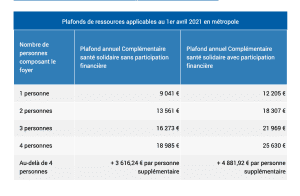
Beyond residency, you qualify based on your income or resources, which include salary, government aid and donations, commercial sales of objects, and gambling gains. Depending on your annual total, you can either qualify for full government aid or you’ll pay less than 1 € per person per day. I was given full aid so I’m not sure what the annual payment would be. It seems safe to assume it’d be under 365 € annually or 30 € monthly, which is equivalent to the cheapest monthly mutuelle.

As you can see below, your income must be quite small in order to qualify:

How Do You Apply?

To apply you fill out a form with your personal and financial information, as well as information about the rest of your household and any dependents. Since Fred and I are PACSed, he’s considered part of my foyer, and his income was included in the calculations.

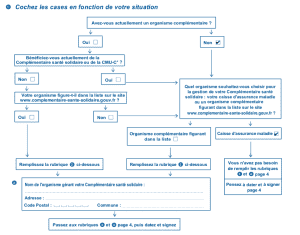
As I mentioned in the list of requirements, you’re also asked to declare any additional government aid you’re receiving such as unemployment or pension. After quite a few boxes pertaining to income sources, there is a deeply puzzling flowchart.

In a very convoluted way, all it’s asking is if you want to have your CSS directly with assurance maladie or through a mutuelle company.

Note: You also need to include your titre de séjour with the application, as this is proof that you’re a current French resident.

How Long Does It Take?

Great question. The assurance maladie website says the application will be processed in two months, which I rounded up to three.

How Long Is It Valid For?

Since the complémentaire is contingent on your income and “need” you must renew your request each year by sending proof of income, as well as your tax documents.

What Happens Next?

  • The short answer: Go to the doctor and get reimbursed.
  • The long answer: Now I can go back to the dentist and not have to worry about how much she’s charging to take X-rays of my teeth. Actually, doctors in France are always upfront about costs, and they must be listed on the doctor’s website so you usually know exactly how much you’re paying before you walk in. In the case of my dentist, she explained that assurance maladie would only cover eighty percent of the cost of the 50 € x-rays, and wanted to make sure I was okay with that. The bill was laughably small compared to my dentist back in New York where I paid $300 for a cleaning.

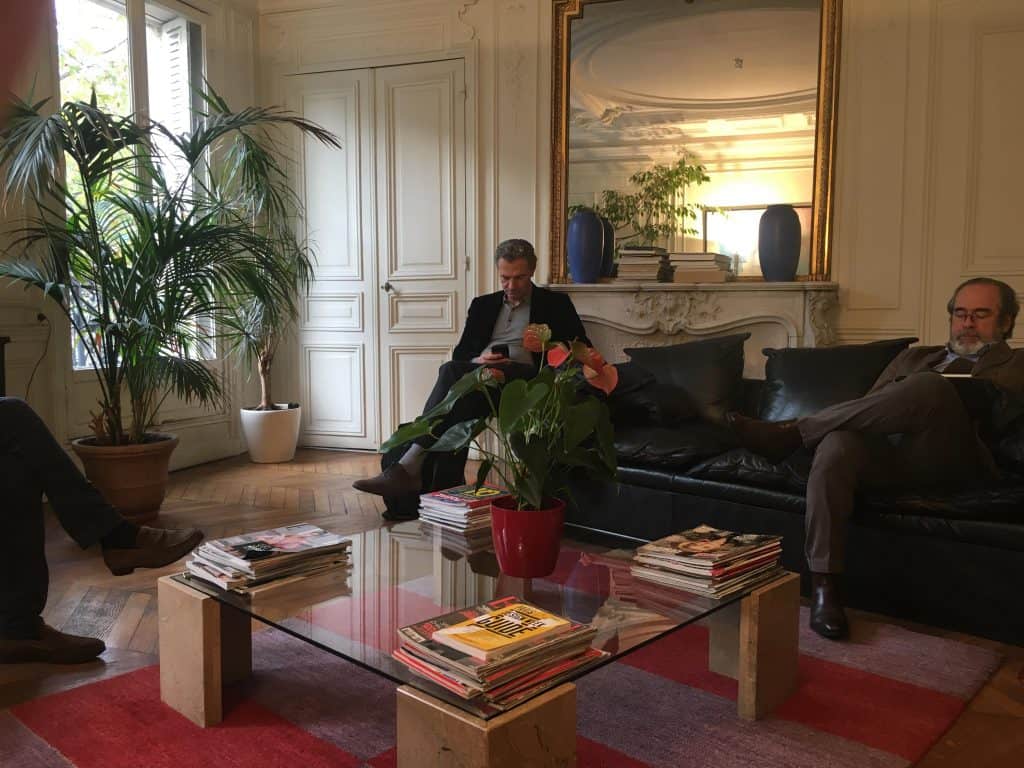
Photo was taken in the tastefully appointed waiting room of my knee doctor.

Did you enjoy this article?  TAIP is 100% reader-supported through tipping.  If you want to leave us a tip of any amount it would be highly appreciated.  These tips help support our efforts to keep TAIP an ad-free environment.  Just as at a cafe, the tips are split evenly among the team.

bicycode marking

Add a Bicycode to Your Bike

Once you’ve spent a lot on a brand new electric bike (even if you got much of it subsidized) you want to protect it from theft.  Unfortunately, not only is Paris a place where more than one of us have at least one “I got pickpocketed” story, but it’s also a place where bikes get stolen: in France 400,000 are stolen annually.  So apart from using one or two strong locks on your bike, what else can you do to protect yourself?  Enter Bicycode.

French Federation of Bicycle Users

When the authorities do manage to find stolen bicycles, it’s challenging to return the bikes to their rightful owners because of changes/damage to the bike.  The French Federation of Bicycle Users (FUB) set up Bicycode back in 2004 with the idea that a “tattoo” on the bike frame would offer a point of identification that could connect a stolen bike to its rightful owner.  It has since marked almost 250,000 bikes in France and Switzerland.

Now, this isn’t to say that your would-be thief is going to see a Bicycode sticker on your bike frame and be scared off from stealing your bike.  It’s just an additional measure you can take to make sure that if your bike is stolen, you’re at least giving yourself some chance of getting it back.  Of the 400,000 annually stolen bikes in France, 150,000 are recovered, and Bicycode at least gives you some kind of shot at recovering your wheels.

Getting Your Bicycode

Once I was sold on this short and easy measure I went to the interactive map showing who the retail providers are and made an appointment.  A number of shops in Paris are not doing them on a regular basis so I ended up going to Melun, which has a shop doing them all the time.

I had to do some basic paperwork (this is France, after all) to establish that I was the owner of this bike and was registering it at an address I had proof of living at. If you ever sell your bike in the future, you can give the buyer your registration material and Bicycode provides a way for the new owner to then register the bike in his/her own name.

Once all the paperwork was done (probably ten minutes of work in total), I handed over 10 € and he got to work.

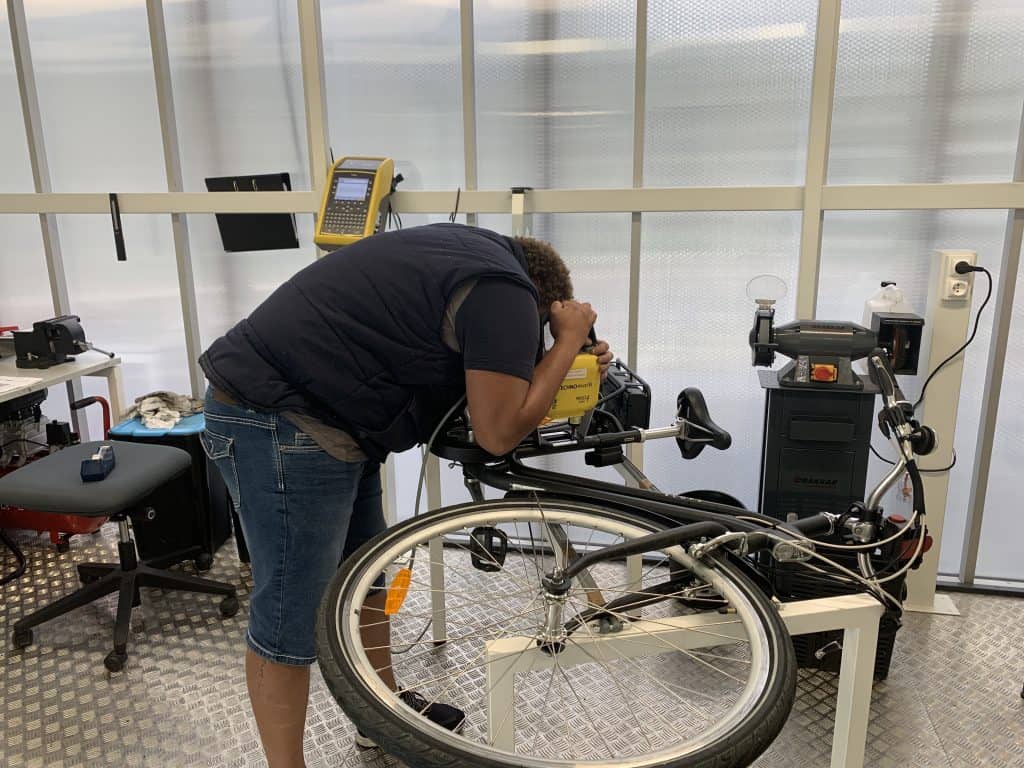
The technology used is apparently resistant to weather, water, UV damage, and high-pressure washing.  The tech took 15 seconds to engrave it once he had the bike in the right position.  The code he put on the bike is unique and linked to my bike’s serial number, my name, and my email address.  If your bike is stolen you log onto your Bicycode account and declare the bike as stolen and give the address of the police station where you made the report (which assumes, of course, you’ve done that as well).

Add to Your Insurance As Well

I also contacted my renter’s insurance to ask them if a bicycle theft was covered and they said it was.  They just needed some paperwork (of course).  I sent them proof of purchase and the serial number of the bicycle and signed a rider to the policy adding the bike.  No change in my premium and the bike was now included.

You can’t prevent your bike from being stolen in all circumstances.  Basics include:

  • using at least one bike lock to secure your bike
  • securing the lock through the frame of your bike rather than the wheels
  • using one of the ever-increasing bike stalls throughout the capital, which have strong metal bars for you to use

But once you’ve added a Bicycode and added the bike to your insurance, there’s nothing more you can do to protect yourself.  Enjoy your ride!

Photo is of the technician marking my bike with its unique Bicycode.

Did you enjoy this article?  TAIP is 100% reader-supported through tipping.  If you want to leave us a tip of any amount it would be highly appreciated.  These tips help support our efforts to keep TAIP an ad-free environment.  Just as at a cafe, the tips are split evenly among the team.
How to Get a Long-Stay Visa for France Through French Lessons

While it would be nice if Americans were able to live in Europe visa-free, it’s not the case (one can dream that it will be someday, right?). If you’re from the US and want to live in a country like France for more than 90 days, you’ll need to apply for a long-stay visa (known as the VLS-TS) first.

If you don’t have family or a French spouse, there are (to really simplify things) two ways you can live in France legally as a non-European: through work or school. 

I’ve already touched on how to obtain a student visa for France, but this “hack” is for those of you who are more interested in improving your French skills rather than going to a university.

What Kind of French Classes Get You a Long-Stay Visa for France?

If you’re like me, you cringe at the thought of going back to school. Maybe you finished your undergraduate degree and thought to yourself “Never again!” Or, maybe you’ve gotten as far as your master’s or doctorate and there isn’t much university-level schooling out there for you. Or, hey, maybe after high school you decided to go straight to work.

As someone who never thought she would ever go back to school after my undergrad, I eventually did get my master’s degree here in France. But, that’s another story for another day. In between being an au pair and enrolling in my master’s program, I did one year of intensive French classes. And, those classes enabled me to get a long-stay visa for France.

For a bit of background, once I did ultimately decide to go for my master’s degree, I knew I needed to improve my French for a few different reasons. First of all, I wanted to be able to intelligently engage in a conversation with a French person. I also knew that in whatever master’s program I enrolled in, I would be required to understand, speak, and write at least basic French (a level I had not yet reached after living here as a nanny). Plus, if you want to go to a public French university as a foreigner, you need to prove that you have at least “B2” level French. 

B2 refers to a level in the “Common European Framework of Reference” (CEFR) scale for languages. It is used to assess people’s language levels and ranges from A1-C2. Here is a breakdown of the different levels for French:

  • A1: Beginner
  • A2: Elementary 
  • B1: Intermediate
  • B2: Fluent
  • C1: Advanced
  • C2: Bilingual

To be honest, whether or not you want to continue on to a master’s or doctorate program if you plan on living in France for an extended period of time, you should try to obtain at least a B2 level. 

The good news is, an intensive French language program will get you that student visa you’re after whatever level you’re at! Here is what is required:

Once you’ve found your dream program, you’ll have to go through the steps of applying for a student visa for French. I’ve mapped out everything you need to know here.

If you’re in Paris, I did the FETE program at Université Nanterre (yup, that Nanterre. Any other 20th-century history buffs out there?). It’s located just outside of the city to the west. I recommend it to anyone who is interested in improving their French. The classes are a mix of speaking and writing as well as cultural classes. Fieldtrips include visits to Parisian museums and landmarks, how cool is that? There is also a similar option at La Sorbonne

If you’re not in Paris, simply take a look at the list of FLE-accredited schools I linked above!

Some Things to Remember if You Want to Renew

If you plan on spending just one year in France and know that you won’t need to renew your visa, you can skip the next section.

If you already know that you’ll want to extend your time in France after one year, there are a few things to keep in mind:

  • You need to pass the school year in order to renew. That means you’ll have to take school seriously. Attend all of your classes and study for your tests. Stay on good terms with your professors as well.
  • Make sure you have a plan for what you want to do next. Do you want to continue with intensive French courses until you’ve achieved C2? Do you want to enroll in university? Remember, for the latter, you’ll need at least a B2 level.
  • Start gathering the paperwork you need to renew 4-5 months before the end of the school year. You’ll need to schedule your renewal appointment at least 3 months before your visa expires.
  • As a general note concerning all French visas: keep everything. That means bank statements, cell phone bills, copies of your lease, or a letter from the person who is housing you saying that they are housing you. You’ll need all of this plus proof that you passed the school year. 

Disclaimer: I’m not giving you permission to slack off or stop going to school if you don’t plan to renew your visa. My advice? Take advantage of the fact that you’re in France learning French. It’s the best way to learn a new language, and you’ll have the opportunity to speak French with actual French people. Don’t throw away an opportunity like that.

Molli offers private consultation services which range from help with visas and adjusting to life abroad to Paris travel itineraries. Fill out the contact form to learn more.

Photo by Faisal Waheed on Unsplash

Did you enjoy this article? TAIP is 100% reader-supported through tipping. If you want to leave us a tip of any amount it would be highly appreciated. These tips help support our efforts to keep TAIP an ad-free environment. Just as at a cafe, the tips are split evenly among the team.
An Expat Discussion of Study Abroad Experiences

Editor’s Note: In these articles, Molli Sébrier (MS) & Gracie Bialecki (GB) discuss their study abroad experiences, particularly in the light of later on becoming Paris residents.

MS: I was never someone who imagined herself in a foreign country. But, when I found myself in the study abroad office of my university in the fall of 2011 and the advisor suggested Paris in January 2012, I said yes. When I think back to that gloomy afternoon on my New England campus, I know now that it was a defining moment in my life. If I had never said “yes” to Paris almost ten years ago, I most likely would have never gotten my master’s degree, learned a foreign language, or said “yes” to my French husband

I’m getting ahead of myself. I needed a passport (I never had the need for one before), to apply for financial aid, tell my parents, quit my job…all of these seemingly onerous tasks stood in the way of me and my great escape. But, none of that mattered because I was going to Paris. The more I thought about it, the more I realized how much I did want to live abroad. I had just never let myself have those feelings because it seemed impossible. A lesson in never saying never, for sure. 

Gracie, did you always know that you wanted to study abroad, or was it a spur-of-the-moment decision like it was for me? What prompted you to spend a semester in Paris?

GB: I’m pretty much on the exact opposite end of the study abroad spectrum. At age twelve, I decisively chose to study French over Spanish, and I fell even more in love with the country when I visited with my family the following year. On that trip, I also met our French family friends who continue to play an integral part in my life and my expat experience.

Clearly, I had the France bug from a young age, and I continued to study it in college with the goal of spending a semester abroad. There were programs in other French cities and countries, but I was all eyes on Paris. To me, it was incredible to have an opportunity to live in the city for an entire semester, and it was something I’d wanted to do for as long as I could remember.

I’m interested in what you imagined Paris would be like before you left — did you have a clear idea of what you were getting into? Any specific hopes and dreams for your first extended stay outside of the US?

MS: I honestly went into the entire experience blindly, with next to zero expectations. The week before I was set to leave, it suddenly hit me that I was actually going to be living in a foreign country for the next 6 months, and I got really emotional about leaving friends and family behind. I was so caught up in spending time with everyone, that I didn’t really have time to imagine what I was getting myself into!

I definitely did have certain expectations once I did arrive in Europe — I remember getting to my host family’s apartment with my roommate and we were both really disappointed. We looked out of our window, looked at each other, and said, “We can’t even see the Eiffel Tower from here!” when in reality, we were in the beautiful and quintessentially Parisian neighborhood Saint-Germain-des-Prés.

But, looking back, I’m happy that I didn’t spend much time imagining what Paris was going to be like (other than assuming that you could see the Eiffel Tower from every window in the city). Going into it so blindly meant that I was shocked and awed by nearly everything I saw. One thing that I loved about Paris at the time (and still do!) is the fact that everything is just so old. I’m from New England, the oldest part of the United States, but nothing can compare to the thousand-year-old buildings that are around every corner here.

I imagine that you must have had certain expectations about France since you had been dreaming about coming here for years. Did Paris live up to your expectations? Did anything surprise you about living abroad? 

GB: My study abroad experience was quite stereotypical in that it had a mixture of joyful-loving-Paris highs as well as frustrated-at-foreign-living-lows. Unlike you, my host family lived in Boulogne which is in the west of Paris at the end of the Line 9. While the subway goes there, it’s not in an arrondissement and wouldn’t be considered part of Paris proper. 

So while you could walk many places from Saint-Germain-des-Prés, I was at least a forty-minute subway ride from everything I wanted to do. On top of that, the métro closes around midnight on the weekdays at one a.m. on the weekends. This meant I was constantly watching the clock and making sure I could get home. Keep in mind that I studied abroad before Uber, electric scooters, and all the transportation options we have today. And at that time, there was no way I could’ve afforded a taxi from the center of Paris out to Boulogne.

Transportation struggles aside, I did the most I could to immerse myself in French language and culture. I spoke exclusively French with my host family and prioritized spending time with my French friends. My main goal was to be as “French” as possible. Many of the other students in my program spent all their time together, which meant they were speaking English and exploring the city in a way that felt overly touristy. As I mentioned in my other article on studying abroad, I only took one class at a French university, so I struggled a bit with being in a program that was teaching us about the city while also not necessarily integrating us into it.

On a personal note, I was also in a relationship with my boyfriend who lived in Los Angeles which is nine time zones away from France. It was hard to be that far apart and I spent a lot of time and energy missing him even though I was only gone for three months. It’s interesting that your program was twice as long as mine. How did you feel after six months in Paris? At the end of your stay, did you consider yourself comfortably “Parisian”?

MS: At the end of my program a group of friends and I actually ended up moving to the South of France because we weren’t ready to go back to America and reality. I wasn’t ready to leave my newfound French life behind just yet! 

But, funnily enough, I was a lot like the other students in your study abroad program — I stuck with the group and didn’t have any French friends until I moved to the south. I think a lot of it had to do with the fact that I was so comfortable in our little “English bubble,” and breaking away from that felt scary! I barely spoke French and had a hard enough time trying to communicate with my “host mom” that just the thought of trying to make friends in French made me break out into a cold sweat.

So, in that way, I don’t think that I felt Parisian after my 6-month study abroad program, no. I feel much more French and Parisian now after my 7+ years here, mostly because I had a completely different mindset the second time I moved to France. But, that’s another story for another article

You mentioned that your host family was located outside the city. Were you disappointed when you learned that or excited that you were going to be with a “real” French family in a “real” Parisian suburb? I already told you that I was pretty terrified of my host mom, what was your relationship with your host family like?

GB: I had mixed feelings about living in Boulogne rather than Paris “proper.” Part of me was quite disappointed to be that far outside of the city, especially since other students on the program were located centrally, like you in Saint-Germain-des-Près. To anyone familiar with Paris, it seems cruel and unfair. At the same time, my other French “family,” who I met through my father when I was thirteen, also live in Boulogne. So in a crazy coincidence, I ended up having both my official and my unofficial French parents in the same neighborhood. That said, being so far outside of Paris did significantly change my experience, and I think it’d be hard for anyone to get the most out of the city while navigating métro closings and public transportation schedules, especially in the time before smartphones. 

My relationship with my host family was fairly cordial — they were considerate and certainly took good care of me, though they didn’t seem particularly interested in learning about my life or my American perspective. They’d been hosting students for many years, and it felt more like a way to fill an empty room in their house than to have a cultural exchange. In retrospect, this is totally reasonable, though going into the program, I expected to be greeted with slightly more open arms. Then again, that’s also a cultural difference. My family had two sons who lived at home, and though they weren’t around much, they always chatted with me. Everyone spoke French which gave me lots of practice — I don’t remember ever once reverting to English. In that regard, being immersed with a family who doesn’t speak much English can be a blessing. Since the easy way to improve a language is to slog through the daily communication in order to be understood. Overall, I’m grateful for my experience and the way my French improved in those three short months.

Do you have any final thoughts on your time studying abroad in France? Any takeaways that stick out to you as you look back?

MS: The major takeaway for me is how important it is for anyone to leave their home country and live abroad. I mentioned that it was never something that I thought I would do, I wasn’t encouraged to do it by my family, or by anyone around me, really. If it wasn’t for that one persistent study abroad advisor, I honestly don’t know where I would be today! 

Studying abroad was totally life-changing for me. That’s not to say that I think everyone who studies abroad should eventually leave their home country for good, but it is an eye-opening experience. Even going from one Western country to another, there are immense differences between France and the United States, and it was really important for me to see that with my own eyes. I think this is especially true for Americans. We tend to grow up in a bubble, quite separate from the rest of the world — both in terms of geography and in terms of mindset. It can be helpful to realize that there are other ways of life out there.

So, if you’re waiting for a sign — this is it! We encourage everyone reading this article to visit the study abroad offices at their university and to think seriously about their options. You never know where a semester or two in a foreign country could lead you.

Photo was taken from the bell towers of Notre Dame, when such views were available to anyone willing to stand in line.

Did you enjoy this article?  TAIP is 100% reader-supported through tipping.  If you want to leave us a tip of any amount it would be highly appreciated.  These tips help support our efforts to keep TAIP an ad-free environment.  Just like at a cafe, the tips are split evenly among the team.
France 365

In December 2020 I took a business trip to Eindhoven to check in with the editors of Dispatches Europe, which syndicates some of our content here at TAIP.  In November 2021 I took a two-week business trip to Hungary.  That means this week I hit 365 days in France out of the last 380 or so days, a feat I haven’t come remotely close to touching in my near-decade living in France.  As this milestone loomed, an uninterrupted period of time in France with almost no international travel, I was struck by a surprising idea: I didn’t miss it.

Let me give a bit of context first.

I am not a newshound.  I cultivate deliberate ignorance about current events and I do not seek to be “informed” about the “news.”  I have plenty to keep track of with my businesses and my own passions and pursuits without being told about issues that have nothing to do with me and which I can do nothing about.  I’ve only doubled down on that since March 2020.  That has allowed me to use the last two years to focus on what truly mattered to me, and one of those happened to be reading.  Last year I got to read around 150 books.  This year I’ll hit 200.

With that many books comes a flood of inspiration for personal and professional projects, none of which have required me to travel.  So, there’s been nothing to miss on that front.  A lot of time I used to spend traveling went right into reading.

I also did a lot of traveling here in Europe, from the very first month I landed in Paris.  I took my first international trip (to London, my favorite European city outside Paris) within two weeks of moving to Paris and my travels only expanded from there.   The twelve months leading up to March 2020 were the busiest travel period of my entire life, which included trips to Australia, New Zealand, Singapore, and the United States.  I have not been idle with the opportunity to travel in the past decade.  I’ve even used that experience to create a course teaching others how to travel cheaper, better, and longer.

Travel means many things to many people, but for me travel is first and foremost an opportunity to learn about cultures, other people, and myself.  I’ve taken the time I used to spend traveling and spent it working on personal projects, one of which has been a four-year project to read and discuss every Shakespeare play with a group in Paris.  I have been “traveling” with this group since January 2020, and we’ve learned so much together.

So why don’t I miss international travel?  Because I’ve got a lot of great stuff going on in my life, and I’m happy with who I am and where I am going.

A quote I often share is that you should “build the kind of life you don’t need to take a vacation from.”  Unfortunately, for a lot of people, travel represents what they imagine as their “real lives.”  While traveling they get to be who they want to be, do what they want to do, live where they want to live.  After this burst of exhilaration, they return to a life they don’t want, and start planning their next escape.

But if you are living the life you want to live and living where you want to live, what’s the rush to leave it?

Do I miss the opportunity to learn more about other cultures, other peoples, and about myself?  Sure.  But international travel is only one means to obtain those ends, and for most of my time here in Europe has been a very easy way to do so.  But the last two years have reminded me that there are many other such ways to learn, almost none of which involve scanning governmental and news websites for ever-changing rules or lining up to, for perhaps the only time in your life, get medically tested for something you are almost 100% certain that you don’t have.

That isn’t to say I didn’t continue to discover France this year.  I finally made it down to Montpellier after hearing people rave about it for years.  I was not disappointed.  I also got to explore Brittany more, including Vannes, the Gulf of Morbihan, and the dramatic seascape at Le Yaudet, just to name a few places I got to see for the first time.

Remember that wherever you travel to in the world, you’ll be bringing yourself, and if you’re not at peace with the person you are and are becoming, that should be the first order of business, not the wonderful sights and sounds that this world has to offer.  They’ll all be there waiting for you when you’re ready.

My best wishes for the next 365 days, wherever you are.

Photo by Pedro Lastra on Unsplash

Did you enjoy this article?  TAIP is 100% reader-supported through tipping.  If you want to leave us a tip of any amount it would be highly appreciated.  These tips help support our efforts to keep TAIP an ad-free environment.  Just like at a cafe, the tips are split evenly among the team.
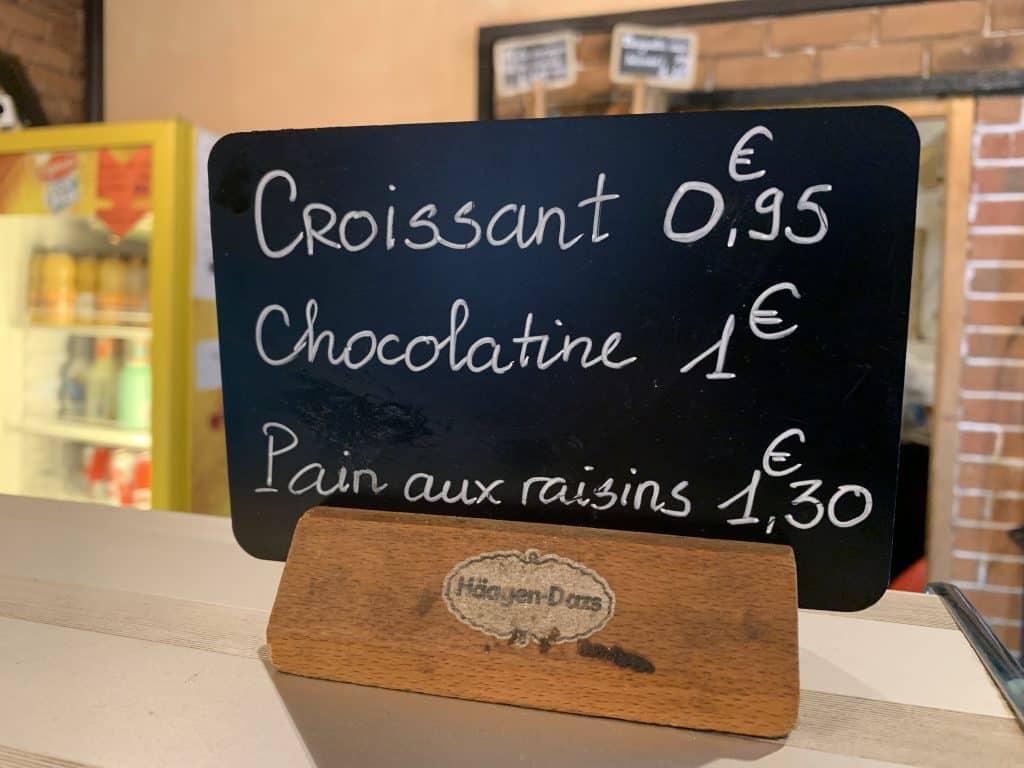
chocolatine

Boulangerie Basics

I can’t speak for every foreigner, but I can describe the feeling that most Americans have the first time we enter a French boulangerie of any size or reputation.

Wow.

Followed closely by that feeling of awe is the complete ignorance you feel about what to order.  Everyone in line with you seems to be on a mission.  The staff are patient, but not so patient for you to simply stare open-jawed indefinitely.  Where will I learn what to do and what to say?

Turns out, imitation works as a start.

It was maybe my second day in France as I stood in line and tentatively ordered, “une baguette, SVP.”  “Ça sera tout?” is the reply that is repeated, verbatim, by every person who works in any boulangerie in France.  I used to automatically answer “oui” but came to realize as years wore on that the French are giving you permission to change your mind.

Perhaps you only came in here to get a baguette or a pastry, but now confronted with the reality of the situation, you might add on another pastry, or another loaf, or perhaps another treat for later, for a friend of course.  Sometimes after this second or third choice there will be silence as they watch your eyes, which are in turn looking at choices.  Then an internal timer dings in their head and they repeat their default saying, “ça sera tout?”  If there are other staff they will already be helping the people behind you in line.

The imitation game picks up tricks rapidly.  You hear someone ask for a “demi-baguette” and watch one of the staff deftly slice one of the baguettes in half to what is a perfect size for a single person’s dinner accompaniment.  “une demi-baguette, SVP,” I say as if I’ve said that countless times in my life, and hand over exactly half the cost of the regular-priced baguette.  Baguettes were even price-controlled until 1986.  Much like rice in Asia, baguettes in France are still seen as a basic “right” of sorts and if prices rise they will usually be on other types of bread before hitting the rates for the baguette.

More imitation: I hear a gentleman ask for a baguette “bien cuite” and ask myself “a well-done baguette?”  I watch the lady shuffle through the baguettes on the shelf and pick one, holding it for inspection.  The gentleman wants a different one.  She finds one in the back and there it is: a well-done baguette means a bit more cooked, hence a bit darker on the outside and crunchier to the mouth.  You can go the opposite way too, by asking for a “blanche” baguette, though I’d never heard this ordered before I ordered one for a friend who I knew preferred them that way.

More imitation: Someone asks for a “tradition” and the lady reaches for something that looks like a baguette but has a slightly different shape and size.  I then order one and inspect and taste for differences.  They have pointier ends and are hand-formed and baked on premises.  By a 1993 law, a “baguette tradition” can only contain flour, leavening, water, and salt.  The “levain” is something like a sourdough starter but that sourdough taste doesn’t come through as strongly as Americans would expect from anything that has “sourdough” attached to it.

How many different ways can the French deliver such a great product, I thought as my imitation game became a knowledge game and I started to share with friends my fascination about how bakeries worked and how I was having to learn as an adult all the things French children know by the age of six.

There’s also the pain au chocolat/chocolatine “controversy,” if it can even be called that.  Anglophiles might be familiar with the differences between how Devon and Cornwall take their cream tea.  In Cornwall, you put jam on your scone first and follow with a spoonful of cream.  In Devon, on the other hand, cream goes on first, then a bit of jam on top.  It’s always amusing to watch English people argue about this difference as if there’s something genuinely at stake.  So too I’ve been amused to watch “chocolatine/pain au chocolat” square-offs.  The last time I witnessed one was near Montparnasse with a fiercely traditional Breton acquaintance, who rolled her eyes at the chocolatine “advocates” and even more so at the peacemaker who proposed “pain au chocolatine” as the compromise.  The divide can be seen down south at large chains like Paul which use “pain au chocolat” in areas where around them all the independent shops use “chocolatine.”  “It does sound a bit more ‘French,'” I noted to the opinionated Bretonne.  “What do you know?” she said in a (mostly friendly) huff.

What is more wonderful is to see the centuries-old tradition of baking and running a bakery at work in the present day.  Nothing is wasted.  The pastries that weren’t sold yesterday are sold at half price in groups of usually half a dozen.  Look for the plastic bags with pastries inside or ask if they are any “viennoiseries à l’ancienne.”  Any bread that is not sold and is on the way to going stale is then sliced up and put back into the oven to shrink into “biscotte” which are sold for (at the most) 75 centimes a bag and are a great accompaniment to soup or can be broken up to serve as croutons for soup or salad.  I’m certain there’s also a fair amount of trade in breadcrumbs to nearby restaurants that might need them.  There is waste that used to go to the poor or to the pigs in the old days, and some of that still goes to them, but with computers and spreadsheets showing historical demand, I think today’s boulangers have the opportunity to make less waste (and more profit) than their ancestors.  Whether they do or not can also depend on how seriously they take their craft.

When you’ve had hundreds of baguettes you finally start to know instinctively what the French know from their early childhood: the difference between real bakery bread and what is warmed up from frozen prep.  The shocking thing is in Paris quite a lot of baguettes are made from frozen, but that’s because the French people know it’s the lowest denominator of bread and in part are okay with that.  Unlike the “tradition” which is regulated by law as to ingredients and prep, baguettes are not and as such are just there at the very base of the bread pyramid, in a way.

This also means you can taste French supermarket bread for what it is: sad, tasteless, industrial lumps of sadness that would have blown your mind had it been served to you when you still lived in America and didn’t know what real bread could be like (that said, I know a lot of places in America are becoming real havens of true baking skills, but the reality in the heartland is still mostly inedible).

Does that mean you should always order a “tradition“?  It totally depends on you.  When you fall into the rhythms of your neighborhood and your own shopping routine, you will notice that people may skip the bakery next to their house and walk 200-300m to another bakery.  Why?  Perhaps they have a good relationship with the owner.  Perhaps that bakery makes the type of crust they really go for.  Or, in my case, they also make kouign-amanns on a regular basis (worth another article in itself!).

There’s even an importance to what time of the day you go to the bakery.  While Americans might balk at standing in line just to buy bread (even though they’ll happily sit in a drive-thru line for junk food), a line is indicative of usually the best time to get it before all you are left with is slim pickings.  The earlier you go, the better, though there’s a window around 16h00, known as “goûter,” when French kids might get a snack on the way home and fresh bread and pastries come out.  When you come late, you might have the “agony” of what happened to me the other night when the gentleman in front of me ordered the last “pavé,” (country white bread that is so called because it’s shaped like a paving stone) which is my personal favorite for my daily bread, and I had to pretend not to be disappointed as I ordered the sole remaining charpentier, but that’s the joke: a “disappointment” in a French bakery means instead of getting my preferred type of bread, I get another amazing type of loaf.  A charpentier has a beautiful color with a wonderful crust and is just as enjoyable as my usual pavé.

So, those are the basics.  First, start with the imitation game.  Listen to those ahead of you in line and order what they order.  When you get to the front of the queue everyone is going to be patient with you: don’t feel like you need to be in a rush.  Just make it clear that you are studying items rather than just staring off into space with no idea.  During this stage you’ve got nothing to lose since you know nothing and tasting is the best way to teach your palette.  Then as your imitation game becomes a knowledge game, actively try different items and different bakeries to expose yourself to everything your neighborhood has on offer.  Finally, resist routine.  All French people fall into this, but should you wish to be a lifelong learner of the absolute gift to civilization that French bread is, you need to keep trying different things and different bakeries.  You are going to turn into a bread snob, but what did you expect when you moved to France?

I took the photo in Toulouse in late 2020 when I excitedly ordered a “chocolatine” for the first time in my life. 🙂

Did you enjoy this article?  TAIP is 100% reader-supported through tipping.  If you want to leave us a tip of any amount it would be highly appreciated.  These tips help support our efforts to keep TAIP an ad-free environment.  Just like at a cafe, the tips are split evenly among the team.
carte vitale

How to Get a Numéro Provisoire or How to Sign up for Assurance Maladie

For the first year after I arrived in France, every time I went to the pharmacy or doctor, they’d ask for my carte vitale. This is the health insurance card every French person has which allows them to be reimbursed for medical expenses, and each time I politely explained I didn’t have one, the person checking me out would be shocked. To be paying out of pocket for my medical costs was unheard of, even though they were fractions of what I was used to in the U.S.

It took me longer than it could’ve to realize I also qualified for medical insurance or assurance maladie. After going through the process, the first document I received was a temporary social security number or numéro provisoire. If you’re in France on a carte de séjour visiteur, this is the only number you’ll be assigned. However, if you are here on a talent visa or vie privée visa, you’ll be eligible for a permanent social security number, as well as a carte vitale.

Who Qualifies?

Anyone living in France in a “stable and regular manner” qualifies to be covered by France’s healthcare system. This means you do not have to be born in France, married in France, or even working in France to register. However, it means you do have to have spent at least three months in the country and have a valid titre de séjour.

How do I Register?

To register you need to send copies of the following documents to the closest health insurance office. You can look up which one here.

Required Documents:

  • National Identity Card or passport or residence permit, as well as any documentation of your civil status.
  • Extract of birth certificate with filiation or full copy of your birth certificate
  • Completed “Demande d’ouverture des droits d’assurance maladie.” (The second page of the form also lists the necessary documents to include.)

In my case, I sent copies of my passport and current titre de séjour, as well as the récépissé of my PACS — all documents which showed I was a ‘permanent’ resident in France. I also included a long-form copy of my birth certificate which had an apostille and had been translated into French, as well as a letter d’hébergement saying I lived with Fred. Luckily, I was doing this process soon after being PACSed and had all these documents on hand. Proving you live in France usually all boils down to the same set.

Why is it Taking so Long?

  • The Short Answer: Assurance Maladie is a single government health agency that serves the entire country of France. Unsurprisingly, it can take them a long time to process documents, especially since you’re required to mail in your application.
  • The Long Answer: There are many reasons why an application can be deemed incomplete –– perhaps you sent an abbreviated version of your birth certificate, perhaps you forgot to sign a certain form, perhaps your dossier is inexplicably missing. This was the case for my first attempt, and after waiting three months and without a word from the health insurance office, I went back and discovered they had no record of my ever having filed for a numéro provisoire. Whenever possible, try to keep track of who you’re speaking to, their name and contact info, and any trace that could be helpful in tracking down your file. In my case, I simply resubmitted everything and waited a few more months. As you can see, it’s always worth it to follow up and be on top of these processes.

Bonus Question: What’s the difference between a temporary and permanent number?

Your temporary number allows you to be reimbursed for expenses, assuming to keep the form the doctor or pharmacy fills out, as well as any prescriptions, and mail them to assurance maladie. The reimbursement is done directly to your French bank account on file, though the entire process can take up to a month.

With a permanent number, you qualify for a carte vitale which acts as a debit card and means the French government is paying the upfront costs, or at least the percentage of costs covered by the health care system.  You can create an online account on Ameli (the French government’s healthcare site) which means you no longer have to mail completed forms and proof of doctor visits to be reimbursed. That said, as I’ll talk about in a future article, being reimbursed doesn’t mean that one hundred percent of the costs are covered.

If, like me, and you’ve assumed that you don’t qualify for healthcare because you’re not French, I hope this article is helpful. As you can see, the process of applying is relatively straightforward and worth it from a financial sense and for the mental relief of being “covered.”

Photo is of my new card when it finally arrived!

Did you enjoy this article?  TAIP is 100% reader-supported through tipping.  If you want to leave us a tip of any amount it would be highly appreciated.  These tips help support our efforts to keep TAIP an ad-free environment.  Just like at a cafe, the tips are split evenly among the team.