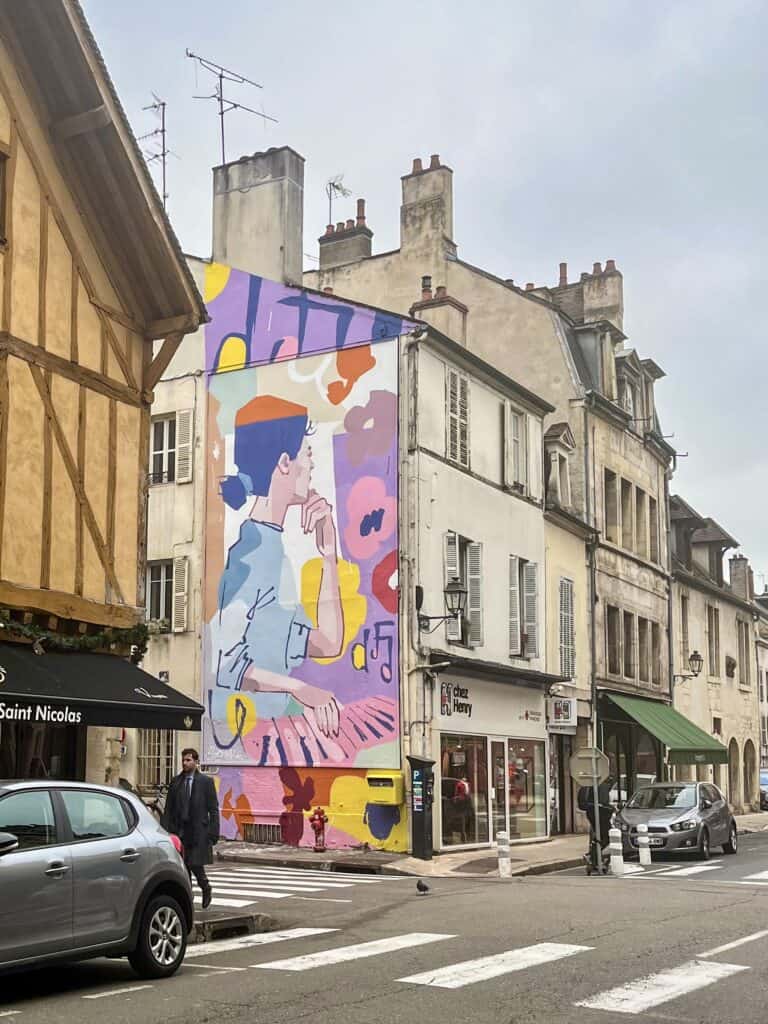
building in Dijon, France with hand painted mural

American Social Norms in France and Why They Don’t Always Translate

As children, we aren’t always taught that what is considered polite to you isn’t necessarily what is polite to another. As an American (especially one from the Midwest), I was raised with a distinct fear of being seen as rude, so when I moved to France this fear followed. It blossomed even more a few months into my new expat life when I realized that much to my surprise, what I was doing to be polite often had the opposite effect.

I did everything I had been taught to make connections, but time and time again conversations ended in tight, awkward smiles and a distinct feeling that things had not gone well despite my efforts. 

I would smile when passing someone by, and if greeted I would say bonjour and try to start a conversation with small talk on the weather or work. If you have spent much time in France maybe you can already see how this eagerness caught locals by surprise and didn’t help assimilation into the French lifestyle. 

Of course, I had been warned about the culture shock and mistranslations, but the sinking realization that I could speak the language but not communicate was heavier than anticipated. So much of what I knew to be polite at home came across as disingenuous, even tedious to my French peers. 

To be completely without cultural misunderstanding is unrealistic, but maybe knowing these social faux pas can help save you a headache or two.

General Conversation and Personal Questions

While living abroad, I found work to be a topic of conversation less welcomed in France. 

In America, work can be seen as a synonym for passion, and asking someone what they do for work is similar to asking what they’re passionate about, but in France that line is less direct. I once heard someone remark, “The French work to live and Americans live to work.” It’s a stereotype that rings true in my experience. 

When I would meet someone, one of the first questions I would ask was what they do for work. To be fair, this question is not always considered impolite, but more than once I would receive a look of someone humoring a child who didn’t know they had done something rude.

It wasn’t until I asked a coworker that they explained in France work is work and passion is passion; not inherently separate but never synonymous. So when asked what one does for a living, the underlying implication isn’t what are you passionate about? and more so, what is your social standing? which (for anyone wondering) is not polite. 

Personal Boundaries and Small Talk

Small talk is considered the necessary evil of getting to know someone in America. We ask questions to build connection, putting in effort and interest, which for many is a show of goodwill. 

However, this form of goodwill didn’t translate and more than once I caught myself outstaying the welcome of French pleasantries. I knew to say bonjour when entering a building, but I mistook this as an invitation for conversation as well, as it had been back home.  

The French show goodwill much longer after getting to know someone than Americans typically do when building a connection. They’re not the type to share as much with strangers and lack the knee-jerk reaction that Americans have to filling silence. Don’t be afraid to let silence sit, and know that most French people build relationships slowly, not through a lot of small talk. 

Performance Cues and Active Listening

Have you ever wondered why Americans do so much active listening? It wasn’t until I was comparing culture shock notes with another American expat that she brought up a conversation she had recently had with her French coworker. 

He mentioned how often Americans smile, nod, and mhmm in conversation and how silly it made them look. It’s true, active listening isn’t done as much in France, and the theories as to why we do this vary from America’s history as a country of immigration to the ever-present “corporate communication” in our daily life. In France however, the bobblehead-ness of active listening more often than not gives Americans an overly earnest appearance.

While at lunch a French friend once remarked that when we first met I had been akin to “Bambi the little deer,” wide-eyed and unsure. He credited the change to my growing confidence, but largely this difference came after I learned to converse without the constant show of attention.

Still show interest, but know the French don’t have to be convinced that you are listening to them. Additionally, know that just because a French person isn’t doing the typical actions we correlate with listening doesn’t mean they aren’t engaged.

Material Expression and Gift Giving

Even after I had finally gotten past the growing pains of forming a cross-cultural relationship, I found my way of showing politeness still tripped me up in terms of appearing overly concerned with material things and gift-giving. 

As an American, it’s often assumed the nicer (and more expensive) the item the better the sentiment. We go out of our way with housewarming events and holidays to show affection through gifts. In France however, the line between good taste and excessive wealth is much thinner. 

More than once I heard someone describe a neighbor or peer as boastful, and when asked why, they would mention something along the lines of how they only drink expensive bottles of wine, or post about fancy vacations and the expensive cars they drove.   

While gifts are still, of course, appreciated, there is more weight behind how much one might pay or “show off” in France. I once had a friend remark on the number of gifts I had given her. It was in an affectionate teasing way the French do when they like you, but it was also a reminder that something that felt so customary to me was not necessarily so for her. 

In all, it took me a while to really evaluate the type of politeness I was raised on and how Midwest manners might not mesh with the lifestyle and culture in France.

While what is polite does not always translate neatly, showing effort is at least a way to communicate that you mean well. When met with communication mishaps, that was one thing that could usually save me, and any expat will tell you all you can do is be patient and sincere in your efforts while living abroad.  

If you find yourself wanting to learn more about American vs French culture I highly recommend the book Cultural Misunderstandings: The French-American Experience by Raymonde Carroll. It’s a great resource and an interesting read filled with personal anecdotes by French anthropologist Carroll, who can possibly help explain why that interaction at the market ended so poorly.

Photo taken in Dijon, France

Did you enjoy this article? TAIP is 100% reader-supported through tipping. If you want to leave us a tip of any amount it would be highly appreciated. These tips help support our efforts to keep TAIP an ad-free environment. Just as at a cafe, the tips are split evenly among the team.
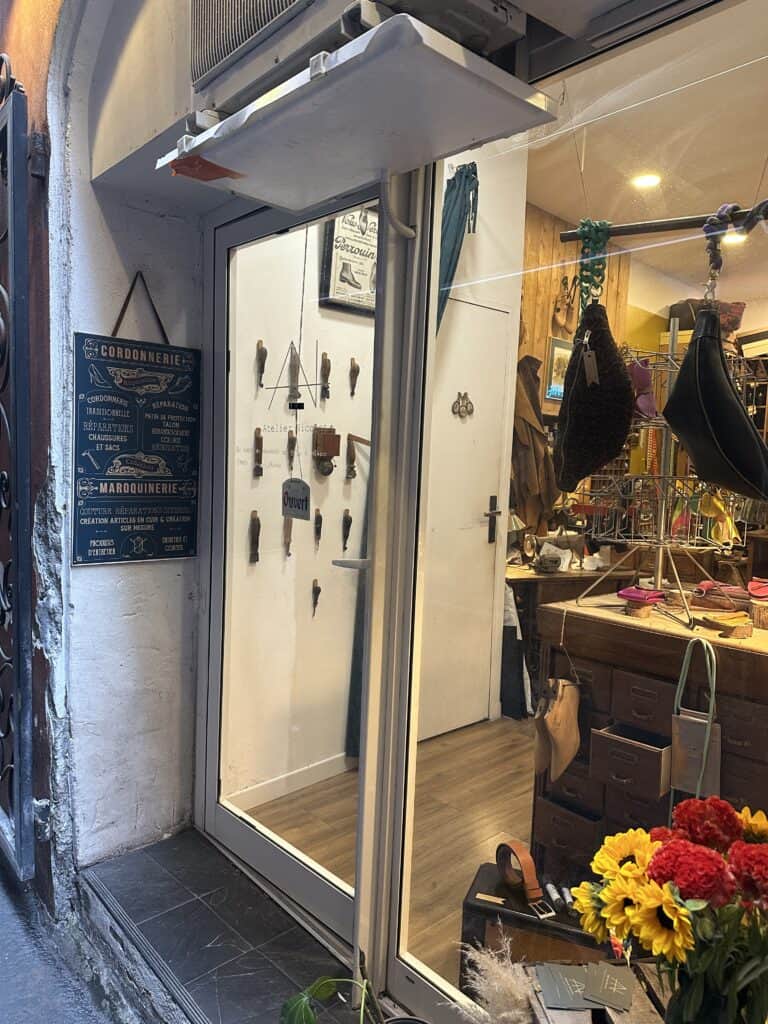
Leather repair shop Atelier Nicolet

A Guide to Female Artisans and Business Owners in Nice

When you move to a new town, you need to start from scratch to find businesses. 

For grocery shopping, if you’re lucky, there will be a nearby supermarket, but other businesses may be further away from home.

Having moved to Nice, at one point I needed a shoemaker, and entered a small shop I found in the Old City. I was surprised to find a female shoemaker; until now, all my shoemakers were male, and in the US, they are often of foreign origin. 

Below are some of my preferred female artisans and women-owned businesses in Nice that I recommend to anyone visiting (or living!) there.

Cordonnerie Atelier Nicolet

Ms. Nicolet always liked working with her hands, but attended university and obtained a degree in literature. However, after attending an event about the bottier (shoemaker in the sense of making shoes) profession, she signed up. In 2008, women were accepted into at least this area of the Compagnonnage du Devoir (craftspeople guild). She found an apprenticeship in Nice, where for two years she alternated between 6 weeks of work in Nice and 2 weeks of training in Paris. After finishing her apprenticeship, she was hired by a Paris-based shoemaker in the Bastille area (which is close to the traditionally artisanal neighborhood of the Faubourg St. Antoine), where she worked for four years.

In the meantime, her partner had been sent to work in Montpellier, and she went to join him, working for another shoe repair company. They both returned to Nice after another four years. However, in Nice, there were few jobs, so she decided to open her own shop in the Old Town, where she was raised, six years ago. Having grown up there, she loves the fact that it is a true neighborhood, even though it is now changing with ever more temporary rentals for tourists. 

She sells a few of her own creations, but she likes doing repairs the most, as every project is a new adventure. Many shoemakers refuse to do some repairs, such as zippers.

Later, after renovating an apartment, it was time to hang art on the walls. I had removed many items from their frames to ship them. An online search for picture framers led me first to one that didn’t exist, so I kept on walking (you can walk to many places in Nice, it’s not an enormous city!) and entered the next shop I found that seemed attractive. Once again, I was welcomed by a woman. 

Ateliers Marianne Strauch

Ms. Strauch herself runs the atelier, and she did her best to offer advice for the painting I brought in, using an old-fashioned wood frame I purchased at the flea market. She was very thorough in explaining the process, and I was curious as to how she came to this particular profession.

She was raised in Nice; her parents were photographers; her father also taught photography. They were not enthused by their daughter’s love for handicrafts. Marianne would spend time at the local ébénisterie (high-end woodworking, from the word ébène, ebony) but to please her parents, she attended college to obtain a BA in history.

However, she didn’t enjoy the notion of continuing to an advanced degree, and set off to tour French workshops around the country, specializing in gold leaf technique, to become an apprentice. Everywhere she was told that she was too old (at 20… usually apprentices start at the age of 13) and that, anyway, she was a woman. 

She came back to the Nice woodworking shop, whose owners knew her well by then. She worked there for a while, but what she really wanted to do was leaf gilding. She was finally able to start training (after sweeping the floors for 6 months) at a Monaco multi-technique establishment which served the Palace. She had to sign a pledge, somewhat like a compagnonnage.

She went on to work overseas in Greek Orthodox monasteries in Greece, Turkey, Egypt, and Russia, in leaf gilding, for several years, then returned to France to work on church furniture in the Ardèche region. There she met her future husband, with whom she had three daughters. When the marriage fell apart, she returned to Nice. 11 years ago, she opened the current shop on Rue Beaumont. Her clients come from all over the region and from all walks of life. One day perhaps… she’ll return to the monasteries!

In more traditionally female-run businesses, I found a wonderful consignment shop in the Riquier neighborhood (east Nice). Old Town is chock full of secondhand shops, but I rarely find anything useful for my needs there. 

Au Fil du Temps

Or, “as time goes by” is run by Melissa. The first thing I noticed was how carefully curated the shop is. Nothing is random. 

Having been raised by a creative mother, Melissa started out with a technical degree in the clothing industry. She spent a short time studying law, but left to work for the lingerie company Etam, where she climbed the ladder to become a store manager. She remained at Etam for 13 years.

She’s always loved the thrill of thrifting when she was younger. After analyzing the secondhand clothing environment, she decided against an Old Town location, as the customer base would be more transient (for those who don’t know Nice, Old Town is a big tourist attraction, along with the seashore boulevard, the famous Promenade des Anglais). She wanted a neighborhood shop, where customers would shop regularly. Tourists who come to the shop find her through online searches.

She’s now run the shop for 17 years. Her goal is not to grow exponentially, but to continue to be able to take care of her business on her own, especially as then she’d need to move. 

Au Fil du Temps is for the women who want good brands, who want to look good, without breaking the bank, while helping the planet by shopping secondhand. 

The Notion of Sustainability

After interviewing these three remarkable women, I realized that all three of them in some way work towards a more sustainable planet: through repairing shoes and bags, instead of discarding them; through reusing materials to make new frames; and, of course, through selling secondhand clothing.

What was also interesting was that all three were raised in Nice, and even if they left at some point, they returned to their hometown. 

My erroneous assumption was that the craftspeople would have inherited their shop from a father or a grandfather; it’s quite the contrary when it comes to women!

Photo of the leather repair shop Atelier Nicolet

Did you enjoy this article? TAIP is 100% reader-supported through tipping. If you want to leave us a tip of any amount it would be highly appreciated. These tips help support our efforts to keep TAIP an ad-free environment. Just as at a cafe, the tips are split evenly among the team.

French Republic Justice Palace in Paris, France

How to Apply For French Citizenship Part IV, Part 1: Decision

To see a video discussion of the information in this article click here.

So on February 25th, roughly three months after my citizenship interview, I got an electronic notice that I should re-apply in two years because of “insufficient professional integration.” I appealed that decision, because it would be silly for me not to, since even if I accepted the decision I would have to start the process all over again in two years.

The way the appeals process works is that if you receive no reply within four months, that is considered an implicit rejection, and you have to sue in Nantes as your final recourse. That meant June 25th would be a final decision, of sorts.

I had no intention of suing, as I knew (and had suspected) that my income might have been an issue.

Some of you reading this have not been on this immigration journey with me for the last decade so I’ll give you the quick version.

In 2013 I moved to France on a visitor visa which I renewed in 2014. In 2015, armed with proper information thanks to people like Jean Taquet (not intolerable Karens in FB groups), I applied for a PL visa which would allow me to work in France, give me a longer renewal window (4 years), and open the possibility of citizenship. My plans of “apply for citizenship the moment I am eligible” faded into the rear-view mirror, along with annual visits to the prefecture to renew my visa.

It’s important to remember here that the income bar necessary to renew your carte de sejour is very different from the bar necessary to obtain a ten-year card or citizenship.

The SMIC, a fixed national minimum wage, is really all you need to obtain a visitor visa, and SMIC + 20% is all you need to obtain and maintain a 4-year card (no, that’s not in writing anywhere: the French government isn’t in a habit of providing clear instructions on immigration requirements).

This is where my being an American, and being an American business owner for twenty years, really influenced my actions.

Most Americans have an aversion to taxes in general, as our country was (ostensibly) founded on a tax revolt. Most people in our country feel like we already pay too much in taxes, and aren’t interested in paying more, no matter what the consequences are to the country as a result.

Furthermore, the US tax code is built around small businesses. The expense deductions that businesses can take allow small businesses to grow and thrive. I know because I’ve seen it myself, having built multiple companies from scratch, including the one I sold that allowed me to move to France in the first place.

So, as I stood up my new French profession libérale business, I created a US equivalent (and later one in the country of Georgia as well) that would allow me to have options on how and in which tax jurisdiction I billed my clients. France has no moral or legal right to require me to do all my business in France, and besides, the PL comes with an income cap of around 85k anyway, so even if I abided by the “keep all my income in France” thinking that France would like me to consider, at some point I would have to bill elsewhere to stay under the cap.

But it never got that far, because I was very unhappy with my first business tax return in France. I was unpleasantly surprised to find out that many of the deductions I had been used to as a US business owner had no equivalent in France, and that what was a much smaller portion of my expenses in America, namely social charges + income tax, were roughly doubled in France, but for no additional benefits to my business.

Let’s clarify a couple of things. There’s no “free education” in France; there’s just education that is paid for by heavy taxation put on everyone. There’s no “free healthcare” either. Not only do all of us pay into a fund that pays for health care, but even at the point of service it’s 70% paid. You have to pay for the rest yourself or via a private insurance plan you pay for. Life in France for me is not beautiful because of the welfare state, it’s beautiful because of the wonderful people in it and the culture they create and uphold.

So, France delivered, and continues to deliver, an incredible lifestyle, one that I love. And yet, I was unwilling to opt for double taxation for it. I was willing to meet the minimum necessary to keep my carte de sejour, not more.

To put this in terms of euros and cents, had I billed more of my clients to my French business over the last five years, which would have been the perfect showcase for my citizenship dossier, I would have paid north of an additional 50,000€ in taxes and social charges, at minimum.

Many would argue, in a world in which citizenships go for millions of dollars (Cyprus, New Zealand, Singapore), why not just pay the 50k? The short answer is, I don’t have that extra money. That 50k I saved paid for trips to every single European country save three (Belarus, Ukraine, and Russia). It paid for trips to Singapore and the US to see my family. It paid for not one but three trips to New Zealand and three to Australia.

Was I willing to give all that up to have a citizenship that would allow me to live in France forever? My actions spoke for me: no.

The Consequences

I have always told everyone, for years, that France is the most anti-business country in Europe and that I only started a business there to have a path to citizenship, and the minute I got that citizenship, I would close the business down.

The logic still holds. Because I didn’t get citizenship, and I’m unwilling to pay more in taxes because of fundamental beliefs and practical reasons, I am going to close my French business. I’ll document that, as I have so many other things, to make sure others have help if and when they have to close their businesses. But that also means that I’ll lose my current immigration status and will have to change it or leave France when my carte de sejour expires in January 2026.

I have an incredible life in France, but I traveled a lot in 2022 and 2023 for personal and professional reasons, and the reason I put in for citizenship in the first place, despite having been eligible for five years already, was that I was considering leaving France for an extended period. It seems now is the right time to do that.

Starting Over

I’m certain many of you might be asking, “Aren’t you afraid of having to start all over?” The answer is no, because it’s not clear to me that my future is in France. This beautiful country has every right to restrict who becomes a citizen and I accept France’s decision.

There’s a big beautiful world out there, and I’m going to see more of it. I’m incredibly grateful for my dozen years in my beloved France. It very much changed my life.

It’s important to always maintain the prerogative in your life to not be bound to scripts or patterns of behavior. Always reserve the right to do what makes the most sense in your life, even if it’s difficult or challenging.

And I still have much I want to share about French life and adapting to it, so I’ll still be writing here at TAIP and appearing with Molli on our YouTube channel, taip on tape.

Thanks for joining me on the French segment of my journey, and I will continue to assist others who wish to come here.

I delayed posting this article for a few months because this decision interrupts our series, which still needs to be finished. I continue to solicit among Americans I know who have completed the process par decret. If you know anyone who fits that bill who would like to write, we only need these two final parts: decision (which we will label Part 2) + ceremony. Use the contact us form to recommend a friend. 

Photo by Nathan Cima on Unsplash

Did you enjoy this article? TAIP is 100% reader-supported through tipping. If you want to leave us a tip of any amount it would be highly appreciated. These tips help support our efforts to keep TAIP an ad-free environment. Just as at a cafe, the tips are split evenly among the team.
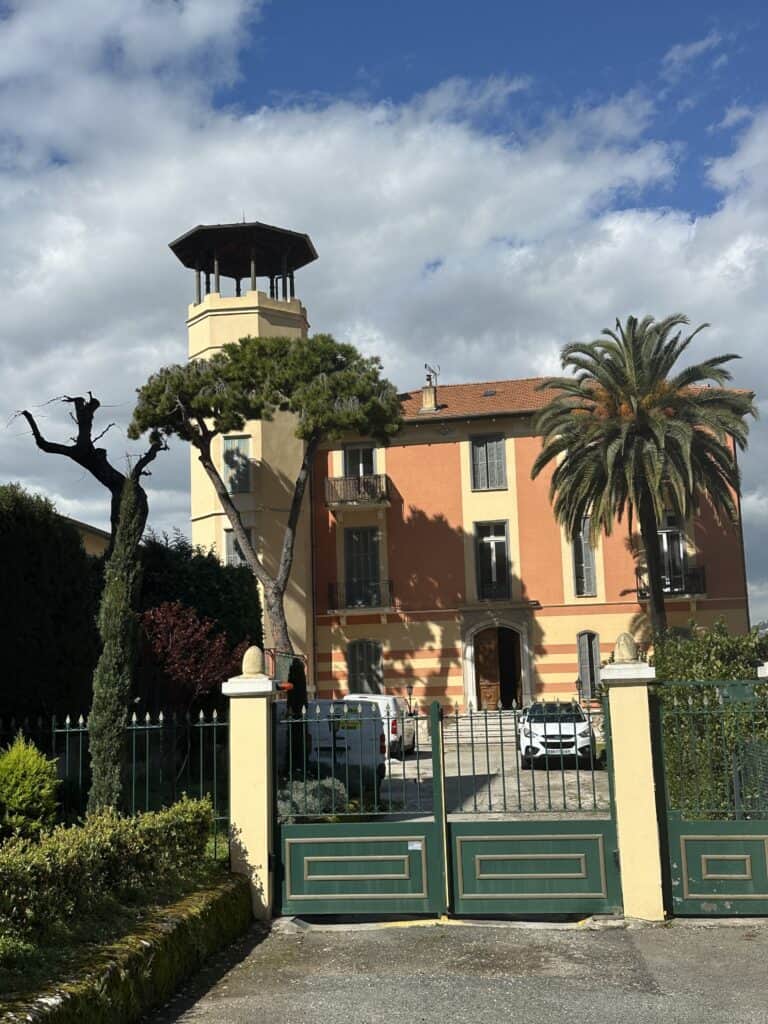
Building in Nice on Mont Boron: probably Villa Marie Leocadie

Moving to France as a Retiree: The Journey (Part 2)

In Part 1, I described how I applied for a long-stay visa to France as an American retiree, without any EU citizenship or job.

I hadn’t mentioned two items in the visa application process:

  • You will be asked to write and sign a letter promising not to work in France.
  • You need to prove an income of at least the French minimum wage. I provided my pension 1099s, and the Embassy requested a few months of bank account statements to boot.

As you may have already read in the TAIP blog, receiving some work-related income in the US is frowned upon by the French tax authorities. France and the US have a tax agreement and last year I did not have to pay any income tax in France (I had already paid in the US).

Settling Down

With a few months’ respite until the next round of residence applications, it was time to figure out where to live on a long-term basis.

The first few weeks, I was in a series of home exchange apartments in several neighborhoods. I moved on to an Airbnb, then to a studio rented previously from friends of a friend, while looking for a longer-term rental. In Nice, my chosen city, it was just the wrong time: students were moving out of their nine-month rentals, and the apartments were being quickly rented out for the tourist season.

I paid a fee to a rental agency: money down the drain. I went to see a longer-term rental, but there was no kitchen equipment (often the case in some European countries), and I didn’t want to buy an oven and a refrigerator for just a few months, for an apartment I didn’t even like. Finally, the decision was made to buy an apartment, as my partner and I were going to stay in Nice anyway. We found by sheer good luck a wonderful realtor who patiently took us to a variety of places in our chosen neighborhoods (close to public transportation but not too close to tourist and second-home areas) until we found a place that checked many boxes.

Another warning: do your homework about the different ways to own property. In France, a notaire (notary) handles many legal issues that in the US would be handled by an attorney. Ours did not lay out the options for us.

Applying for a Carte de Séjour (Residence Card)

Two months before my visa expired, I went online on the immigration website — the same one where I validated my visa. Now I was in the system, but the site wouldn’t accept my password, and I made the terrible mistake of (in desperation) using my email as a user name. That took me down a rabbit hole, and I found out two months later that I had applied for refugee status! Warning: only log in with the numéro d’étranger!

The login area is on the upper right-hand side. Once you’re “in” you’ll see your history. I was asked for a list of documents, including an e-photo (there are specialized photography studios that will take your photo and provide you with a number.) When you enter the number, your photo pops up. That is a really nice digital feature.

Unfortunately, not everything is as polished. As it turns out, it is almost impossible to ask a question. There is a question area, but it feels like a bot is answering. If you attach the wrong item, you wait about a month before being able to modify it. If you try going to the Préfecture (regional administrative headquarters) without an appointment, you’ll stand in line for 2 hours for nothing, as they instruct you to go online. 15 months went by before I received my residence approval. In the meantime, sometimes I’d get a three-month document to prove that I was allowed to be on French territory. It was nerve-wracking every time I needed to travel outside the EU.

Things may go faster in other regions, where there are fewer foreigners. Southern France apparently is notorious for delays, even for other immigration matters.
There are consultants, but in my humble opinion, I am not convinced they can help things go faster. If you don’t speak/understand French, though, it may be worth it to get precise information. Avoid paying anyone you don’t know large amounts of money.

At the end, the system worked. Next year, I’ll start over for the next carte de séjour! I hope it will be easier, but immigration laws may change and I can’t take anything for granted.

Photo of a building in Nice on Mont Boron

Did you enjoy this article? TAIP is 100% reader-supported through tipping. If you want to leave us a tip of any amount it would be highly appreciated. These tips help support our efforts to keep TAIP an ad-free environment. Just as at a cafe, the tips are split evenly among the team.

two large dogs in front of a river

The Ins and Outs of Moving to France with Your Dogs

As my husband and I started sharing the exciting news about our upcoming move to France with our friends and family, many asked, “Are you bringing your dogs?” I was flabbergasted to think that anyone would consider leaving their pets due to a move, but politely replied, “Of course, we could never leave our dogs.” I completely understand the responsibility that comes with owning a pet, and if they can’t move, we can’t either. And thus, the process began. 

Starting our Research

I’ll quickly admit that we weren’t familiar with the process of moving, or even air travel, with our dogs before we committed to moving to France. They have been on many road trips, but they have never been on an airplane. For a bit of background, we have two friendly dogs, Cleo and Maisie. They are both five years old and weigh 70-80 lbs (32-36 kg). 

Before you move any dog to France, there are some restrictions to be aware of: 

  • Dogs must be over 15 weeks of age at the time of entry to France
  • There are multiple dog breeds that are banned in France including: Staffordshire terrier (pitbull), Mastiff, and Tosa 
  • The French may refuse entry if your dog resembles one of the banned breeds if they are a mixed breed 
  • There is a maximum of five dogs per person under the “non-commercial” classification 

There are three basic requirements for anyone traveling with their dogs to France: they must have a registered microchip, an up-to-date Rabies vaccination, and an EU pet health certificate. Additionally, an I-CAD registration is required for any dogs that will be residing in France for more than three months. 

The best place to begin is by making an appointment with your veterinarian in America. During this visit it is important to confirm that your dog has a registered microchip and is up to date on their vaccinations. The microchip must be implanted before the dog receives the rabies shot. You can NOT wait until your final veterinarian appointment for your dog to receive the rabies vaccination as a 21-day waiting period is required before arriving in France. I would also recommend that you ask your veterinarian if they believe your dog will be successful on such a move and confirm that they are an USDA-accredited vet comfortable with completing EU health certifications. 

How Will You Be Traveling to France?

There are two options: boat + car travel, or air travel. It is possible to travel to France from the US via the Queen Mary 2 ship. The Queen Mary 2 departs from New York and arrives in Southampton, England. This is the much longer option as the transatlantic journey takes seven nights and then an additional day to drive to France. However, this is a viable option for pet owners who have dogs that are not suitable for air travel. This primarily applies to snub-nosed (brachycephalic) breeds that can not safely fly. Of note, this option is typically fully reserved a few years in advance so it is best to reach out to Cunard Cruises to inquire as soon as possible if you are interested. 

We decided to go the air travel route. We chose to fly with our dogs because they are both healthy, and the travel time is so much shorter. Dogs can either travel in the cabin or in the cargo section under the airplane. Unfortunately, only dogs under 15-20 lbs (7-9 kg) (variable according to specific airline) have the opportunity to fly in the cabin. There are of course exceptions for service animals. 

Our dogs are both much heavier and need to fly in the cargo. I was very apprehensive of this at first because I had heard horror stories about dogs flying cargo, but as I started to research, I learned that it is actually very safe. I would recommend looking into specific airline policies regarding pets in cargo before booking tickets. We did exactly that and decided to book our tickets through Lufthansa with a layover in Frankfurt. Lufthansa is known to be one of the best airlines for transporting pets and has a designated dog center in the animal lounge in Frankfurt. I booked my husband’s and my tickets first and then called Lufthansa to have both our dogs added to the flight. I recommend that you call them immediately after booking your flights, as they only allow a certain number of animals on each one.

Another Visit to the Vet 

The flights were officially booked, and we knew exactly when we would be arriving in France. The next step was to call the veterinarian and make an appointment for an EU health certification. This appointment MUST be done within ten days of your departure to France. The process requires your vet to fill out the EU pet health certificate and send it to the USDA for endorsement. The USDA will then mail the endorsed health certificate back to you. Therefore, you can NOT make your final appointment the day before you leave America. I would recommend that you discuss the timeline with your veterinarian and make your appointment according to their recommendation (provided that your vet has experience with this process). This is a very important document that will need to be presented at customs when you arrive in France. 

Arrival in France

Bienvenue! If you plan on staying longer than three months, you will need to take your dogs to a French veterinarian for I-CAD (Identification des Carnivores Domestiques) Registration. This is a requirement for all resident dogs in France; it is an official pet registry that can be used if your pet is stolen or gets lost. It is also recommended that you request an EU pet passport during this appointment to allow for easier travel with your pets while in Europe. 

This process may seem daunting, but I promise it will be worth it to enjoy that first croissant outside an authentic French cafe with your sweet dogs at your feet. 

Photo of our dogs Cleo and Maisie

Did you enjoy this article? TAIP is 100% reader-supported through tipping. If you want to leave us a tip of any amount it would be highly appreciated. These tips help support our efforts to keep TAIP an ad-free environment. Just as at a cafe, the tips are split evenly among the team.

The Most Beautiful Place in France

I know the title may be a contestable claim, and so I will add a tiny disclaimer. The Calanque de Sugiton is the most beautiful nature reserve in France that I have seen with my own eyes.

What is a calanque anyway? It is a geologic formation of a steep valley, submerged in part by the ocean. The Calanque de Sugiton is about a 45-minute drive southeast of the Marseille Saint-Charles train station, positioned on the Mediterranean Sea. 

Of the many calanques found in this region, my local friends advised that I see this one in particular for a few reasons. The first being its beauty. Secondly, as I did not have a car during my stay, it is reachable by public transit (and a bit of willpower). Apart from their advice and a pin on Google Maps, I did no research on where to go once I arrived at my final bus stop. This was admittedly very outside my type-A tendencies. In this guide, I will recount the roundabout way I eventually got where I was trying to go and hopefully provide a clearer path for those looking to explore this magnificent nature preserve.

Getting to the Water

When I got off the B1 bus at the stop “Luminy – Parc National des Calanques,” thankfully, I was not alone. On a Thursday morning at 11 am there were about 15 people headed into the park. We were all equipped with our hiking gear, a backpack of snacks, and water for the journey. Although Google insisted that I stay on the road to arrive at the head of the path, I followed the crowd uphill on the sidewalk to a foot path that was marked with a map of the calanques. At this point, I knew I was in the right place. The wide path continued straight ahead, and so did I. 

About a 30-minute walk through the shaded forest led me to a gravel lot with three options of where to go. To my right led a lookout over the calanque. I was anxious to get down to the water and eat my picnic, so I saved the lookout for later and headed left. I chose a path that was marked for pedestrians only. I figured this must be the way to go. The descent led me around an opening in the cliffs. The view was spectacular in the truest sense. Eventually, I reached another fork in the road. To the right was a steep rocky path that offered a shorter descent to the western beach. However, to the left was a slightly longer path to what was marked as the eastern beach. I figured a longer distance would mean fewer people, and so I continued east on the less steep road. 

My instinct was right; there were fewer people, but the smooth descent soon turned into a tricky maneuver along the cliff and over an unwelcoming patch of rocks. My climbing skills were tested and a friendly older woman, who clearly knew her way around, showed me how to get down onto the farther beach. She continued on her way, and I had the rocks and the ocean to myself — for a moment. 

Since it was a little after noon, I started to eat my salad on the shore. I was a few bites in when I noticed a man coming around the rocks I had just come from. A moment later he emerged from around a carving in the shore, now completely naked, to inform me that I was at the nudist beach. He was nice enough to leave me laughing to myself as I packed up my lunch and headed back to the rocky path. I remember thinking, “That’s what I get for not doing my research!”

I retraced my steps and found my way to a shaded overlook above what I could see was the western beach. I sat on the rocks, finished my lunch, and took in the magnificent scenery. When I finally had the courage to continue my search for the right path, I made my way to the last fork in the road that I remembered was labeled with the path to the west. I found a steep rocky way up that rejoined with the road. When I arrived at the road, I turned around to see that the path I had come from was explicitly labeled for the beach I was looking for. Confused, I asked for directions from some fellow hikers beginning their descent. They said that I had come from the correct path, but to hug the right as I made my way down. 

This time I noticed a red marking on the rocks that indicated a steeper descent. Just when I thought I was going too far right and surely going off the path, I happened upon a set of cement stairs that led the way down securely. Finally, this was promising! My hopes were not disappointed and in no time I was at the calm waters, with many a happy pilgrim that had beat me there. I scoped out a spot to leave my things and got in the water as fast as I could. 

When to Go

Being the middle of September, the water was particularly cold, but the sun remained strong enough to encourage me to dive in. I enjoyed a swim around the rocks in the cleanest water I have ever been in. When I made it back to the shore, I warmed up in the sun with a book. At this point I was surrounded by people of all tongues and cultures, fellow explorers and locals alike. It’s hard to keep beauty a secret. I was thankful that it was during the week and off-season. I learned later on that if I had come in summer or even the weekend before, I would have needed to make a reservation. 

After enjoying a few hours by the water, I packed up my things, said goodbye to my moment in paradise, and made my final ascent. After the 30-minute hike uphill, I opted to detour to the lookout that I skipped at the beginning. It was a stunning view and well worth the 40 minutes it took me to get out and back. It was about 4pm by the time I returned to the gravel lot, ready to make the final 30-minute stroll through the forest to return to the bus stop. I arrived with just a 10-minute wait to catch a ride back into town. 

Words of Wisdom

For those willing and able, the Calanque de Sugiton is a generous reward for a day’s hike. The challenge of arriving there revived my spirit of adventure, and I reckon it has done likewise for many. There is no cell signal once the descent begins, so I’d recommend turning your phone to airplane mode and planning a truly unplugged afternoon. If public transit is your chosen method, I’d also advise reviewing bus times in advance to ensure a smooth return.

Have you been to the calanques in Southern France? Has your experience come with other insights? Better yet, do you have another hike in France you recommend? I’d love to hear in the comments below. 

Photo by yours truly, taken before my descent to the water.

Did you enjoy this article? TAIP is 100% reader-supported through tipping. If you want to leave us a tip of any amount it would be highly appreciated.  These tips help support our efforts to keep TAIP an ad-free environment. Just like at a cafe, the tips are split evenly among the team.
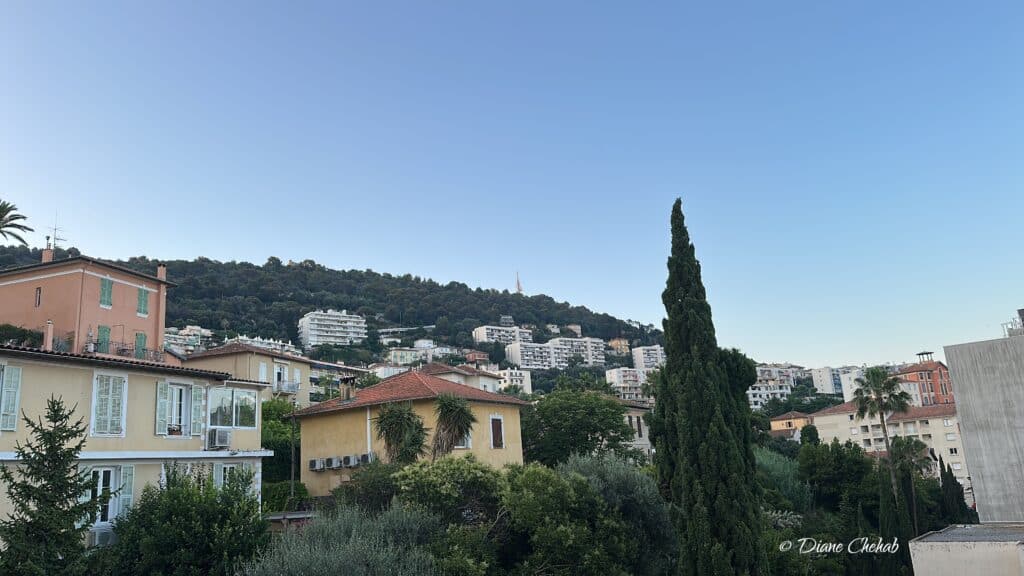
View of Mont Boron in Nice

Moving to France as a Retiree: The Journey (Part 1)

At the age of 69, I decided to move to France. 

I had already lived in the Paris area in my youth, first as the child of an expat working for a US company, and then as an architecture student at the Beaux Arts (Fine Arts). Until 2005, I only had French degrees (not on purpose, it just happened due to moving, wars, et al). 

This background is, however, of no interest whatsoever to the French government when I decided to move to France (definitely or indefinitely). I have US citizenship, and that’s it. No European ancestors to call upon, unless a crusader strayed into my forebears, but that would be too long ago, anyway.

I’ll provide the story of my journey (I don’t mean the plane journey, long enough from San Francisco to Nice), from decision to first residence card. A couple of things may have changed in the meantime, but not much, as far as I can tell. I wish I had known all the pitfalls before I started; at least I would have been better prepared.

My first bit of advice is to get on Americans in France blogs, Facebook groups, etc., before you start, rather than afterwards! You can’t believe everything (and you shouldn’t even believe me, without verifying first), but at least you get a lot of information about the pain points.

Before You Pull Up All Your US Roots

  • If you are selling your home, do it before you move to France. Otherwise, you may incur additional capital gains taxes in France.
  • Before you cancel your car insurance, ask for a letter that shows your claims history (in theory, 14 years’ worth). Otherwise, you’ll be treated as a beginner driver.
  • Only some US states have a reciprocity agreement for the driver’s license. 

The Start: the Long-Stay Visa

France is not a country that is especially welcoming to non-EU (European Union) immigrants. There are no golden visas and no special deals. There are many categories of immigrants, and the first action item is to figure out where you fit in. There is no official “retiree” visa: it is a visitor visa. It is only at the expiration of the 1-year visa that you can apply for a residence card.

You’d think the place to apply would be the French embassy or consulate in your area, but no. Visas had been outsourced to a company called VSF Global — now it’s another company, TLSContact. Visas are handled for a variety of countries; the person I interviewed with didn’t even speak French. Before booking an appointment, you fill in an application.

The visa requires health insurance. I got mine via the VFS website, with a company named Mutuaide. Possibly, TLScontact offers links to insurance companies. American insurance companies may be very expensive. **Note from the editor: we recommend Cigna Global for the health insurance needed for your visa application.

You register your account on the TLS site, find the appropriate visa type (VLS-TS), provide the documents they request, and ask for an appointment. Remember, there is no specific retired person visa; you apply as a visitor.

At the appointment, you’ll be asked some questions, get fingerprinted, and hand over your passport, which will be sent to the French Embassy. If the request is accepted, you’ll get it back in about a week or so, with a full page stamp that shows your “numéro d’étranger” (your “foreigner’s number”) that will follow you for the length of your time in France as a foreign resident.

Arrival in France

Once you have arrived in France, you will need to “validate” your visa online. There will be a fee.

Then you receive an email with an appointment for a health check. In 2023, I needed a recent chest scan, but this may not be the case any longer. My scan was a couple of months old, so I had to undergo a new X-ray at the government office on the day of my appointment.

You cannot choose your appointment. If it’s inconvenient, you can cancel it and wait for a new appointment. It took about 6 weeks for me. There is nothing you can do to speed it up. If it’s inconvenient again, well, too bad. I had to cancel a trip.

After the chest scan, you go to another location and fill in a couple of questionnaires. One of my questionnaires was about my mental health. Some questions were tricky: “Do you worry about your weight?” for example. “Have you ever been upset at your coworkers?” (I don’t recall the exact wording.) You undergo an interview with health professionals, and if you pass muster, you are given a receipt that is NOT TO BE LOST (even though nobody asked me for it again).

Health Coverage

After three months in France, you can apply for a Social Security number (this is for healthcare): “ouverture des droits.” 

You’ll need to prove that you live in France (usually via electrical invoices), and provide:

  • Notarized copy of birth certificate (may need to be translated by a certified translator)
  • Copy of passport 
  • Visa or receipt for residence application
  • Proof of residence: for example, a rental agreement, or 3 months of electrical invoices 
  • IBAN (French bank account info)

Make sure the name on your passport is the same as the name on your birth certificate. If you can’t, be prepared to be able to prove who you are!

Most probably, you will receive a questionnaire or a request for more documents. And then you wait, and you wait some more. You may have been approved without even knowing it. Sometimes it’s easy, and sometimes it’s very difficult. You can call them for updates; they have English-speaking agents, but you may not get the correct answer. 

In the meantime, it’s less expensive to get medical care in France than in the US without insurance. 

Taxes

Once you’ve been in France for over 6 months, you will be considered a tax resident. Income taxes are filed around May. The deadline works well for US taxpayers, as we file in April.

There may be a tax office in your town, and it is possible to talk with the counselors; it’s better to go before high tax season starts (I waited for an hour in the pouring rain in April, and at one point someone advised me in the lobby. They were very, very busy).

A Few More Notes

  • US Medicare does not cover overseas expenses
  • Beware requesting a 6-month visa instead of a 1-year visa on the TLS website; you won’t be able to request the carte de séjour (residence card)
  • American Express is not widely accepted in Europe, and they charge fees for overseas charges
  • US credit card companies will not automatically cover your overseas expenses in the unfortunate case of your card being stolen and used before you can block it
  • When you get money at an ATM, it is usually preferable to choose to get the money in euros, rather than have it converted by the bank managing the ATM. Unless the US dollar is in free fall. You never know

This first part covers my experience of getting your foot into France! Stay tuned for Part 2 for the next part of the saga. 

Photo of the view of Mont Boron in Nice.

Did you enjoy this article? TAIP is 100% reader-supported through tipping. If you want to leave us a tip of any amount it would be highly appreciated.  These tips help support our efforts to keep TAIP an ad-free environment. Just like at a cafe, the tips are split evenly among the team.

doctor and nurse figurines in front of another on a hospital bed

How Healthcare for Expats in France Really Works

We often get asked questions about healthcare for expats in France. This is especially true for our older audience — retirees hoping to move abroad, folks over 50 who decide to make a life for themselves in Paris or elsewhere — they want to make sure they’ll have coverage.

It’s no surprise that Americans are concerned about this as our healthcare system is one of the most complicated, expensive, and challenging ones in the world (I said what I said). For many, healthcare is one of the biggest unknowns when moving to France. 

The good news is that France consistently ranks among the best in the world for quality and accessibility of care. I have had nothing but good experiences with healthcare in France (okay, maybe I’ll admit the one dentist I saw wasn’t the best), and I found it easy to navigate once I got the hang of it. 

We’ve already written about our experiences with osteopaths and chiropractors, how to get a numéro provisoire to get your carte vitale and sign up for a mutuelle, and the differences between the CSS and top-up insurance, but I wanted to create a deep dive to hopefully help quell some of your worries.

While the system may seem intimidating at first, healthcare for expats in France is surprisingly affordable and reliable once you understand how it works.

The Basics of French Healthcare

France operates on a universal healthcare system called the PUMA (Protection Universelle Maladie). This means that every legal resident — yes, including legal expats — is entitled to coverage. When you go to the doctor or a hospital, the state pays a percentage of your medical costs and you’re responsible for the rest.

The golden ticket to benefiting from this system is the carte vitale. This small green health insurance card is tied to your French social security number, and when you hand it over at the end of appointments or at pharmacies your reimbursement is processed automatically. 

Once you arrive, securing this card is one of the first big steps toward fully integrating into life in France.

Who’s Eligible and When

Generally anyone with legal residence in France can access the system. Non-EU expats (like Americans) typically have to wait three months after their arrival before they can apply. 

Students, salaried workers, and retirees each have slightly different processes:

While you wait for approval, we typically suggest you stick to the private health insurance you were required to have for your visa application. Cigna Global has great options for expats, as does AXA.

What’s Covered and What Isn’t

One of the best surprises about healthcare for expats in France in my opinion is just how much is included. Doctor’s visits, specialist appointments, hospital stays, prescriptions, and maternity care all fall under the state system. Most GP visits cost around 25 €, and the government reimburses about 70% of that (color me surprised at my first appointment when I only owed 7.50 €!). Hospital stays are reimbursed at 80%, and chronic conditions are covered 100%.

The biggest gap is in dental care, eye care (including glasses and contact lenses), and certain specialists. I personally found the cost to be nominal coming from the US, but after some encouragement from my mother-in-law, who was choquée that I didn’t have top-up insurance to cover it, I did end up signing up for a mutuelle to help cover the costs (more on that later).

One thing to note if you’re still waiting on your carte vitale — save your receipts. You’ll be required to pay up front, but as soon as you receive your card, you can submit your feuilles de soins for reimbursement later. And yes, I can confirm they actually do reimburse you.

The Role of the Mutuelle

A mutuelle is France’s version of supplemental private insurance, or “top-up” insurance. You can think of it as the add-on that fills any gaps left by the state. A typical mutuelle covers the remaining 30% of GP visits, plus higher percentages of dental and eye care.

Don’t let the word “private” fool you, it’s still very affordable especially coming from the US. You can expect to pay anywhere from 30 € to 100 € per month, depending on the coverage you choose. I wear glasses and contact lenses so I decided to get a plan somewhere in the middle and paid around 45 € per month. Most, if not all, of my appointments were covered and my glasses and lenses were very inexpensive.

For any of our salarié readers, if you’re employed in France your company is legally required to provide a mutuelle, and it’s usually one with very good coverage. Freelancers, students, visitors, and retirees need to shop around for themselves. I like Harmonie Mutuelle myself.

Tips for Using the System

Once you’re set up with your carte vitale and mutuelle (if you choose), daily life within the French healthcare system is very straightforward:

  • Finding a doctor: USE DOCTOLIB. It’s the easiest way for expats to find a doctor, especially if you haven’t made French friends yet who can recommend one. You can even set filters for providers who speak English. If you’re in the Paris area, I loved my team at Ipso.
  • Appointments: Remember to bring your carte vitale so you are reimbursed automatically. Otherwise, save your receipts to submit later.
  • Pharmacies: You’ll also need your carte vitale to pick up prescriptions. Another thing to mention: don’t be afraid to ask your pharmacist for advice on medications. I’ve found that they are incredibly helpful and knowledgeable and they served as an invaluable resource for me.
  • Emergencies: Don’t call 911 and expect to receive help. Instead, dial 15 for the SAMU (medical emergency line that can connect you to ambulances).

The one caveat about the French healthcare system that I feel called to share is that not all French doctors are well-trained in bedside manner. I do believe this is changing as more time goes on, but like many things, don’t expect to receive the same exact experience as you would in the US. 

The care is just as good, don’t get me wrong, but you likely won’t be coddled in the same way you would in America. Honestly, this is good advice to heed when it comes to adjusting to life in France as a whole (just saying).

Healthcare for expats in France may seem intimidating at first glance, but once you take care of the necessary paperwork, it will quickly become one of the more reassuring aspects of life there. With universal coverage, reasonable costs, and a mutuelle to handle all of the extras, feel confident that if something happens, you’ll be well cared for.

Photo by Annie Spratt on Unsplash

Did you enjoy this article? TAIP is 100% reader-supported through tipping. If you want to leave us a tip of any amount it would be highly appreciated.  These tips help support our efforts to keep TAIP an ad-free environment. Just like at a cafe, the tips are split evenly among the team.

a notebook with a pen and a cup of espresso on a wooden table

Call for Writers!

Have you ever thought about writing for The American in Paris? Now’s your chance — I’m putting out a call for new writers to join our small but mighty TAIP team. We still have plenty to share ourselves, and now I’m interested in expanding our reach via new voices, new stories, new pieces full of advice for new or hopeful expats.

If you’re currently living abroad in France or have ever lived there, you’d make a great fit. If you’ve more recently gone through the process of applying for a visa and are just waiting to board your plane, you’d also be perfect. People of all ages are more than welcome to apply — our team is made up of people in their 20s, 30s, 40s, and (well) beyond.

Those who are interested can comment below with their email or please feel free to send me a message directly at info@theamericaninparis.com. Include any writing samples if you have them, a few article ideas, and a little bit about yourself. This is a paid, freelance position with opportunities to publish at least two times per month.

Looking forward to hearing from (and reading) all of you.

Photo by Elena Kloppenburg on Unsplash

Did you enjoy this article? TAIP is 100% reader-supported through tipping. If you want to leave us a tip of any amount it would be highly appreciated.  These tips help support our efforts to keep TAIP an ad-free environment. Just like at a cafe, the tips are split evenly among the team.
students in front of a building for La Rentrée in France

Understanding La Rentrée in France

I’ve always loved late summer and early fall — “back-to-school” season if you will, though I’ve been out of school for many years at this point. It feels like a fresh start in many ways. My adopted country seems to feel the same, which you’ve likely noticed if you’ve spent an extended amount of time there. La rentrée in France, literally “the return,” permeates nearly every part of French life. 

After the mass exodus of the August holidays, the country seems to come alive, student or not. For my American readers, the closest comparison might be the energy in early January, but in France, it feels like September is the true reset button. Just like I’ve always liked it (no wonder I love it there so much).

The Meaning of La Rentrée in France

While the literal meaning of la rentrée isn’t anything special, in practice, it seems to represent a shift in energy that defines the year — again, even more so than January 1. In France, New Year’s Eve and Day are more about spending time with family and continuing to indulge after the December holidays, not heading to the gym and starting a new diet. Now, I won’t say every French person chooses September to get in shape, but it does feel like a time of new beginnings.

It’s the end of those slow August days when most of the country is on vacation and the moment when schools, workplaces, and even cultural institutions all realign and restart — together. Unlike in the US, where September can feel like just another month on the calendar (especially if you don’t have children), it’s a cultural moment in France.

Back-to-School During La Rentrée in France

That’s not to say that school isn’t a major player in la rentrée. Also unlike in the US, it’s a nationwide return to school. Nearly all of them begin on the same day, no matter where you live. Whether you’re in Paris, Provence, Brittany, or even Corsica, you’ll see crowds of children and adolescents heading back to class at the same time, which contributes to the feeling of it being a shared national moment.

And then there’s the school supply list, which I just have to mention. French parents aren’t just told to buy notebooks and pencils. I was an au pair the first time I was introduced to the extensive liste des fournitures scolaires — a long, detailed list from teachers that often includes specific brands, colors, and paper sizes. Indications like “a blue notebook with large squares, not small,” a very particular pen style, and of course the trousse — the pencil case that’s practically the holy grail for every French child. 

Many families spend the last few weeks of August rushing around to track down the right supplies (I’ve been tasked to help with this bona fide scavenger hunt when I was a nanny). For those on a tight budget, the French government even offers allowances to help cover costs, acknowledging la rentrée in France can be a financial burden for some.

Work Life After Summer

Walk through a French city in August and you’ll often find businesses shuttered or short-staffed. Come September, it can feel like someone switched a proverbial switch. Meetings get scheduled, emails are finally answered, and projects move forward after weeks of delay.

For American expats used to life in the US where vacation is more spread out and work doesn’t slow to a crawl in August, this can feel jarring… but again, I love it. In my opinion, the long break helps get the creative juices flowing again, and once September hits I’m ready and raring to go. That’s exactly how I feel this year, thanks to giving myself most of August off from the TAIP website and our YouTube channel. Very un-American of me, I know.

The Cultural Rentrée

Another thing that makes la rentée in France unique is how far it spills beyond school and work, and right into culture. September is also when French theaters, concert halls, and museums launch their new seasons. You’ll often see posters plastered across the streets of Paris and in the métro for new plays, opéras, movies, and exhibitions all beginning around the same time.

There’s also the rentrée littéraire. Every September, hundreds of new books are released to coincide with la rentrée. Bookstores feature fresh new titles and the publishing world begins to announce nominations for literary prizes like the Prix Goncourt.

In true French fashion it’s quite symbolic — as children go back to school with fresh notebooks, adults start new novels.

To live comfortably amongst the French is to live with the rhythm of la rentrée. And it’s just one of many cultural phenomena that make me feel at home. So, America, you can keep your New Year’s resolutions. You’ll find me making big changes in September.

Photo by Rad Pozniakov on Unsplash

Did you enjoy this article? TAIP is 100% reader-supported through tipping. If you want to leave us a tip of any amount it would be highly appreciated.  These tips help support our efforts to keep TAIP an ad-free environment. Just like at a cafe, the tips are split evenly among the team.