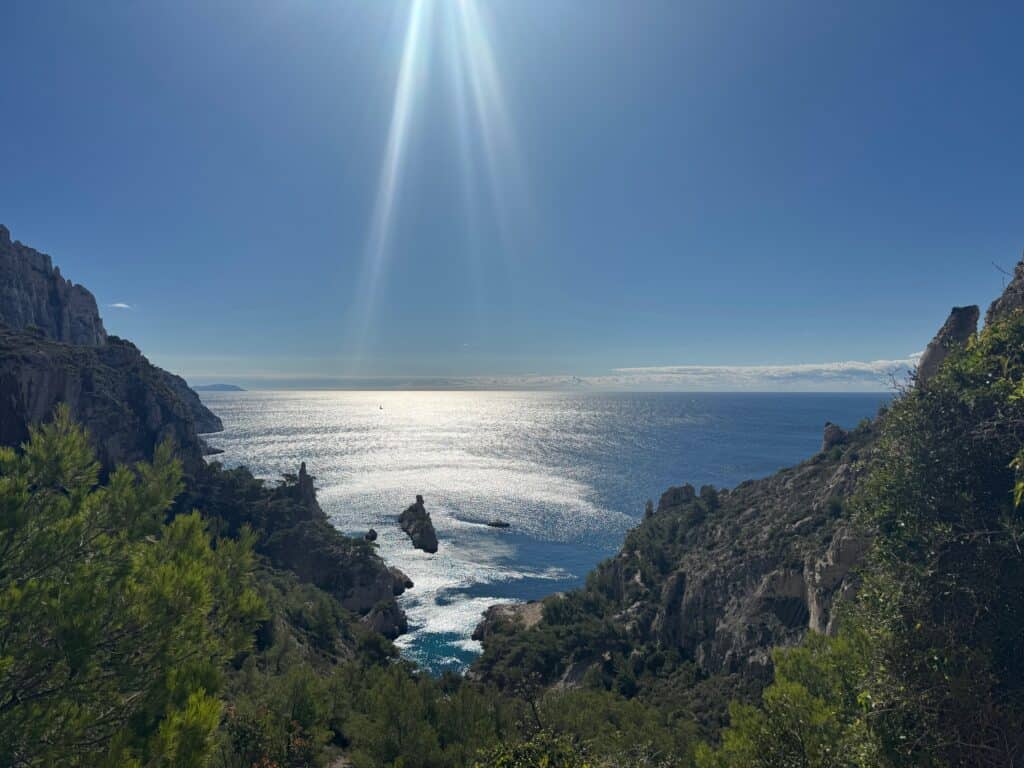
The Most Beautiful Place in France

I know the title may be a contestable claim, and so I will add a tiny disclaimer. The Calanque de Sugiton is the most beautiful nature reserve in France that I have seen with my own eyes.

What is a calanque anyway? It is a geologic formation of a steep valley, submerged in part by the ocean. The Calanque de Sugiton is about a 45-minute drive southeast of the Marseille Saint-Charles train station, positioned on the Mediterranean Sea. 

Of the many calanques found in this region, my local friends advised that I see this one in particular for a few reasons. The first being its beauty. Secondly, as I did not have a car during my stay, it is reachable by public transit (and a bit of willpower). Apart from their advice and a pin on Google Maps, I did no research on where to go once I arrived at my final bus stop. This was admittedly very outside my type-A tendencies. In this guide, I will recount the roundabout way I eventually got where I was trying to go and hopefully provide a clearer path for those looking to explore this magnificent nature preserve.

Getting to the Water

When I got off the B1 bus at the stop “Luminy – Parc National des Calanques,” thankfully, I was not alone. On a Thursday morning at 11 am there were about 15 people headed into the park. We were all equipped with our hiking gear, a backpack of snacks, and water for the journey. Although Google insisted that I stay on the road to arrive at the head of the path, I followed the crowd uphill on the sidewalk to a foot path that was marked with a map of the calanques. At this point, I knew I was in the right place. The wide path continued straight ahead, and so did I. 

About a 30-minute walk through the shaded forest led me to a gravel lot with three options of where to go. To my right led a lookout over the calanque. I was anxious to get down to the water and eat my picnic, so I saved the lookout for later and headed left. I chose a path that was marked for pedestrians only. I figured this must be the way to go. The descent led me around an opening in the cliffs. The view was spectacular in the truest sense. Eventually, I reached another fork in the road. To the right was a steep rocky path that offered a shorter descent to the western beach. However, to the left was a slightly longer path to what was marked as the eastern beach. I figured a longer distance would mean fewer people, and so I continued east on the less steep road. 

My instinct was right; there were fewer people, but the smooth descent soon turned into a tricky maneuver along the cliff and over an unwelcoming patch of rocks. My climbing skills were tested and a friendly older woman, who clearly knew her way around, showed me how to get down onto the farther beach. She continued on her way, and I had the rocks and the ocean to myself — for a moment. 

Since it was a little after noon, I started to eat my salad on the shore. I was a few bites in when I noticed a man coming around the rocks I had just come from. A moment later he emerged from around a carving in the shore, now completely naked, to inform me that I was at the nudist beach. He was nice enough to leave me laughing to myself as I packed up my lunch and headed back to the rocky path. I remember thinking, “That’s what I get for not doing my research!”

I retraced my steps and found my way to a shaded overlook above what I could see was the western beach. I sat on the rocks, finished my lunch, and took in the magnificent scenery. When I finally had the courage to continue my search for the right path, I made my way to the last fork in the road that I remembered was labeled with the path to the west. I found a steep rocky way up that rejoined with the road. When I arrived at the road, I turned around to see that the path I had come from was explicitly labeled for the beach I was looking for. Confused, I asked for directions from some fellow hikers beginning their descent. They said that I had come from the correct path, but to hug the right as I made my way down. 

This time I noticed a red marking on the rocks that indicated a steeper descent. Just when I thought I was going too far right and surely going off the path, I happened upon a set of cement stairs that led the way down securely. Finally, this was promising! My hopes were not disappointed and in no time I was at the calm waters, with many a happy pilgrim that had beat me there. I scoped out a spot to leave my things and got in the water as fast as I could. 

When to Go

Being the middle of September, the water was particularly cold, but the sun remained strong enough to encourage me to dive in. I enjoyed a swim around the rocks in the cleanest water I have ever been in. When I made it back to the shore, I warmed up in the sun with a book. At this point I was surrounded by people of all tongues and cultures, fellow explorers and locals alike. It’s hard to keep beauty a secret. I was thankful that it was during the week and off-season. I learned later on that if I had come in summer or even the weekend before, I would have needed to make a reservation. 

After enjoying a few hours by the water, I packed up my things, said goodbye to my moment in paradise, and made my final ascent. After the 30-minute hike uphill, I opted to detour to the lookout that I skipped at the beginning. It was a stunning view and well worth the 40 minutes it took me to get out and back. It was about 4pm by the time I returned to the gravel lot, ready to make the final 30-minute stroll through the forest to return to the bus stop. I arrived with just a 10-minute wait to catch a ride back into town. 

Words of Wisdom

For those willing and able, the Calanque de Sugiton is a generous reward for a day’s hike. The challenge of arriving there revived my spirit of adventure, and I reckon it has done likewise for many. There is no cell signal once the descent begins, so I’d recommend turning your phone to airplane mode and planning a truly unplugged afternoon. If public transit is your chosen method, I’d also advise reviewing bus times in advance to ensure a smooth return.

Have you been to the calanques in Southern France? Has your experience come with other insights? Better yet, do you have another hike in France you recommend? I’d love to hear in the comments below. 

Photo by yours truly, taken before my descent to the water.

Did you enjoy this article? TAIP is 100% reader-supported through tipping. If you want to leave us a tip of any amount it would be highly appreciated.  These tips help support our efforts to keep TAIP an ad-free environment. Just like at a cafe, the tips are split evenly among the team.
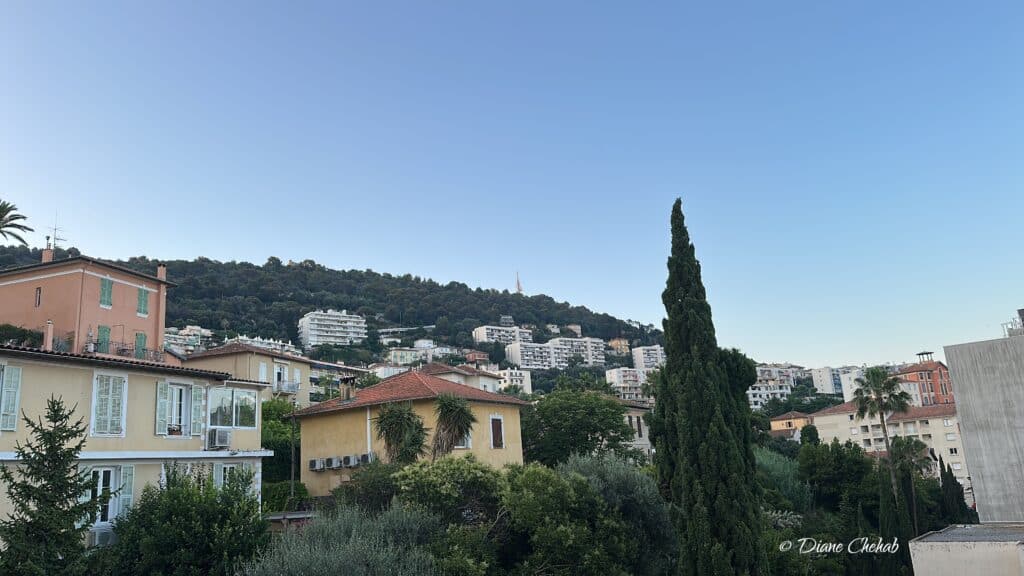

View of Mont Boron in Nice

Moving to France as a Retiree: The Journey (Part 1)

At the age of 69, I decided to move to France. 

I had already lived in the Paris area in my youth, first as the child of an expat working for a US company, and then as an architecture student at the Beaux Arts (Fine Arts). Until 2005, I only had French degrees (not on purpose, it just happened due to moving, wars, et al). 

This background is, however, of no interest whatsoever to the French government when I decided to move to France (definitely or indefinitely). I have US citizenship, and that’s it. No European ancestors to call upon, unless a crusader strayed into my forebears, but that would be too long ago, anyway.

I’ll provide the story of my journey (I don’t mean the plane journey, long enough from San Francisco to Nice), from decision to first residence card. A couple of things may have changed in the meantime, but not much, as far as I can tell. I wish I had known all the pitfalls before I started; at least I would have been better prepared.

My first bit of advice is to get on Americans in France blogs, Facebook groups, etc., before you start, rather than afterwards! You can’t believe everything (and you shouldn’t even believe me, without verifying first), but at least you get a lot of information about the pain points.

Before You Pull Up All Your US Roots

  • If you are selling your home, do it before you move to France. Otherwise, you may incur additional capital gains taxes in France.
  • Before you cancel your car insurance, ask for a letter that shows your claims history (in theory, 14 years’ worth). Otherwise, you’ll be treated as a beginner driver.
  • Only some US states have a reciprocity agreement for the driver’s license. 

The Start: the Long-Stay Visa

France is not a country that is especially welcoming to non-EU (European Union) immigrants. There are no golden visas and no special deals. There are many categories of immigrants, and the first action item is to figure out where you fit in. There is no official “retiree” visa: it is a visitor visa. It is only at the expiration of the 1-year visa that you can apply for a residence card.

You’d think the place to apply would be the French embassy or consulate in your area, but no. Visas had been outsourced to a company called VSF Global — now it’s another company, TLSContact. Visas are handled for a variety of countries; the person I interviewed with didn’t even speak French. Before booking an appointment, you fill in an application.

The visa requires health insurance. I got mine via the VFS website, with a company named Mutuaide. Possibly, TLScontact offers links to insurance companies. American insurance companies may be very expensive. **Note from the editor: we recommend Cigna Global for the health insurance needed for your visa application.

You register your account on the TLS site, find the appropriate visa type (VLS-TS), provide the documents they request, and ask for an appointment. Remember, there is no specific retired person visa; you apply as a visitor.

At the appointment, you’ll be asked some questions, get fingerprinted, and hand over your passport, which will be sent to the French Embassy. If the request is accepted, you’ll get it back in about a week or so, with a full page stamp that shows your “numéro d’étranger” (your “foreigner’s number”) that will follow you for the length of your time in France as a foreign resident.

Arrival in France

Once you have arrived in France, you will need to “validate” your visa online. There will be a fee.

Then you receive an email with an appointment for a health check. In 2023, I needed a recent chest scan, but this may not be the case any longer. My scan was a couple of months old, so I had to undergo a new X-ray at the government office on the day of my appointment.

You cannot choose your appointment. If it’s inconvenient, you can cancel it and wait for a new appointment. It took about 6 weeks for me. There is nothing you can do to speed it up. If it’s inconvenient again, well, too bad. I had to cancel a trip.

After the chest scan, you go to another location and fill in a couple of questionnaires. One of my questionnaires was about my mental health. Some questions were tricky: “Do you worry about your weight?” for example. “Have you ever been upset at your coworkers?” (I don’t recall the exact wording.) You undergo an interview with health professionals, and if you pass muster, you are given a receipt that is NOT TO BE LOST (even though nobody asked me for it again).

Health Coverage

After three months in France, you can apply for a Social Security number (this is for healthcare): “ouverture des droits.” 

You’ll need to prove that you live in France (usually via electrical invoices), and provide:

  • Notarized copy of birth certificate (may need to be translated by a certified translator)
  • Copy of passport 
  • Visa or receipt for residence application
  • Proof of residence: for example, a rental agreement, or 3 months of electrical invoices 
  • IBAN (French bank account info)

Make sure the name on your passport is the same as the name on your birth certificate. If you can’t, be prepared to be able to prove who you are!

Most probably, you will receive a questionnaire or a request for more documents. And then you wait, and you wait some more. You may have been approved without even knowing it. Sometimes it’s easy, and sometimes it’s very difficult. You can call them for updates; they have English-speaking agents, but you may not get the correct answer. 

In the meantime, it’s less expensive to get medical care in France than in the US without insurance. 

Taxes

Once you’ve been in France for over 6 months, you will be considered a tax resident. Income taxes are filed around May. The deadline works well for US taxpayers, as we file in April.

There may be a tax office in your town, and it is possible to talk with the counselors; it’s better to go before high tax season starts (I waited for an hour in the pouring rain in April, and at one point someone advised me in the lobby. They were very, very busy).

A Few More Notes

  • US Medicare does not cover overseas expenses
  • Beware requesting a 6-month visa instead of a 1-year visa on the TLS website; you won’t be able to request the carte de séjour (residence card)
  • American Express is not widely accepted in Europe, and they charge fees for overseas charges
  • US credit card companies will not automatically cover your overseas expenses in the unfortunate case of your card being stolen and used before you can block it
  • When you get money at an ATM, it is usually preferable to choose to get the money in euros, rather than have it converted by the bank managing the ATM. Unless the US dollar is in free fall. You never know

This first part covers my experience of getting your foot into France! Stay tuned for Part 2 for the next part of the saga. 

Photo of the view of Mont Boron in Nice.

Did you enjoy this article? TAIP is 100% reader-supported through tipping. If you want to leave us a tip of any amount it would be highly appreciated.  These tips help support our efforts to keep TAIP an ad-free environment. Just like at a cafe, the tips are split evenly among the team.
doctor and nurse figurines in front of another on a hospital bed

How Healthcare for Expats in France Really Works

We often get asked questions about healthcare for expats in France. This is especially true for our older audience — retirees hoping to move abroad, folks over 50 who decide to make a life for themselves in Paris or elsewhere — they want to make sure they’ll have coverage.

It’s no surprise that Americans are concerned about this as our healthcare system is one of the most complicated, expensive, and challenging ones in the world (I said what I said). For many, healthcare is one of the biggest unknowns when moving to France. 

The good news is that France consistently ranks among the best in the world for quality and accessibility of care. I have had nothing but good experiences with healthcare in France (okay, maybe I’ll admit the one dentist I saw wasn’t the best), and I found it easy to navigate once I got the hang of it. 

We’ve already written about our experiences with osteopaths and chiropractors, how to get a numéro provisoire to get your carte vitale and sign up for a mutuelle, and the differences between the CSS and top-up insurance, but I wanted to create a deep dive to hopefully help quell some of your worries.

While the system may seem intimidating at first, healthcare for expats in France is surprisingly affordable and reliable once you understand how it works.

The Basics of French Healthcare

France operates on a universal healthcare system called the PUMA (Protection Universelle Maladie). This means that every legal resident — yes, including legal expats — is entitled to coverage. When you go to the doctor or a hospital, the state pays a percentage of your medical costs and you’re responsible for the rest.

The golden ticket to benefiting from this system is the carte vitale. This small green health insurance card is tied to your French social security number, and when you hand it over at the end of appointments or at pharmacies your reimbursement is processed automatically. 

Once you arrive, securing this card is one of the first big steps toward fully integrating into life in France.

Who’s Eligible and When

Generally anyone with legal residence in France can access the system. Non-EU expats (like Americans) typically have to wait three months after their arrival before they can apply. 

Students, salaried workers, and retirees each have slightly different processes:

While you wait for approval, we typically suggest you stick to the private health insurance you were required to have for your visa application. Cigna Global has great options for expats, as does AXA.

What’s Covered and What Isn’t

One of the best surprises about healthcare for expats in France in my opinion is just how much is included. Doctor’s visits, specialist appointments, hospital stays, prescriptions, and maternity care all fall under the state system. Most GP visits cost around 25 €, and the government reimburses about 70% of that (color me surprised at my first appointment when I only owed 7.50 €!). Hospital stays are reimbursed at 80%, and chronic conditions are covered 100%.

The biggest gap is in dental care, eye care (including glasses and contact lenses), and certain specialists. I personally found the cost to be nominal coming from the US, but after some encouragement from my mother-in-law, who was choquée that I didn’t have top-up insurance to cover it, I did end up signing up for a mutuelle to help cover the costs (more on that later).

One thing to note if you’re still waiting on your carte vitale — save your receipts. You’ll be required to pay up front, but as soon as you receive your card, you can submit your feuilles de soins for reimbursement later. And yes, I can confirm they actually do reimburse you.

The Role of the Mutuelle

A mutuelle is France’s version of supplemental private insurance, or “top-up” insurance. You can think of it as the add-on that fills any gaps left by the state. A typical mutuelle covers the remaining 30% of GP visits, plus higher percentages of dental and eye care.

Don’t let the word “private” fool you, it’s still very affordable especially coming from the US. You can expect to pay anywhere from 30 € to 100 € per month, depending on the coverage you choose. I wear glasses and contact lenses so I decided to get a plan somewhere in the middle and paid around 45 € per month. Most, if not all, of my appointments were covered and my glasses and lenses were very inexpensive.

For any of our salarié readers, if you’re employed in France your company is legally required to provide a mutuelle, and it’s usually one with very good coverage. Freelancers, students, visitors, and retirees need to shop around for themselves. I like Harmonie Mutuelle myself.

Tips for Using the System

Once you’re set up with your carte vitale and mutuelle (if you choose), daily life within the French healthcare system is very straightforward:

  • Finding a doctor: USE DOCTOLIB. It’s the easiest way for expats to find a doctor, especially if you haven’t made French friends yet who can recommend one. You can even set filters for providers who speak English. If you’re in the Paris area, I loved my team at Ipso.
  • Appointments: Remember to bring your carte vitale so you are reimbursed automatically. Otherwise, save your receipts to submit later.
  • Pharmacies: You’ll also need your carte vitale to pick up prescriptions. Another thing to mention: don’t be afraid to ask your pharmacist for advice on medications. I’ve found that they are incredibly helpful and knowledgeable and they served as an invaluable resource for me.
  • Emergencies: Don’t call 911 and expect to receive help. Instead, dial 15 for the SAMU (medical emergency line that can connect you to ambulances).

The one caveat about the French healthcare system that I feel called to share is that not all French doctors are well-trained in bedside manner. I do believe this is changing as more time goes on, but like many things, don’t expect to receive the same exact experience as you would in the US. 

The care is just as good, don’t get me wrong, but you likely won’t be coddled in the same way you would in America. Honestly, this is good advice to heed when it comes to adjusting to life in France as a whole (just saying).

Healthcare for expats in France may seem intimidating at first glance, but once you take care of the necessary paperwork, it will quickly become one of the more reassuring aspects of life there. With universal coverage, reasonable costs, and a mutuelle to handle all of the extras, feel confident that if something happens, you’ll be well cared for.

Photo by Annie Spratt on Unsplash

Did you enjoy this article? TAIP is 100% reader-supported through tipping. If you want to leave us a tip of any amount it would be highly appreciated.  These tips help support our efforts to keep TAIP an ad-free environment. Just like at a cafe, the tips are split evenly among the team.
students in front of a building for La Rentrée in France

Understanding La Rentrée in France

I’ve always loved late summer and early fall — “back-to-school” season if you will, though I’ve been out of school for many years at this point. It feels like a fresh start in many ways. My adopted country seems to feel the same, which you’ve likely noticed if you’ve spent an extended amount of time there. La rentrée in France, literally “the return,” permeates nearly every part of French life. 

After the mass exodus of the August holidays, the country seems to come alive, student or not. For my American readers, the closest comparison might be the energy in early January, but in France, it feels like September is the true reset button. Just like I’ve always liked it (no wonder I love it there so much).

The Meaning of La Rentrée in France

While the literal meaning of la rentrée isn’t anything special, in practice, it seems to represent a shift in energy that defines the year — again, even more so than January 1. In France, New Year’s Eve and Day are more about spending time with family and continuing to indulge after the December holidays, not heading to the gym and starting a new diet. Now, I won’t say every French person chooses September to get in shape, but it does feel like a time of new beginnings.

It’s the end of those slow August days when most of the country is on vacation and the moment when schools, workplaces, and even cultural institutions all realign and restart — together. Unlike in the US, where September can feel like just another month on the calendar (especially if you don’t have children), it’s a cultural moment in France.

Back-to-School During La Rentrée in France

That’s not to say that school isn’t a major player in la rentrée. Also unlike in the US, it’s a nationwide return to school. Nearly all of them begin on the same day, no matter where you live. Whether you’re in Paris, Provence, Brittany, or even Corsica, you’ll see crowds of children and adolescents heading back to class at the same time, which contributes to the feeling of it being a shared national moment.

And then there’s the school supply list, which I just have to mention. French parents aren’t just told to buy notebooks and pencils. I was an au pair the first time I was introduced to the extensive liste des fournitures scolaires — a long, detailed list from teachers that often includes specific brands, colors, and paper sizes. Indications like “a blue notebook with large squares, not small,” a very particular pen style, and of course the trousse — the pencil case that’s practically the holy grail for every French child. 

Many families spend the last few weeks of August rushing around to track down the right supplies (I’ve been tasked to help with this bona fide scavenger hunt when I was a nanny). For those on a tight budget, the French government even offers allowances to help cover costs, acknowledging la rentrée in France can be a financial burden for some.

Work Life After Summer

Walk through a French city in August and you’ll often find businesses shuttered or short-staffed. Come September, it can feel like someone switched a proverbial switch. Meetings get scheduled, emails are finally answered, and projects move forward after weeks of delay.

For American expats used to life in the US where vacation is more spread out and work doesn’t slow to a crawl in August, this can feel jarring… but again, I love it. In my opinion, the long break helps get the creative juices flowing again, and once September hits I’m ready and raring to go. That’s exactly how I feel this year, thanks to giving myself most of August off from the TAIP website and our YouTube channel. Very un-American of me, I know.

The Cultural Rentrée

Another thing that makes la rentée in France unique is how far it spills beyond school and work, and right into culture. September is also when French theaters, concert halls, and museums launch their new seasons. You’ll often see posters plastered across the streets of Paris and in the métro for new plays, opéras, movies, and exhibitions all beginning around the same time.

There’s also the rentrée littéraire. Every September, hundreds of new books are released to coincide with la rentrée. Bookstores feature fresh new titles and the publishing world begins to announce nominations for literary prizes like the Prix Goncourt.

In true French fashion it’s quite symbolic — as children go back to school with fresh notebooks, adults start new novels.

To live comfortably amongst the French is to live with the rhythm of la rentrée. And it’s just one of many cultural phenomena that make me feel at home. So, America, you can keep your New Year’s resolutions. You’ll find me making big changes in September.

Photo by Rad Pozniakov on Unsplash

Did you enjoy this article? TAIP is 100% reader-supported through tipping. If you want to leave us a tip of any amount it would be highly appreciated.  These tips help support our efforts to keep TAIP an ad-free environment. Just like at a cafe, the tips are split evenly among the team.

The Week Before I Move to France

I’ve got my visa, a year’s supply of my favorite deodorant, and a one-way ticket to France. The countdown to my departure began when I returned to Texas from France four months ago, but I’m still struggling to fathom how those 120 days are now in the single digits. 

Last year, I worked as an English teaching assistant in this quaint town on the south side of the country. This year, I’m returning to the same program, the same lodging situation, and the same community I grew to love. It’s crazy to think that this time last year, I was preparing to live in a city where I didn’t know a soul! 

Round two of working in France has a lot fewer questions on the outset, or at least the questions have changed form. 

“Where will I live?” has become, “What will it look like to live with different people in the same place?” 

“How will I teach?” has become, “How will I serve my new co-workers and students?”

“Who will my community be?” has become, “How will my relationships grow in the months ahead?”

Now being more accustomed to the different language, culture, and daily rhythms of living abroad, I have noticed that my goals have also moved from the category of surviving to thriving. Last year, I learned how to get around using public transportation and my own two feet. This year, my goal is to trade in my US driver’s license for a French driver’s permit. Last year, I learned what a month’s worth of expenses could look like in France. This year, my goal is to live in awareness of my budget instead of relying on additional savings to pick up my slack. Last year, my goal was to keep my head above water and this year, I want to be a well of reassurance and knowledge for the new language assistants coming to my town from around the world.

So now that I’ve talked through the theoretical, let me share a bit of the practical. Here is my to-do list one week before I (re)move to France. 

  • Fill out as much of the paperwork as possible for my request for CAF lodging assistance
  • Purchase a professional translation of my driver’s license and driving record
  • Send in my rolls of film from this summer to be developed and returned to me digitally 
  • Buy a pair of jeans; mine are wearing out and there is nothing quite like American jeans
  • Finish one of the books I’m reading so I don’t have to travel with it; books weigh more than you think
  • Make a final trip to the pharmacy to stock up on my American medical needs
  • Buy a train ticket from Paris to Lyon
  • Plan my arrival
  • Start packing 

Knowing it will be a minute before I see my friends and family on this side of the world again, the logistics are balanced by the weighty work of being present to my community.  I’ve made plans with friends for our final lunch and dinner dates of 2025. Just the other day, I realized that my mom has never been to my favorite park, which is a 20-minute drive from her home. Naturally, we’ve chosen an evening to go together before I hop the pond. Making time for these shared moments is something I know I won’t regret down the line when being together in the flesh is simply not an option. Prioritizing relationships this month has meant pulling back from work projects and letting go of goals I had for this season stateside, but I’m learning that is okay. Choosing personal well-being over professional security, dare I say, even feels a little French. 

Starting a new chapter inevitably means finishing another, and so in this moment of turning the page, I’m also choosing to take the time to reflect. What have I learned from this time in the States? What am I grateful for? What do I want to take with me? What do I want to leave behind? These questions stand up against the metaphorical and the physical. Remember, packing is still on my to-do list. Though sometimes I wish my mind and heart had no luggage fee or weight limit, the reality is they do. The more I process and let go of here, the lighter I will go into the season that awaits me. And as I preach to my fellow travelers, and often stand in need of a reminder myself, “The lighter you are, the happier you will be.”

Cheers to taking flight and traveling light.

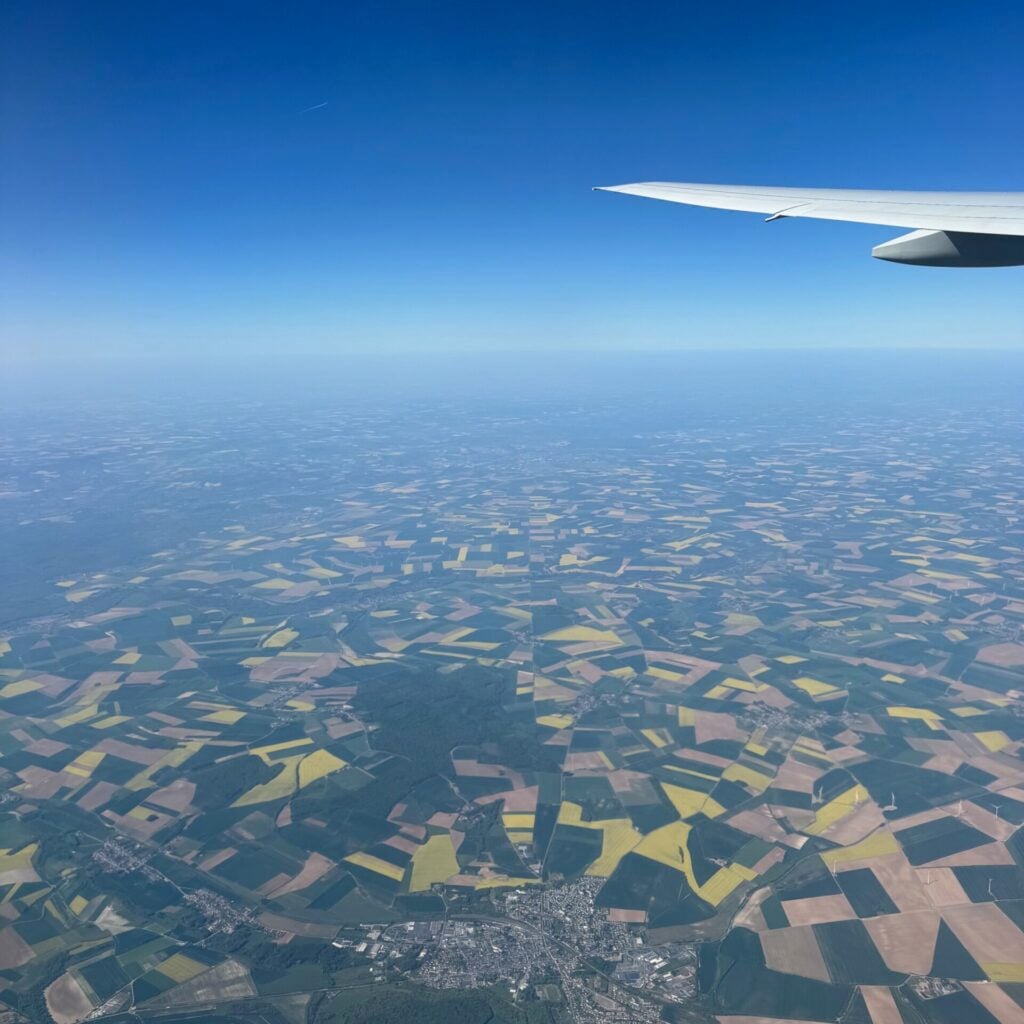
Photo from my last flight over France.

Did you enjoy this article? TAIP is 100% reader-supported through tipping. If you want to leave us a tip of any amount it would be highly appreciated.  These tips help support our efforts to keep TAIP an ad-free environment. Just like at a cafe, the tips are split evenly among the team.

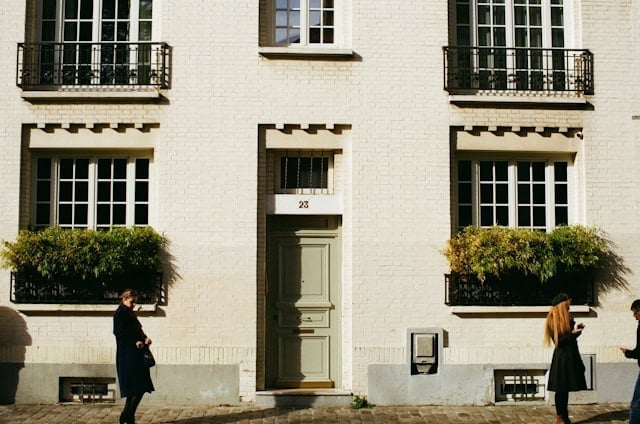
closed shutters on a Parisian building

Why Everything Closes in France in August

If you’ve ever tried to do anything administrative in France during the month of August, you’ve probably hit a wall — or a closed door. Or maybe a handwritten note taped to a window that reads, “fermeture annuelle, réouverture le 2 septembre,” or something similar. 

Most shops close down too (with the exception of many places in Paris that cater to tourists), bakers disappear, your doctor and dentist seem to vanish, and entire neighborhoods go quiet. I remember being extremely confused the first summer I moved here. Why does everything close in France in August? I wondered. 

The short answer? Vacation is sacred here. The long answer is tied to French labor laws, cultural values, and a national love of slowing down. What was once very confusing to me makes total sense and has become just one more thing about the French I admire deeply.

The History Behind August Shutdowns in France

The long-standing tradition of closing up shop in August began in the early 20th century when France introduced paid vacation leave for all workers in 1936. At first, it was only two weeks (the unfortunate truth for most Americans à nos jours), but it eventually grew to the five weeks of paid leave the majority of French employees enjoy today.

For the working class, August was the logical time to take that break. School was out, the weather was nice across most of the country, and most factories and workplaces already had reduced activity. It soon became part of the social rhythm in France, where everyone from small business owners to government workers collectively stepped away from their responsibilities and headed out of town.

Even now, many companies shut down entirely for the month. Government offices operate on reduced staff and administrative processes grind to a near halt (good luck renewing your visa in August). Again, this is something I admire so much about the French, and is something that would never happen in the US. When Americans want something done, they want it done yesterday. In France, there’s a better understanding that, actually, we are human beings, and every human being deserves a break. Wild concept, isn’t it?

Where Does Everyone Go in August?

As they should, the French love their summer exodus, and in true French fashion they even have words for it:

  • Les juilletistes: those who vacation in July
  • Les aoûtiens: those who vacation in August

August is more popular, but I also understand why some people prefer to take their vacation in July — there’s something to be said about taking a holiday before everyone else does and a few of the families I used to babysit for leaned much more juilletiste.

Many French families have long-standing vacation traditions, like returning to the same small village year after year, maisons de campagne that have been in the family for generations (surprisingly, unlike in the US, families of nearly all social standings have “country homes,” another thing that initially shocked me), and spending time with the same neighbors who may have also fled the city. For others, it’s a chance to disconnect, travel internationally, or just step away from the daily grind.

So, What Actually Closes in August?

My American brain initially really could not comprehend the idea of the majority of businesses closing in August. But, how are they okay with nothing getting done for an entire month?! I wondered constantly. Growing up in a capitalist country where the bottom line is the most important thing, this cultural norm seemed impossible. 

But, folks… it is certainly possible and the country doesn’t fall apart at the seams every summer. The real answer to what actually closes is: more than you think, but technically, not everything. 

Here’s what you can expect to be closed:

  • Independent boulangeries and patisseries
  • Pharmacies (unless it’s their turn to be the “pharmacie de garde,” or an emergency pharmacy that’s required to stay open)
  • Family-run restaurants and cafés
  • Doctors, dentists, and specialists
  • Small boutiques and bookstores
  • Many post offices, banks, and local government buildings

Again, this isn’t always the case in Paris, where tourists have forced the city to Americanize in many ways. But, in smaller towns and residential areas in larger cities, it’s not unusual to find entire streets shut down.

Here’s what tends to stay open:

  • Large supermarkets like Carrefour, Monoprix, and Franprix
  • Chain restaurants and fast food restaurants
  • Tourist attractions, museums, and monuments
  • Major transportation hubs

What This Means for Daily Life

August in France definitely requires some adjustment, but once you hop on the vacances train you’ll see it’s not that complicated. Make a note to check your favorite store windows for handwritten closure signs. Refill any necessary prescriptions early and make doctor’s appointments well in advance (or simply wait for September). And, by all means, avoid anything involving French bureaucracy until la rentrée, for your own mental sanity. 

I often learned this the hard way, but once I did, I got used to it and the August closures became another part of my normal everyday French life.

These closures are a direct reflection of how the French think about time, work, and rest. Unlike many Anglophone cultures, where rest is earned through burnout, the French see vacation as a right, not a reward. And it’s not just a week or a long weekend, it’s a true break.

What’s more, there’s no guilt attached to this rest. No pressure to stay plugged in, and certainly no Slack messages coming through. No, “I’m technically on vacation, but feel free to reach out.” A French person would never say something like that, and I really respect them for it.

As such, TAIP will also be taking our summer holidays for the rest of the month of August. We’ll resume posting regularly after la rentrée — see you all on the other side 😉

Photo by Eric Prouzet on Unsplash

Did you enjoy this article? TAIP is 100% reader-supported through tipping. If you want to leave us a tip of any amount it would be highly appreciated. These tips help support our efforts to keep TAIP an ad-free environment. Just as at a cafe, the tips are split evenly among the team.

a woman standing in front of a colorful flower shop in Paris

Living in France Changed my Relationship with Time

To be honest, I never really thought much about my relationship with time. Until I moved to France and realized just how differently they approach it in terms of, well, almost everything.

Things that have become normalized in the US, like eating lunch at your desk, sandwich in one hand, typing away with the other, working multiple jobs to make sure I had some cash to enjoy the little time off I had, squeezing in dinner before a workout, falling into bed at night from pure exhaustion… the list could go on and on. 

The addiction to the hustle and “being busy” is very real in the States. Not to say I didn’t have to hustle a little to live in France (in fact, it’s how I met Stephen originally), there’s no denying that life moves at a much faster pace for the average American compared to the average French person.

When I moved to France, suddenly I was living in a country where “urgent” rarely means what you think it does, where many shops close for lunch, and where a vacation is treated as sacred, not optional. My busy American brain didn’t know what to do with this at first, but I got used to it very quickly, and ultimately learned to absolutely adore it.

This slower pace of life is something Stephen and I talk a lot about on our YouTube channel — it seems to come up time and time again. While some aspects certainly took getting used to, we both agree how refreshing it was to have more time and space in our lives… without feeling guilty about it.

Slowing Down, Whether You Want To or Not

One of my very first culture shocks was the fact that most shops and stores are closed on Sundays, even in a massive city like Paris. Now, that has changed a bit, and nowadays you’ll be able to find at least a grocery store or two open. But it’s nothing like in the US, where things seem to be open 24/7, or at least seven days a week.

In Paris, there aren’t many shops that close for lunch, but in smaller places (even Bordeaux, which is still a pretty major city for France standards), you’ll be hard pressed to find a pharmacy or boutique open from noon to 2pm. 

Not to mention the whole country seemingly shutting down for the entire month of August. I remember being in a panic one fateful summer, when I was waiting for a very important piece of administrative documentation needed for an upcoming student visa I had to apply for. The offices at the school were closed promptly at 4pm on July 31 and I unfortunately did not have the forethought to go pick up my paperwork before then. I had my visa appointment in mid-August and quickly began to panic.

Shockingly, when I explained the issue back at the Boston consulate, they totally understood and ended up issuing my visa anyway, thanks to a few other key pieces of paperwork I did manage to get my hands on. I do NOT recommend trying to do the same, but it just goes to show that not being able to get anything administrative done in August is a cultural and accepted norm in France.

My shift toward this new concept of time didn’t happen overnight and it was extremely frustrating at first. But slowly, I got used to it and even began to lean into it myself.

Learning to ‘Be’ in a Culture That Values ‘Being’

Everything takes more time in France and they like it that way. A two-hour dinner isn’t a luxury, it’s normal. Even average, weekday dinners at my in-laws are often at least one hour long. They do not rush through meals, and it’s something I personally love about the culture.

Weekends are for friends, relaxing, long walks, and markets. Sundays are for staying at home. And five weeks of paid vacation isn’t a perk or “benefit,” it’s your right. Coffee dates aren’t 20-30 minutes long, they often span over several hours and may even turn into a meal if you time it right. It’s better to take the scenic route. It’s okay to just… sit.

There’s less competition in France too, which I think influences this attitude of “it’s okay to take your time.” I don’t think all Americans are competitive in nature, but it’s so ingrained in our culture that we don’t see the little ways it affects our everyday lives. It’s also worth noting that France is not a capitalist country. Now, if you talk to most French people, they’ll say that this is changing (no thanks to American influence), but it still is nothing compared to the consumerism-obsessed États-Unis.

As someone who grew up in the US, it’s so, so refreshing.

Now that my French husband and I are back in the States (for now), I won’t lie: it’s been difficult to keep the slow-paced French lifestyle here. There are just so many more pressures. Pressures to earn more because the cost of living, at least in our situation, is four times what it cost us to live in Paris. Pressures to have the latest and greatest car/gadget/home/clothing/electronic/etc. Pressures to keep up with everyone else around us.

But, ultimately, I am so glad to be back here with my husband because he often reminds me to slow down and lean back into the French way of life. We’re slowly but surely creating our own little pocket of France in our little beach house on the East Coast. And constantly reminding ourselves: ‘more’ doesn’t always mean happier. Because it often doesn’t.

Photo by Eliott Goutard on Unsplash

Did you enjoy this article? TAIP is 100% reader-supported through tipping. If you want to leave us a tip of any amount it would be highly appreciated. These tips help support our efforts to keep TAIP an ad-free environment. Just as at a cafe, the tips are split evenly among the team.

a small table and chairs in front of a stone building covered in vines

Living the French Life, Wherever You Are

Something that kept me in France for nearly a decade was my appreciation for the French way of life. There’s no denying that it’s slower and more intentional than the fast-paced ambiance you find in the US. I like to think of myself as an intentional type of person, so it’s not that surprising that I felt so at home there.

Maybe that’s one of the things that brought you to France and ultimately kept you there like me, or perhaps you’ve only ever visited, but are itching to go back and make a real life for yourself there. Either way, you’ll want to get to know Jane Dieu. 

Jane is a UK-born artist and YouTube content creator living in the French countryside with her family. Her channel, Living Well in France, is dedicated to helping people bring more French beauty into their everyday lives. She recently interviewed Stephen and I on her channel, and as soon as we started chatting, I knew her message would resonate with all of you, dear TAIP readers. Especially the many retirees in our audience who are thinking deeply about how they want their next chapter to feel.

Because while yes, I want to encourage everyone of you to live in France, Jane’s philosophy isn’t just about moving there. She urges that you can indeed live like the French wherever you are in the world, and I can’t help but agree.

Life as an Artist in France

Jane lives in a quiet part of France and splits her time between painting and making videos that share what it’s really like to adopt a French lifestyle. Her artwork features detailed renderings of boats and seascapes, inspired by her time working in luxury yacht marketing. She says that during these years she “developed a passion for the beauty and craftsmanship of these vessels” and has since created some very impressive works.

In a handful of her videos, she invites viewers into her studio to watch her paint, talk through creative routines, and share what it’s like to live as an artist in a country and culture that deeply values beauty and craft.

It’s a side of French life reminiscent of what we sometimes read about when exploring the history of artists who made their home there — Van Gogh, Picasso, Monet, and many other greats, to name a few. There’s a reason why artists of all shapes and sizes (including myself) flock to France. The reverence for art, conversation, and the idea that life isn’t meant to be rushed through, but enjoyed, is something that I personally can’t get enough of. And it seems Jane feels the same.

Why the French Lifestyle Resonates

You’ll all remember I moved to France thinking I’d only stay a year, and ended up living there for nearly a decade. When I reflect on why, it was the culture that kept me. The way people make time for themselves and each other. The ritual of long, shared meals. The sense that life is happening right now, and it’s meant to be appreciated in the moment instead of worrying about the next thing on my to-do list.

Jane talks about these same values on her channel: how the French prioritize connection, how they prepare simple but beautiful meals, how they stay active in ways that feel joyful, not punishing. And for retirees, especially, many of whom have already spent years in busy, career-focused environments. This outlook on life can feel incredibly appealing. And incredibly different from what we experience in the US.

Living Like the French Wherever You Are

Jane filled me in that she is working on an online course full of guidance on how to adopt a more French lifestyle without having to pack up and move across the world (unless you want to do that… because you all know I’m all for it). Topics will include everything from learning to enjoy cooking again to rediscovering the art of conversation, choosing a form of movement you actually love, and finding beauty in everyday life.

She also shared that she is developing a second course focused on integrating into French culture, which would be ideal for those planning a move, or folks who are already in France and want to feel more comfortable in their new home abroad. 

I know I personally often struggled with an odd feeling of otherness — like I was almost on the outside of French culture looking in, even after months or years in there (I even spoke about this in a recent taip on tape YouTube episode). Jane’s course will offer a way in, in what promises to be a very thoughtful way.

But, I have to say, what I love most about Jane’s work is that it aligns so closely with what I — and what TAIP — believe in. That French culture has something to teach us, whether we live there full-time or not. That our quality of life improves when we slow down, talk more, and surround ourselves with beautiful things. That aging can be graceful, food can be simple, and joy should come naturally instead of being forced.

You can find Jane’s channel here, and I highly recommend subscribing, especially if you’re someone who’s craving a little more beauty, more ease, and more, well, joie de vivre. She publishes thoughtful videos on everything from painting to aging well, and her recent conversation with Stephen is now live there as well, plus some additional videos with me that will be coming out soon.

Whether you’re already living in France, planning your move, or just want some advice on how to slow down and appreciate life, I know you’ll enjoy it.

Photo by V2F on Unsplash

Did you enjoy this article? TAIP is 100% reader-supported through tipping. If you want to leave us a tip of any amount it would be highly appreciated.  These tips help support our efforts to keep TAIP an ad-free environment. Just like at a cafe, the tips are split evenly among the team.

a pond in giverny France with water lilies and tress

Best Day Trips from Paris for Summer 2025

This may be an unpopular opinion, but I love Paris in the summer. Spring gets all the credit in books, poetry, and songs, but Paris in the summertime holds such a special place in my heart. 

Is it hot? Yes. Is it kind of miserable in the métro and on the bus? Of course. But, if you commit to walking wherever you can, have a can of spray mist for face on hand, and some tissues to wipe the sweat off your upper lip (or is that just me?), it can be really enjoyable.

Now, that’s not to say I blame the Parisians who choose to leave every August — I was one of them at one time. Visitors who dislike the heat or have visited Paris before are also likely in need of some ideas for places to go and things to see. Or, maybe a few of you reading are local expats with friends in town, hoping to show them more than just the capital.

Luckily, one of the best things about Paris is how easy it is to escape from, even if just for the day. From art and history to forested trails or a fun champagne tasting, I tailored this guide to the best day trips from Paris for summer travelers looking for a quick and manageable but memorable getaway.

I’ve separated the list into “true” day trips that are under two hours away from Paris and others that are a bit further, but definitely worth the extra effort if you’re up for an early start.

True Day Trips from Paris (under 2 Hours)

Giverny to see Monet’s Gardens

This is one of my most-visited day trips. Just over one hour away, Giverny is the perfect summer day trip from Paris for art lovers and gardening enthusiasts. The world-famous water lilies, Japanese bridge, and Monet’s charming little house really do come to life between late spring and mid-July if you can get there.

Trains run regularly from Gare Saint-Lazare to Vernon, where you’ll find an easy shuttle to the gardens.

Fontainebleau to visit the chateau and forest

If you’ve seen Versailles already, visit Fontainebleau instead. The castle and grounds are often overshadowed by its more-famous counterpart, but I actually prefer it — especially in the busy summer months.

Fontainebleau is never as crowded, and the surrounding forest is shaded and breezy in the summer heat. It’s a quick train ride from Gare de Lyon, and the town is very walkable and relaxed. Perfect for a quiet day of exploring.

Provins to step back into medieval times

My husband and I love this one — I have so many good memories from a long weekend we took there once to celebrate an anniversary. It’s also quiet and relaxed, but the medieval town really comes alive in the summer with regular festivals, falconry shows (!!), and craft fairs.

Only 90 minutes from Paris by train, it’s also a UNESCO World Heritage site that has somehow maintained its “hidden gem” vibe. Be sure to give yourself enough time to wander around and soak in the medieval architecture.

Reims to sip on authentic champagne

If your idea of the perfect summer afternoon involves sipping cold champagne in a cellar followed by lunch in the sun, we can be friends. And we can definitely take a day trip to Reims together to do just that.

Just 45 minutes by TGV, you can tour famous houses like Tittinger or Veuve Clicquot, or you can head to my favorite, Pommery. Head to the cathedral next, and you can be back in Paris before dinner.

Chartres to admire the cathedral and a light show

Chartres is best known for its cathedral — it boasts incredible stained glass windows and Gothic architecture — but during the summer months, you’ll be treated to a stunning son et lumière (sound and light) show that gets projected on its façade each night.

During the day? You can enjoy a riverside picnic, a cool drink in a quiet café, or simply wander around and soak up the small French town charm, just over an hour away by train.

Auvers-sur-Oise to see where Van Gogh lived

So many famous artists lived in France at some point, and Vincent Van Gogh is one of them. He lived out the last few months of his life in Auvres-sur-Oise, and the area clearly inspired his final paintings.

The peaceful village is less than an hour away from Paris, where you can visit his final resting place, tour the Auberge Ravoux (the inn he lived and ate in), and wander the countryside that clearly captured his imagination.

Versailles, but in the summer

Just because I like Fontainebleau doesn’t mean I’m skipping Versailles, another one of my favorites, especially when it’s warm enough to fully explore the gardens and grounds. Choose your day wisely as it’s not smart to go during a canicule (heat wave), but there are plenty of shaded spots to take breaks throughout the day. 

Rent a bike to explore with ease, lie out a picnic in the grass, or admire the musical fountains. You could even rent a rowboat — I’ve done it a few times and it was so fun (and offered a great photo op). It’s only a 45-minute RER ride from central Paris, too.

Longer Day Trips from Paris (if You’re Motivated)

Étretat for some coastal cliffs and sea air

If you’re hoping to trade the Seine for the sea, Étretat in Normandy boasts white chalk cliffs and turquoise water that makes it worth the 2.5-hour trek. This one is actually still on my list! I can’t wait to visit one day, and have heard amazing things about the cliff-side hiking trails and pebble beaches.

You’ll need to take a train to Le Havre and then a shuttle or taxi to get all the way there, but the cool breeze on a hot summer day makes the effort well worth it.

Deauville for something a little more glamorous

One of the families I used to nanny for had a second home in Deauville and I never really understood just how chic the little town is until they shared photos of said home. It reminded me of the seaside town I lived in before moving to France — Newport, Rhode Island. If you know, you know that Deauville has the same vibe. Almost like vintage Riviera vibes.

Only two hours from Paris and teeming with striped umbrellas, seafood restaurants, and a well-known boardwalk to stroll along, Deauville also hosts summer festivals and horse races. If you want to get in touch with your inner European prepster, head here.

Tips for Summer Travel from Paris

  • Book trains ahead for the best prices and seat options, especially on weekends. Don’t sleep on the OUIGO TGV!
  • Remember to pack sunscreen, refillable water bottles, and comfortable walking shoes. Choose stylish ones if you don’t want to scream, I’m an American tourist.
  • Try to leave early to maximize your time. Many towns come alive before lunch, but don’t forget the summer daylight lingers late in France — some nights in late June and early July, the sun doesn’t go down until after 9pm.

Whether you want to explore nature, learn about the history of France, or sample some of its world-famous champagne, these day trips from Paris are the best way to enjoy summer in France.

Did I miss anything?

Photo by Gregoire Baron on Unsplash

Did you enjoy this article? TAIP is 100% reader-supported through tipping. If you want to leave us a tip of any amount it would be highly appreciated.  These tips help support our efforts to keep TAIP an ad-free environment. Just like at a cafe, the tips are split evenly among the team. 

French Tax Office Rules Against Remote Work

In the United States, when there is ambiguity about a tax law, if enough accountants and people ask about, the IRS will give guidance which then means people will have to, at least from that time forward, act accordingly. For example, when crypto came into its own some years ago, the IRS gave guidance for how to deal with it. That guidance is publicly listed on an official government website so everyone knows.

Just a few days ago, Emma Pearson of The Local wrote a very helpful article sharing new guidance on remote working in France. While I am unclear as to why the French Tax office would choose to “exclusively clarify to The Local” a rather important tax rule, instead of publishing and publicizing it themselves on a government website, we are grateful for Emma’s work regardless, as the guidance is clear.

This is the key quote:

“The French tax authorities (DGFiP) consider that work is carried out in France when it is physically performed from French territory, regardless of the employer or location of the clients. So if you’re an employee or freelancer working for a company based abroad, but physically carrying out your tasks from France, this constitutes work carried out in France for tax purposes.”

Our position at TAIP for many years has been that since we have guided many people through successful visa applications in which a letter from employers stating that the applicant was remote working, that as far as immigration authorities are concerned, remote work in France is legal. That is still our position. The ruling of the tax authorities cannot overrule another equivalent (or possibly higher) department of the government: immigration. A ruling or clarification would still need to come from there.

However, this clarification from the tax authorities makes such visa applications now impractical, as once you get here, the tax authorities play an oversized role in your ability to stay in France. Various attestations, including the P-237 which I had to submit for my French citizenship application, all need to come from them and you want to be in their good graces. You couldn’t be in their good graces in the face of this new clarification.

Practical Effects

What does this mean for you? Here are some scenarios we have considered as of today, when we are officially amending our advice on visitor visa applications:

Current Visitor Working Remotely

Our advice is for you to transition to a Profession Libérale visa, freelancing in the field you already work in. This may be straightforward in some fields. For example, if you are a bookkeeper, you could simply set up a French bookkeeping practice with this visa, and your now-employer could then transition to using a foreign contractor. On the American side, this will be relatively painless, as they don’t have to enter the French labor market. They are simply hiring a foreign freelancer. The tax implications are on the freelancer. You can start working on the paperwork now (we have courses and consultations to assist), and then when renewal comes, you can simply apply for a “change of status” and present your application then.

Hopeful Visitor Who Wanted to Work Remotely

As we noted above, this door is now officially barred so you’ll have to consider Passeport Talent or Profession Libérale as alternatives, and our website is full of advice on both.

Person Who Decides to “Risk It For the Biscuit”

Okay, so you’ve done your own French taxes for years, and you’ve correctly reported your foreign-sourced income. There’s no real way for the tax authorities to know you work remotely, as we’ve always noted (there are no tax authority digital police roaming around, no matter what the Karens say…or believe!). But your long-term future in France doesn’t offer solid possibilities. To get a ten-year card you will need to prove financial anchorage in France, which you can’t do with mostly (or entirely) foreign-sourced income (N.B.: we have seen exceptions to this principle made for retirees). The bar is even higher for citizenship. So, you can potentially get away with this indefinitely, but you’ll be stuck with only ever getting one-year cards forever. Not a pleasant prospect.

Reflections

Other nations like Croatia and Spain have created much more progressive visas in which immigration and the tax authorities work together, so there could never have been any ambiguity about visas because one department considered remote working legal and the other illegal. That’s neither good nor bad, as every country has a right to run itself as it sees fit, but it’s unfortunate for those who would like to live in France but don’t wish to start a business, get into a relationship with a French person, or have the particular set of skills that would lead a French company to pay a one-time bounty + a percentage of every paycheck indefinitely just to hire you when they could hire a European. This ruling from the tax authorities excludes many people from France who would otherwise have come to the country, paid into the economy, possibly learned French, and made friends (and maybe found a spouse).

In a time of global uncertainty, such a stance cannot be considered welcoming from a country that prides itself on hospitality and showcasing its treasures. And why the tax authorities have chosen to effectively speak for French immigration, I’ll never know. However, it’s not our duty to like official rulings, but to comply with them and advise our clients to do so, as we always have here on TAIP.

Photo courtesy of Wikimedia Commons.

Did you enjoy this article? TAIP is 100% reader-supported through tipping. If you want to leave us a tip of any amount it would be highly appreciated. These tips help support our efforts to keep TAIP an ad-free environment. Just as at a cafe, the tips are split evenly among the team.